HTTP 200 OK
Allow: GET, HEAD, OPTIONS
Content-Type: application/json
Vary: Accept
{
"count": 257835,
"next": "https://hermes.lco.global/api/v0/messages/?format=api&limit=100&offset=2600&ordering=topic",
"previous": "https://hermes.lco.global/api/v0/messages/?format=api&limit=100&offset=2400&ordering=topic",
"results": [
{
"id": 6983,
"topic": "gcn.circular",
"uuid": "5ed488b4-80a4-4e88-b431-c100539c30e5",
"title": "LIGO/Virgo/KAGRA S240422ed: EP-FXT Detection of the Potential Opitcal Electromagnetic Counterpart AT 2024hfq Reported by DECam",
"submitter": "Hop gcn.circular",
"authors": "EP Team at NAOC/CAS <ep_ta@bao.ac.cn>",
"data": {
"date": "24/04/26 16:02:40 GMT",
"from": "EP Team at NAOC/CAS <ep_ta@bao.ac.cn>",
"urls": {
"gcn_circular": "https://gcn.nasa.gov/circulars/36319"
},
"title": "GCN CIRCULAR",
"number": "36319",
"subject": "LIGO/Virgo/KAGRA S240422ed: EP-FXT Detection of the Potential Opitcal Electromagnetic Counterpart AT 2024hfq Reported by DECam"
},
"message_text": "C.K. Li (IHEP, CAS), D. Y. Li, H. Q. Cheng, J. W. Hu, H. Sun, C. C. Jin (NAOC, CAS), J. Guan, H. S. Zhao, Y. Chen, S.M. Jia, W. W. Cui, J. Zhang, H. Feng, W. Li, C. Z. Liu, F. J. Lu, L. M. Song, J. Wang, J. J. Xu, D. W. Han, S. N. Zhang, X. F. Zhao (IHEP, CAS), E. Kuulkers, A. Santovincenzo (ESA), P. O'Brien (Univ. of Leicester), P. Friedrich, V. Burwitz, N. Meidinger, K. Nandra, A. Rau (MPE), B. Cordier (CEA), B. Zhang (UNLV), W. D. Zhang, Z. X. Ling, Y. Liu, H. Y. Liu, Y. F. Xu, W. Yuan, M. Zhang, C. Zhang (NAOC, CAS) on behalf of the Einstein Probe team\n\nWe report the results from a follow-up observation with the Follow-up X-ray Telescope (FXT) on board the Einstein Probe (EP) mission, on one of the potential optical counterparts, namely AT 2024hfq, as reported by DECam (Cabrera et al. GCN #36298).\n\nOur EP-FXT observation started at 2024-04-25 11:57:54 (UTC) with an exposure time of 1189 seconds. An X-ray source was signifcantly detected at the position of R.A. = 126.2886, DEC. = -24.7273 (R.A. = 08:25:09.26, DEC. = -24:43:38.3), with a position uncertainty of 10\" (90% C.L. statistical and systematic). This position is 9.4 arcsec away from AT 2024hfq, and 9.7 arcsec away from the nearby galaxy WISEA J082508.82-244345.9. The absorption-corrected flux in 0.5-10 keV is about 2.7 x 10 ^-13 erg/s/cm2 assuming a power-law spectrum with a photon index of 2.0 with Galactic absorption. No previously known X-ray sources are found within the error circle around this position. A flux upper limit set by the eRASS1 survey is 2.4 x 10^-13 erg/s/cm2 (99.9% C.L.) in 0.2-5.0 keV .\n\nPlease note that EP-FXT is currently undergoing in-flight calibration, and the derived source parameters may be subject to larger uncertainties than quoted here; so please use them with caution. Launched on January 9, 2024, EP is a space X-ray observatory to monitor the soft X-ray sky with X-ray follow-up capability (Yuan et al. 2022, Handbook of X-ray and Gamma-ray Astrophysics). EP is a mission of the Chinese Academy of Sciences in collaboration with ESA, MPE and CNES.\n\n\nView this GCN Circular online at https://gcn.nasa.gov/circulars/36319.",
"published": "2024-04-26T16:02:56.030746Z",
"message_parser": "GCN Circular Parser v1",
"retracted": false,
"created": "2024-04-26T16:02:56.030762Z",
"modified": "2024-04-26T16:02:56.034851Z",
"nonlocalizedevents": [
{
"event_id": "S240422e"
}
],
"targets": []
},
{
"id": 6991,
"topic": "gcn.circular",
"uuid": "b4688f86-feed-4402-a8d2-54b834b95a80",
"title": "LIGO/VIRGO/KAGRA S240422ed: Historical variability for EP240426a",
"submitter": "Hop gcn.circular",
"authors": "Andrew Levan at Radboud University <a.levan@astro.ru.nl>",
"data": {
"date": "24/04/26 21:26:32 GMT",
"from": "Andrew Levan at Radboud University <a.levan@astro.ru.nl>",
"urls": {
"gcn_circular": "https://gcn.nasa.gov/circulars/36325"
},
"title": "GCN CIRCULAR",
"number": "36325",
"subject": "LIGO/VIRGO/KAGRA S240422ed: Historical variability for EP240426a"
},
"message_text": "A. J. Levan (Radboud), N. R. Tanvir (U. Leicester), D.T.H. Steeghs (Warwick) report for the ENGRAVE collaboration:\n\nThe field of EP240426a (Sun et al., GCN 31313), the X-ray transient suggested as a possible counterpart to S240422ed (LVK, GCN 36236), has been observed multiple times in the K-band during 2018-2019 as part of the VISTA Variables in Via Lactea (VVV) survey undertaken with the ESO/VISTA telescope. Image subtraction of several of these images reveals a clear residual signal at the nucleus of 2MASX J08072584-292734.\n\nThe presence of past nuclear infrared variability of the source suggests that the most likely origin for both the recent X-ray (Sun et al., GCN 31313) and apparent optical variability (Hu et al., GCN 36317) is due to ongoing AGN variability, and that the source is probably not related to S240422ed.\n\n\n\nView this GCN Circular online at https://gcn.nasa.gov/circulars/36325.",
"published": "2024-04-26T21:26:48.197451Z",
"message_parser": "GCN Circular Parser v1",
"retracted": false,
"created": "2024-04-26T21:26:48.197473Z",
"modified": "2024-04-26T21:26:48.204395Z",
"nonlocalizedevents": [
{
"event_id": "S240422e"
}
],
"targets": []
},
{
"id": 6992,
"topic": "gcn.circular",
"uuid": "88ef43ec-edd5-47d9-95ba-224fcaed78be",
"title": "LIGO/Virgo/KAGRA S240422ed: GRANDMA Optical Upper Limits for EP240426a",
"submitter": "Hop gcn.circular",
"authors": "Damien Dornic <ddornic@km3net.de>",
"data": {
"date": "24/04/26 21:27:56 GMT",
"from": "Damien Dornic <ddornic@km3net.de>",
"urls": {
"gcn_circular": "https://gcn.nasa.gov/circulars/36326"
},
"title": "GCN CIRCULAR",
"number": "36326",
"subject": "LIGO/Virgo/KAGRA S240422ed: GRANDMA Optical Upper Limits for EP240426a"
},
"message_text": "E. G. Elhooseiny (NRIAG), D. Dornic (CPPM), M. Pillas, S. Antier (OCA), J. Dibasso (Berkeley) A. Klotz (IRAP), P. Thierry (AGORA association), S. Karpov (FZU), C. Andrade (UMN), M. Coughlin (UMN), P.A. Duverne (APC), P. Hello (IJCLAB), I. Tosta e Melo (UniCT-DFA), T. Pradier (Unistra/IPHC), D. Turpin (CEA), M. Freeberg (KNC), H-B Eggenstein (KNC), J.-G. Ducoin (CPPM)\nReport on behalf of GRANDMA collaboration.\n\nWe responded to the detection of a candidate counterpart EP240426a by EP/FXT (H. Sun et al, GCN 36313).\n\nWe investigated in ATLAS forced photometry any possible previous detection from 2024-04-26T00:41:14 to 2024-04-23T01:27:14. No detection at mag [12.2 - 20.0] mag in the orange filter. We then performed observations with GRANDMA (Kilonova-catcher telescopes in Australia and LesMakes-T60 at la Reunion) of EP240426a from 2024-04-26T11:18:00 to 2024-04-26T18:03:15 UTC, under moderate weather conditions.\n\nWe used T0 as the LIGO/Virgo/Kagra S240422ed GW candidate event (LIGO-Virgo-Kagra, GCN 36236).\n\nIn the following table we report the preliminary photometry of our\nobservations. Upper limits are reported at the 5-sigma limit,\nin the AB system.\n\nT-T0 (day)| MJD | Observatory | Exp. | Filter | Upp.Mag. | Comments\n------------------------------------------------------------------------------------------------------------\n3.58 |60426.477894 | KNC |10x180s| Johnson V | 16.7 | calibrated in R, Gaia\n3.63 |60426.528530 | KNC |7x180s | Rc | 16.6 | calibrated in sdssg, PS1, low elevation and moon\n3.76 |60426.652754 | LesMakes-T60|5x120s | Clear | 19.5 | calibrated in sdssr, PS1\n3.78 |60426.668757 | LesMakes-T60|15x120s| Clear | 20.9 | calibrated in sdssr, PS1\n3.80 |60426.696710 | LesMakes-T60|40x120s| sdssr | 21.2 | calibrated in sdssr, PS1\n\n\nAll the data have been reduced by a single data processing pipeline STDPIPE (Karpov et al., 2022).\n\nIn our low latency analysis (Antier & Karpov, in prep), comparing to PS1, we did not find any new candidates in our frames from LesMakes-T60 within 15 arcmin radius centered around ra\u00121.8567 dec=-29.4609\n\nOur results are consistent with the non-detection reported by GMG (GCN 36315), DECam-r (GCN 36317) and YAHPT (GCN 36323).\n\nWe can provide any image from this campaign by request.\n\nWe thank the EP collaboration for useful communication.\n\nGRANDMA is a worldwide telescope network (grandma.ijclab.in2p3.fr) devoted to the observation of transients in the context of multi-messenger astrophysics [2]. Kilonova-Catcher (KNC) is the citizen science program of GRANDMA (kilonovacatcher.in2p3.fr).\n\n\nView this GCN Circular online at https://gcn.nasa.gov/circulars/36326.",
"published": "2024-04-26T21:28:04.355597Z",
"message_parser": "GCN Circular Parser v1",
"retracted": false,
"created": "2024-04-26T21:28:04.355614Z",
"modified": "2024-04-26T21:28:04.360088Z",
"nonlocalizedevents": [
{
"event_id": "S240422e"
}
],
"targets": []
},
{
"id": 7010,
"topic": "gcn.circular",
"uuid": "c677750d-96be-4ae9-ab30-909330ad5fec",
"title": "EP240426b: AST3-2 optical upper limit",
"submitter": "Hop gcn.circular",
"authors": "Tianrui Sun at Purple Mountain Obs,CAS <trsun@pmo.ac.cn>",
"data": {
"date": "24/04/27 16:54:44 GMT",
"from": "Tianrui Sun at Purple Mountain Obs,CAS <trsun@pmo.ac.cn>",
"urls": {
"gcn_circular": "https://gcn.nasa.gov/circulars/36335"
},
"title": "GCN CIRCULAR",
"number": "36335",
"subject": "EP240426b: AST3-2 optical upper limit"
},
"message_text": "Tian-Rui Sun, Yan-Long Hua, Jin-Jun Geng, Xue-Feng Wu, Ke-Lai Meng (Purple Mountain Observatory, CAS), Xiao-Yan Li, Zheng-Yang Li, Yun Li, Xiang-Yan Yuan (Nanjing Institute of Astronomical Optics & Technology, CAS), Lifan Wang (TAMU), Xiao-Feng Wang, Mao-Kai Hu (Tsinghua University), Lei Hu (CMU) report on behalf the AST3 Team:\n\nFollowing the detection of EP240426b by Wide-field X-ray Telescope (WXT) on board the Einstein Probe (EP) (Pan et al. GCN 36330),\nwe use Antarctic Survey Telescope 3-2 at Dome A, Antarctic (Latitude -80.4173, Longitude 77.0950) for follow-up.\nOur observation started on 2024-04-27T12:44:01.\nNo obvious optical source was detected with an uncertainty of 3 arcmin in radius.\nOur detection limit on the coadded images is down to 19.2 mag for total 36x60s with filter i.\nWe use the ATLASREFCAT2 (Tonry et al. 2018) as the magnitude calibration reference.\n\nWe thank Prof. Michael Ashley (UNSW) for his excellent support on the operation of AST3-2.\n\n\nView this GCN Circular online at https://gcn.nasa.gov/circulars/36335.",
"published": "2024-04-27T16:54:59.064511Z",
"message_parser": "GCN Circular Parser v1",
"retracted": false,
"created": "2024-04-27T16:54:59.064528Z",
"modified": "2024-04-27T16:54:59.071898Z",
"nonlocalizedevents": [],
"targets": []
},
{
"id": 6984,
"topic": "gcn.circular",
"uuid": "fbbc7f02-c9a4-4f05-8a7a-69332be56175",
"title": "LIGO/Virgo/KAGRA S240422ed: BOOTES-4/MET Optical Upper Limits for EP240426a",
"submitter": "Hop gcn.circular",
"authors": "Dingrong Xiong at Yunnan Observatories of CAS, China <xiongdingrong@ynao.ac.cn>",
"data": {
"date": "24/04/26 16:03:13 GMT",
"from": "Dingrong Xiong at Yunnan Observatories of CAS, China <xiongdingrong@ynao.ac.cn>",
"urls": {
"gcn_circular": "https://gcn.nasa.gov/circulars/36320"
},
"title": "GCN CIRCULAR",
"number": "36320",
"subject": "LIGO/Virgo/KAGRA S240422ed: BOOTES-4/MET Optical Upper Limits for EP240426a"
},
"message_text": "D. R. Xiong, J. M. Bai, J. R. Mao, Y. F. Fan, C. J. Wang, Y. X. Xin, X. H. Zhao (Yunnan Observatories of CAS), E. Fernandez-Garcia, I. Perez-Garcia, M.D. Caballero-Garcia, R. Sanchez-Ramirez, S. Guziy, S.-Y. Wu and A. J. Castro-Tirado (IAA-CSIC, Granada), C. J. Perez del Pulgar (UMA) on behalf of the BOOTES team report:\n\n\n\n\nA possible X-ray counterpart candidate of S240422ed (The LIGO-Virgo-KAGRA Collaboration, GCN 36236) EP240426a was found by EP-FXT (GCN 36313).\n\nWe observed the EP240426awith R.A. = 121.8567 deg, DEC = -29.4609 deg, and did not found any optical counterpart within an uncertainty of 10 arcsec in radius compared to the PanSTARRS DR1 image. The upper limits of magnitudes (without being corrected for Galactic extinction) are given as follows.\n\nUT (start) | 3 sigma Upper Limit (error) | Exposure Time | Filter\n\n--------------------------------------------------------------------------------------------------------------\n\n24-04-26 13:37:00 | 19.31 (0.02) | 60*10s | Clear\n\n-------------------------------------------------------------------------------------------------------------\n\nThe Burst Optical Observer and Transient Exploring System (BOOTES, bootes.iaa.es) is a completed world-wide network of robotic telescopes led at IAA-CSIC (Spain) which aims at following-up transients and other astrophysical sources in the sky for which the first station was installed in 1998 (Castro-Tirado et al. 1999). The fourth station of the BOOTES Network, BOOTES-4/MET, is located at the Lijiang Observatory of the Yunnan Observatories of China (Xiong et al. 2020). See also Hu et al. (2021). We acknowledge the support of BOOTES-4 technical staffs. =================================================================\n\nView this GCN Circular online at https://gcn.nasa.gov/circulars/36320.",
"published": "2024-04-26T16:03:22.092732Z",
"message_parser": "GCN Circular Parser v1",
"retracted": false,
"created": "2024-04-26T16:03:22.092749Z",
"modified": "2024-04-26T16:03:22.096331Z",
"nonlocalizedevents": [
{
"event_id": "S240422e"
}
],
"targets": []
},
{
"id": 6986,
"topic": "gcn.circular",
"uuid": "2fd100e5-2554-4c41-aab9-a039c8013400",
"title": "LIGO/Virgo/KAGRA S240426dl: Identification of a GW compact binary merger candidate",
"submitter": "Hop gcn.circular",
"authors": "emiliarose.chick@ligo.org",
"data": {
"date": "24/04/26 16:29:40 GMT",
"from": "emiliarose.chick@ligo.org",
"urls": {
"gcn_circular": "https://gcn.nasa.gov/circulars/36321"
},
"title": "GCN CIRCULAR",
"number": "36321",
"subject": "LIGO/Virgo/KAGRA S240426dl: Identification of a GW compact binary merger candidate"
},
"message_text": "We identified the compact binary merger candidate S240426dl during real-time processing of data from LIGO Hanford Observatory (H1) and LIGO Livingston Observatory (L1) at 2024-04-26 15:18:03.773 UTC (GPS time: 1398179901.773). The candidate was found by the CWB [1], GstLAL [2], and MBTA [3] analysis pipelines.\n\n\nS240426dl is an event of interest because its false alarm rate, as estimated by the online analysis, is 5.2e-08 Hz, or about one in 7 months. The event's properties can be found at this URL:\n\n\nhttps://gracedb.ligo.org/superevents/S240426dl\n\n\nThe classification of the GW signal, in order of descending probability, is Terrestrial (70%), BBH (30%), BNS (<1%), or NSBH (<1%).\n\n\nAssuming the candidate is astrophysical in origin, the probability that the lighter compact object is consistent with a neutron star mass (HasNS) is <1%. [4] Using the masses and spins inferred from the signal, the probability of matter outside the final compact object (HasRemnant) is <1%. [4] Both HasNS and HasRemnant consider the support of several neutron star equations of state. The probability that either of the binary components lies between 3 and 5 solar masses (HasMassGap) is <1%.\n\n\nThree sky maps are available at this time and can be retrieved from the GraceDB event page:\n * bayestar.multiorder.fits,0, an initial localization generated by BAYESTAR [5], distributed via GCN notice about 25 seconds after the candidate event time.\n * cwb.multiorder.fits,0, an initial localization generated by cWB [1], distributed via GCN notice about 2 minutes after the candidate event time.\n * cwb.multiorder.fits,1, an initial localization generated by cWB [1], distributed via GCN notice about 7 minutes after the candidate event time.\n\n\nThe preferred sky map at this time is cwb.multiorder.fits,1. For the cwb.multiorder.fits,1 sky map, the 90% credible region is 2024 deg2.\n\n\nFor further information about analysis methodology and the contents of this alert, refer to the LIGO/Virgo/KAGRA Public Alerts User Guide https://emfollow.docs.ligo.org/.\n\n\n [1] Klimenko et al. PRD 93, 042004 (2016) doi:10.1103/PhysRevD.93.042004\n [2] Tsukada et al. PRD 108, 043004 (2023) doi:10.1103/PhysRevD.108.043004 and Ewing et al. (2023) arXiv:2305.05625\n [3] Aubin et al. CQG 38, 095004 (2021) doi:10.1088/1361-6382/abe913\n [4] Chatterjee et al. ApJ 896, 54 (2020) doi:10.3847/1538-4357/ab8dbe\n [5] Singer & Price PRD 93, 024013 (2016) doi:10.1103/PhysRevD.93.024013\n\n\n\n\nView this GCN Circular online at https://gcn.nasa.gov/circulars/36321.",
"published": "2024-04-26T16:29:57.009367Z",
"message_parser": "GCN Circular Parser v1",
"retracted": false,
"created": "2024-04-26T16:29:57.009386Z",
"modified": "2024-04-26T16:29:57.014443Z",
"nonlocalizedevents": [
{
"event_id": "S240426d"
}
],
"targets": []
},
{
"id": 6987,
"topic": "gcn.circular",
"uuid": "222c59d4-b5fc-4d39-b924-8625358877fe",
"title": "XMM-Newton observation of EP240426a",
"submitter": "Hop gcn.circular",
"authors": "Norbert Schartel at XMM-Newton/ESA <xmmtoo@sciops.esa.int>",
"data": {
"date": "24/04/26 16:45:04 GMT",
"from": "Norbert Schartel at XMM-Newton/ESA <xmmtoo@sciops.esa.int>",
"urls": {
"gcn_circular": "https://gcn.nasa.gov/circulars/36322"
},
"title": "GCN CIRCULAR",
"number": "36322",
"subject": "XMM-Newton observation of EP240426a"
},
"message_text": "XMM-Newton has scheduled an observation of the field of EP240426a, the\npotential X-ray counterpart of S240422ed (The LIGO-Virgo-KAGRA\nCollaboration, GCN 36236) reported in GCN 36313,\nat location RA\bh07m25.61s, Dec=-29d27'39.2'', starting at 20:10\nUT, on April 26 2024, for an exposure time of 45 ks.\n\n\nThis message is intended only for the recipient(s) named above. It may contain proprietary information and/or\nprotected content. Any unauthorised disclosure, use, retention or dissemination is prohibited. If you have received\nthis e-mail in error, please notify the sender immediately. ESA applies appropriate organisational measures to protect\npersonal data, in case of data privacy queries, please contact the ESA Data Protection Officer (dpo@esa.int).\n\n\n\n\n\nView this GCN Circular online at https://gcn.nasa.gov/circulars/36322.",
"published": "2024-04-26T16:45:19.263604Z",
"message_parser": "GCN Circular Parser v1",
"retracted": false,
"created": "2024-04-26T16:45:19.263624Z",
"modified": "2024-04-26T16:45:19.268623Z",
"nonlocalizedevents": [],
"targets": []
},
{
"id": 6988,
"topic": "gcn.circular",
"uuid": "35f94d42-b4d3-4b2f-91a1-2a1bbba40a96",
"title": "EP240426a: YAHPT optical upper limit",
"submitter": "Hop gcn.circular",
"authors": "Tianrui Sun at Purple Mountain Obs,CAS <trsun@pmo.ac.cn>",
"data": {
"date": "24/04/26 16:57:35 GMT",
"from": "Tianrui Sun at Purple Mountain Obs,CAS <trsun@pmo.ac.cn>",
"urls": {
"gcn_circular": "https://gcn.nasa.gov/circulars/36323"
},
"title": "GCN CIRCULAR",
"number": "36323",
"subject": "EP240426a: YAHPT optical upper limit"
},
"message_text": "Tian-Rui Sun, Jin-Jun Geng, Jian Chen, Yan-Long Hua and Lei Hu report on behalf of the YAHPT team:\n\nFollowing the detection of EP240426a by Einstein Probe (Sun et al., GCN 36313),\nwe use the Yaoan High Precision Telescope at Yaoan Astronomy Observation Station (Yunnan province, China) to search and follow up.\n\nWe observed the target position in both Rc and Ic starting from 2024-04-26T12:47:25.100 with 300s exposure.\nWe did not detect any possible new optical counterpart with an uncertainty of 10 arcsec in the coadded image.\n\nUT (start) |5 sigma Upper Limit| Exposure Time | Filter\n2024-04-26T12:47:25.100| 21.26 | 300*8s | Rc\n2024-04-26T12:42:22.700| 21.12 | 300*8s | Ic\n\nThis non-detection result of the transient is in agreement with the previous circulars (Wang et al., 36315; Xiong et al.,36320).\nWe used the USNO B1.0 catalogue (R2mag and Imag) as the magnitude reference for calibration.\n\n\nView this GCN Circular online at https://gcn.nasa.gov/circulars/36323.",
"published": "2024-04-26T16:57:51.220617Z",
"message_parser": "GCN Circular Parser v1",
"retracted": false,
"created": "2024-04-26T16:57:51.220634Z",
"modified": "2024-04-26T16:57:51.224652Z",
"nonlocalizedevents": [],
"targets": []
},
{
"id": 6989,
"topic": "gcn.circular",
"uuid": "b95965f6-246e-4bc6-8467-48668c8fef79",
"title": "GRB 240426A: AstroSat CZTI detection",
"submitter": "Hop gcn.circular",
"authors": "Gaurav Waratkar at IIT Bombay <gauravwaratkar@iitb.ac.in>",
"data": {
"date": "24/04/26 17:17:25 GMT",
"from": "Gaurav Waratkar at IIT Bombay <gauravwaratkar@iitb.ac.in>",
"urls": {
"gcn_circular": "https://gcn.nasa.gov/circulars/36324"
},
"title": "GCN CIRCULAR",
"number": "36324",
"subject": "GRB 240426A: AstroSat CZTI detection"
},
"message_text": "G. Waratkar (IITB), J. Joshi (IUCAA), A. Vibhute (IUCAA), V. Bhalerao (IITB), D. Bhattacharya (Ashoka University/IUCAA), A. R. Rao (IUCAA/TIFR), and S. Vadawale (PRL) report on behalf of the AstroSat CZTI collaboration:\n\nAnalysis of AstroSat CZTI data with the CIFT framework (Sharma et al., 2021, JApA, 42, 73) showed the detection of a long-duration GRB 240426A. Inspection of INTEGRAL/SPI-ACS data also showed the detection of the burst.\n\nThe source was clearly detected in the CZT detectors in the 20-200 keV energy range. The light curve showed a single peak of emission that peaked at 2024-04-26 13:24:10.5 UTC. The measured peak count rate associated with the burst is 122 (+47, -1) counts/s above the background in the combined data of all quadrants, with a total of 1360 (+272, -248) counts. We caution that there is a 0.3 s readout dead time in CZT data during the burst which affects the calculated total counts. The local mean background count rate was 318 (+3, -3) counts/s. Using cumulative rates, we measure a T90 of 20 (+4, -3) s.\n\nIt was also clearly detected in the CsI anticoincidence (Veto) detector in the 100-500 keV energy range. The light curve showed a single peak of emission that peaked at 2024-04-26 13:24:09.6 UTC. The measured peak count rate is 403 (+69, -52) counts/s above the background in the combined Veto data of all quadrants, with a total of 3640 (+415, -459) counts. The local mean background count rate was 1412 (+6, -6) counts/s. We measure a T90 of 23 (+1, -3) s from the cumulative Veto light curve.\n\nCZTI is built by a TIFR-led consortium of institutes across India, including VSSC, URSC, IUCAA, SAC, and PRL. The Indian Space Research Organisation funded, managed, and facilitated the project.\n\nCZTI GRB detections are reported regularly on the payload site at:\nhttp://astrosat.iucaa.in/czti/?q=grb\n\n\n\nView this GCN Circular online at https://gcn.nasa.gov/circulars/36324.",
"published": "2024-04-26T17:17:45.049015Z",
"message_parser": "GCN Circular Parser v1",
"retracted": false,
"created": "2024-04-26T17:17:45.049032Z",
"modified": "2024-04-26T17:17:45.057736Z",
"nonlocalizedevents": [],
"targets": []
},
{
"id": 7007,
"topic": "gcn.circular",
"uuid": "afed1b0a-f6cf-4339-93fe-4d14d624b767",
"title": "LIGO/Virgo/KAGRA S240422ed: A transient discovered from Subaru/MOIRCS near-infrared observations by J-GEM Collaboration",
"submitter": "Hop gcn.circular",
"authors": "Ichiro Takahashi at Tokyo Tech <itakahashi@hp.phys.titech.ac.jp>",
"data": {
"date": "24/04/27 11:23:37 GMT",
"from": "Ichiro Takahashi at Tokyo Tech <itakahashi@hp.phys.titech.ac.jp>",
"urls": {
"gcn_circular": "https://gcn.nasa.gov/circulars/36333"
},
"title": "GCN CIRCULAR",
"number": "36333",
"subject": "LIGO/Virgo/KAGRA S240422ed: A transient discovered from Subaru/MOIRCS near-infrared observations by J-GEM Collaboration"
},
"message_text": "Ichiro Takahashi, Narikazu Higuchi, Mahito Sasada (Tokyo Tech), Tomoki Morokuma (ARC/Chitech), Nozomu Tominaga, Kenshi Yanagisawa, Ichi Tanaka, Michitoshi Yoshida (NAOJ), Kazuya Matsubayashi (U. of Tokyo), Hiroshi Akitaya (ARC/Chitech), Ryusei Hamada, Daisuke Suzuki (Osaka U), Hibiki Seki, Shigeaki Joshima, Haruna Hagio, Yoshiyuki Kubo (Tokyo Tech), Satoshi Honda, Jun Takahashi, Tomohito Ohshima (Univ. of Hyogo/NHAO), Koji Kawabata, Tatsuya Nakaoka (Hiroshima U.), Ryosuke Itoh (Ibara City), Mitsuru Kokubo, Natsuki Hayatsu, Hidekazu Hanayama (NAOJ), Takahiro Kanai, Yumiko Oasa (Saitama Univ.), Katsuhiro L. Murata, Kenta Taguchi, Kouji Ohta, Miho Kawabata, Keiichi Maeda (Kyoto U.), Takayoshi Kusune (Nagoya University), Yuu Niino (U. of Tokyo), Yuichiro Sekiguchi (Toho University), Masaomi Tanaka (Tohoku University), Yousuke Utsumi (SLAC) report on behalf of Japanese Collaboration for Gravitational-Wave Electro-Magnetic Follow-up (J-GEM) collaboration: \n\nWe report a transient candidate discovered in Subaru/MOIRCS near-infrared (Y and Ks bands) observations (GCN 36265, 36302ââ), in response to the gravitational wave event LIGO/Virgo/KAGRA S240422ed (GCN 36236). The source was discovered in a Y-band image targeted for the galaxy GL080850-243120 on UT 2024-04-23. The same source was also marginally detected in the Ks-band image on the same night. No known minor planet was found in MPChecker. Assuming the association with GL080850-243120 (237 Mpc), the offset is about 39 kpc.\n\nName RA2000 Dec2000 Filter Mag (AB)\nJ-GEM24a 122.215846 -24.516465 Y 19.7\n\nThe source was not detected in our follow-up observations in Y and Ks bands on UT 2024-04-24 (GCN 36302ââ, with limiting magnitudes of about 20 mag AB).\n\n\n\nView this GCN Circular online at https://gcn.nasa.gov/circulars/36333.",
"published": "2024-04-27T11:24:39.679320Z",
"message_parser": "GCN Circular Parser v1",
"retracted": false,
"created": "2024-04-27T11:24:39.679343Z",
"modified": "2024-04-27T11:24:39.698851Z",
"nonlocalizedevents": [
{
"event_id": "S240422e"
}
],
"targets": []
},
{
"id": 7008,
"topic": "gcn.circular",
"uuid": "bbc6bf22-74c0-4176-91cc-1688a4647676",
"title": "LIGO/Virgo/KAGRA S240422ed: Observations with 1.6m Mephisto",
"submitter": "Hop gcn.circular",
"authors": "Brajesh Kumar at SWIFAR, YNU <brajesh@ynu.edu.cn>",
"data": {
"date": "24/04/27 16:18:50 GMT",
"from": "Brajesh Kumar at SWIFAR, YNU <brajesh@ynu.edu.cn>",
"urls": {
"gcn_circular": "https://gcn.nasa.gov/circulars/36334"
},
"title": "GCN CIRCULAR",
"number": "36334",
"subject": "LIGO/Virgo/KAGRA S240422ed: Observations with 1.6m Mephisto"
},
"message_text": "Yuan-Pei Yang, Xin-Lei Chen, Brajesh Kumar, Xinzhong Er, Jinghua Zhang, Prospero Lagioia Edoardo, Tianrui Sun, Guowang Du, Xiangkun Liu, Yu Wang, Gaofan Feng, Lei Yang, Xingzhu Zou, Yu Pan, Weikang Lin, Yuan Fang, Chenxu Liu, Shiyan Zhong, Xiaowei Liu (SWIFAR, YNU)\n\nWe performed simultaneous multi-band photometric observations in response to the gravitational wave candidate LIGO/Virgo/KAGRA S240422ed (GCN 36236) and the suggested X-ray counterpart (EP240426a, GCN 36313). The observation began on 2024-04-26 (12:35:44 UT) using the 1.6m Multi-channel Photometric Survey Telescope (Mephisto) of Yunnan University at Lijiang Observatory (IAU code: 044) of Yunnan Astronomical Observatories, Chinese Academy of Sciences. Multiple frames in u, v, g, r, i, and z bands were obtained in moderate sky conditions. In our preliminary analysis on co-added images, the transient (GCN 36331, GCN 36333) is not detected at the 5 sigma limit. The pre-processing and preliminary photometry of the images were done with automatic data reduction and photometry pipeline developed for the Mephisto. Here, we note that the Mephisto filter system (u, v, g, r, i, and z) mean transmission wavelengths are 345, 385, 530, 630, 837 and 945 nm and the effective band widths are 38, 37, 79, 102, 109 and 71 nm.\n\nStart time (UT) | Filter | Mag (AB)\n12:35:44 | u | >19.10\n12:35:44 | g | >19.85\n12:35:44 | i | >19.58 \n12:59:16 | v | >19.97\n12:59:16 | r | >20.18\n12:59:16 | z | >18.75\n---------------------------------------------------------------------------------------------------------------------------------------\nMephisto (Multi-channel Photometric Survey Telescope) is a 1.6-m wide-field multi-channel telescope, the first of its type in the world, capable of imaging the same field of view in three optical bands simultaneously. It provides real-time, high-quality colors of stellar objects. The on-site telescope assemblage and commissioning were carried out in September 2022. The first light in all three channels was achieved on 2023 December 21.\n---------------------------------------------------------------------------------------------------------------------------------------\n\n\nView this GCN Circular online at https://gcn.nasa.gov/circulars/36334.",
"published": "2024-04-27T16:19:25.061487Z",
"message_parser": "GCN Circular Parser v1",
"retracted": false,
"created": "2024-04-27T16:19:25.061506Z",
"modified": "2024-04-27T16:19:25.070953Z",
"nonlocalizedevents": [
{
"event_id": "S240422e"
}
],
"targets": []
},
{
"id": 7009,
"topic": "gcn.circular",
"uuid": "095a28e7-6ba2-45f3-90ae-d6c1c6444af7",
"title": "LIGO/Virgo/KAGRA S240422ed: Observations with 1.6m Mephisto",
"submitter": "Hop gcn.circular",
"authors": "Brajesh Kumar at SWIFAR, YNU <brajesh@ynu.edu.cn>",
"data": {
"date": "24/04/27 16:18:50 GMT",
"from": "Brajesh Kumar at SWIFAR, YNU <brajesh@ynu.edu.cn>",
"urls": {
"gcn_circular": "https://gcn.nasa.gov/circulars/36334"
},
"title": "GCN CIRCULAR",
"number": "36334",
"subject": "LIGO/Virgo/KAGRA S240422ed: Observations with 1.6m Mephisto"
},
"message_text": "Yuan-Pei Yang, Xin-Lei Chen, Brajesh Kumar, Xinzhong Er, Jinghua Zhang, Prospero Lagioia Edoardo, Tianrui Sun, Guowang Du, Xiangkun Liu, Yu Wang, Gaofan Feng, Lei Yang, Xingzhu Zou, Yu Pan, Weikang Lin, Yuan Fang, Chenxu Liu, Shiyan Zhong, Xiaowei Liu (SWIFAR, YNU)\n\nWe performed simultaneous multi-band photometric observations in response to the gravitational wave candidate LIGO/Virgo/KAGRA S240422ed (GCN 36236) and the suggested X-ray counterpart (EP240426a, GCN 36313). The observation began on 2024-04-26 (12:35:44 UT) using the 1.6m Multi-channel Photometric Survey Telescope (Mephisto) of Yunnan University at Lijiang Observatory (IAU code: 044) of Yunnan Astronomical Observatories, Chinese Academy of Sciences. Multiple frames in u, v, g, r, i, and z bands were obtained in moderate sky conditions. In our preliminary analysis on co-added images, the transient (GCN 36331, GCN 36333) is not detected at the 5 sigma limit. The pre-processing and preliminary photometry of the images were done with automatic data reduction and photometry pipeline developed for the Mephisto. Here, we note that the Mephisto filter system (u, v, g, r, i, and z) mean transmission wavelengths are 345, 385, 530, 630, 837 and 945 nm and the effective band widths are 38, 37, 79, 102, 109 and 71 nm.\n\nStart time (UT) | Filter | Mag (AB)\n12:35:44 | u | >19.10\n12:35:44 | g | >19.85\n12:35:44 | i | >19.58 \n12:59:16 | v | >19.97\n12:59:16 | r | >20.18\n12:59:16 | z | >18.75\n---------------------------------------------------------------------------------------------------------------------------------------\nMephisto (Multi-channel Photometric Survey Telescope) is a 1.6-m wide-field multi-channel telescope, the first of its type in the world, capable of imaging the same field of view in three optical bands simultaneously. It provides real-time, high-quality colors of stellar objects. The on-site telescope assemblage and commissioning were carried out in September 2022. The first light in all three channels was achieved on 2023 December 21.\n---------------------------------------------------------------------------------------------------------------------------------------\n\n\nView this GCN Circular online at https://gcn.nasa.gov/circulars/36334.",
"published": "2024-04-27T16:19:25.094352Z",
"message_parser": "GCN Circular Parser v1",
"retracted": false,
"created": "2024-04-27T16:19:25.094376Z",
"modified": "2024-04-27T16:19:25.100749Z",
"nonlocalizedevents": [
{
"event_id": "S240422e"
}
],
"targets": []
},
{
"id": 6993,
"topic": "gcn.circular",
"uuid": "1b3c92de-8387-4653-a7ef-7f5c1211b466",
"title": "LIGO/Virgo/KAGRA S240422ed: BOOTES-6/DPRT optical upper limits for EP240426a",
"submitter": "Hop gcn.circular",
"authors": "Alberto Castro-Tirado at Inst.de Astro. de Andalucia <ajct@iaa.es>",
"data": {
"date": "24/04/26 21:37:38 GMT",
"from": "Alberto Castro-Tirado at Inst.de Astro. de Andalucia <ajct@iaa.es>",
"urls": {
"gcn_circular": "https://gcn.nasa.gov/circulars/36327"
},
"title": "GCN CIRCULAR",
"number": "36327",
"subject": "LIGO/Virgo/KAGRA S240422ed: BOOTES-6/DPRT optical upper limits for EP240426a"
},
"message_text": "|I. Perez-Garcia, E. Fernandez-Garcia, M.D. Caballero-Garcia, R. Sanchez-Ramirez, S. Guziy, S.-Y. Wu and A. J. Castro-Tirado (IAA-CSIC, Granada), P. J. Meintjes and H. J. van Heerden (UFS, South Africa), A. Martin-Carrillo and L. Hanlon (UCD, Ireland), M. Gritsevich (Univ. of Helsinki), |||D. R. Xiong (YNAO) |and C. J. Perez del Pulgar (UMA, Malaga), on behalf of a larger collaboration, report: |Following the detection of a possible X-ray counterpart for LIGO/Virgo/KAGRA S240422ed (LVK collaboration, GCNC 36236), the BOOTES-6/DPRT robotic telescope pointed to the location of EP240426a (discovered by EP-FXT, Sun et al. GCNC 36313) starting at Apr 26, 18:21 UT. No optical counterpart within an uncertainty of 10 arcsec in radius compared to the PanSTARRS DR1 image was found on a 1-hr coadd (60x60s) g'-band image, down to 20.3 mag. This is in agreement with previous reports by Wang et al. (GCNC 36315), Xiong et al. (GCNC 36320), Sun et al. (GCNC 36323) and Elhooseiny et al. (GCNC 36323). We note that the position center is only|5.5 arcsec away from the red galaxy 2MASX J08072584-2927344, which makes difficult the observation at longer wavelengths. We thank the staff at Boyden Observatory for their excellent support. |\n\n\n\n\nView this GCN Circular online at https://gcn.nasa.gov/circulars/36327.",
"published": "2024-04-26T21:37:57.679198Z",
"message_parser": "GCN Circular Parser v1",
"retracted": false,
"created": "2024-04-26T21:37:57.679220Z",
"modified": "2024-04-26T21:37:57.685256Z",
"nonlocalizedevents": [
{
"event_id": "S240422e"
}
],
"targets": []
},
{
"id": 6996,
"topic": "gcn.circular",
"uuid": "4520b3dc-ec1a-4c54-b443-3cbe6185a6ce",
"title": "LIGO/Virgo/KAGRA S240422ed: Swope Follow-up of AT2024hfq, AT2024hfr, AT2024hfs, and AT2024hfx",
"submitter": "Hop gcn.circular",
"authors": "Ryan Foley at UC Santa Cruz <foley@ucsc.edu>",
"data": {
"date": "24/04/26 21:52:07 GMT",
"from": "Ryan Foley at UC Santa Cruz <foley@ucsc.edu>",
"urls": {
"gcn_circular": "https://gcn.nasa.gov/circulars/36328"
},
"title": "GCN CIRCULAR",
"number": "36328",
"subject": "LIGO/Virgo/KAGRA S240422ed: Swope Follow-up of AT2024hfq, AT2024hfr, AT2024hfs, and AT2024hfx"
},
"message_text": "A. L. Piro, J. D. Simon (Carnegie), A. Polin (Carnegie/Purdue), C. R. Burns (Carnegie), D. A. Coulter (STScI), M. R. Drout (Toronto), R. J. Foley, and C. Rojas-Bravo (UC Santa Cruz)\n\nreport on behalf of the Carnegie Gravitational wave ElectroMagnetic follow-up (CGEM) collaboration, the One-Meter Two-Hemisphere (1M2H) collaboration, and the Swope Supernova Survey:\n\nAs part of our ongoing search for optical counterparts to the candidate gravitational wave event S240422ed (GCN 36236, GCN 36240), we have obtained imaging with the 1.0m Swope telescope at Las Campanas Observatory of the sources AT2024hfq (GCN 36298, GCN 36319), AT2024hfr (GCN 36298), AT2024hfs (GCN 36298), and AT2024hfx (GCN 36303, GCN 36304, GCN 36308).\n\nDifferential PSF photometry of the candidates and local sequence stars was obtained using DAOPHOT. The local sequence photometry was calibrated using the Refcat2 catalog, transformed to the Carnegie Supernova Project (CSP) natural system. The measured magnitudes are listed in the table below. AT2024hfq has a similar magnitude to that reported two nights earlier by DECam. AT2024hfr is likely somewhat brighter than measured by DECam on the previous night. AT2024hfs is consistent with being brighter and redder than the source was on the previous two nights. AT2024hfx is brighter by ~1 sigma than measured on the previous night by PS2.\n\n+-----------+---------------+--------+--------------------+\n| ID | JD | filter | magnitude |\n+-----------+---------------+--------+--------------------+\n| AT2024hfq | 2460426.565 | i | 20.97 +/- 0.14 |\n| AT2024hfr | 2460426.590 | i | 19.69 +/- 0.19 |\n| AT2024hfs | 2460426.577 | g | 21.07 +/- 0.19 |\n| AT2024hfs | 2460426.582 | i | 20.53 +/- 0.25 |\n| AT2024hfx | 2460426.551 | g | 19.74 +/- 0.03 |\n| AT2024hfx | 2460426.557 | i | 19.88 +/- 0.05 |\n+-----------+---------------+--------+--------------------+\n\nWe thank Francesco di Mille and the rest of the LCO staff for making these observations possible.\n\n\n\nView this GCN Circular online at https://gcn.nasa.gov/circulars/36328.",
"published": "2024-04-26T21:52:25.193445Z",
"message_parser": "GCN Circular Parser v1",
"retracted": false,
"created": "2024-04-26T21:52:25.193464Z",
"modified": "2024-04-26T21:52:25.198136Z",
"nonlocalizedevents": [
{
"event_id": "S240422e"
}
],
"targets": []
},
{
"id": 6997,
"topic": "gcn.circular",
"uuid": "612bd12a-c502-4dbf-bf44-ecf93d3ef910",
"title": "LIGO/Virgo/KAGRA S240422ed: Archival radio detection of EP240426a",
"submitter": "Hop gcn.circular",
"authors": "akashjanaki98@gmail.com",
"data": {
"date": "24/04/26 23:01:02 GMT",
"from": "akashjanaki98@gmail.com",
"urls": {
"gcn_circular": "https://gcn.nasa.gov/circulars/36329"
},
"title": "GCN CIRCULAR",
"number": "36329",
"subject": "LIGO/Virgo/KAGRA S240422ed: Archival radio detection of EP240426a"
},
"message_text": "Akash Anumarlapudi (UWM), David Kaplan (UWM), Dougal Dobie (U. Sydney/OzGrav), Tara Murphy (U. Sydney), and Emil Lenc (CSIRO), Tomas Ahumada (Caltech).\n\nWe report the radio detection of an archival source positionally consistent with the recently discovered Einstein Probe (EP) transient EP240426a (GCN 36313). EP240426a was detected as a potential counterpart to of the LIGO/Virgo/KAGRA event S240422ed (GCN 36236, GCN 36240). A coincident optical source was also detected in the error circle of EP240426a by Palmese et al. (GCN 36317). Here we report the radio observations from the Australian SKA Pathfinder (ASKAP) Variable And Slow Transients Survey (VAST; Murphy et al. 2021, PASA, 38, e054).\n\nThe field of EP240426a was observed regularly as a part of the VAST survey with a biweekly cadence starting in December 2022. We detected a persistent faint source at the location of EP240426a in all epochs. Stacking all the observations together, we find a strong radio source with a flux density of 600+/-40 uJy at a frequency of 888 MHz at this location. We also inspect the archival data from the Very Large Array Sky Survey (VLASS) and do not find a point source at this location. Using VAST and VLASS data, we infer the power-law spectral index to be steeper than -0.7, consistent with it being an AGN. We also inspect the WISE colors and using the W4 color and radio fluxes, the estimated FIR to radio ratio is consistent with FIR/radio correlation which supports the AGN hypothesis. Additionally, we analyzed the historic WISE and NEOWISE data at the source location (within 2 arcsec), and found a variable source in the W1 and W2 passbands. \n\nThe ASKAP VAST image for this event can be obtained [here](https://www.vast-survey.org/assets/images/EP240426a.jpg).\n\nThis work uses data obtained from Inyarrimanha Ilgari Bundara / the Murchison Radio-astronomy Observatory. We acknowledge the Wajarri Yamaji People as the Traditional Owners and native title holders of the Observatory site. CSIROâs ASKAP radio telescope is part of the Australia Telescope National Facility (https://ror.org/05qajvd42) Operation of ASKAP is funded by the Australian Government with support from the National Collaborative Research Infrastructure Strategy. ASKAP uses the resources of the Pawsey Supercomputing Research Centre. Establishment of ASKAP, Inyarrimanha Ilgari Bundara, the CSIRO Murchison Radio-astronomy Observatory and the Pawsey Supercomputing Research Centre are initiatives of the Australian Government, with support from the Government of Western Australia and the Science and Industry Endowment Fund.\n\n\nView this GCN Circular online at https://gcn.nasa.gov/circulars/36329.",
"published": "2024-04-26T23:01:20.414266Z",
"message_parser": "GCN Circular Parser v1",
"retracted": false,
"created": "2024-04-26T23:01:20.414284Z",
"modified": "2024-04-26T23:01:20.420469Z",
"nonlocalizedevents": [
{
"event_id": "S240422e"
}
],
"targets": []
},
{
"id": 7000,
"topic": "gcn.circular",
"uuid": "d6ba2060-7487-4d9f-a67c-df8428433e58",
"title": "EP240426b: EP-WXT detection of a new fast X-ray transient",
"submitter": "Hop gcn.circular",
"authors": "EP Team at NAOC/CAS <ep_ta@bao.ac.cn>",
"data": {
"date": "24/04/27 05:01:10 GMT",
"from": "EP Team at NAOC/CAS <ep_ta@bao.ac.cn>",
"urls": {
"gcn_circular": "https://gcn.nasa.gov/circulars/36330"
},
"title": "GCN CIRCULAR",
"number": "36330",
"subject": "EP240426b: EP-WXT detection of a new fast X-ray transient"
},
"message_text": "X. Pan, D. H. Zhao (NAOC, CAS), J. Q. Peng (IHEP, CAS), C. C. Jin, Z. X. Ling, Y. Liu, Z. X. Ling, C. Zhang, H. Q. Cheng, W. Chen, C. Z. Cui, D. W. Fan, H. B. Hu, J. W. Hu, M. H. Huang, D. Y. Li, H. Y. Liu, M. J. Liu, Z. Z. Lv, T. Y. Lian, X. Mao, H. W. Pan, H. Sun, W. X. Wang, Y. L. Wang, Q. Y. Wu, X. P. Xu, Y. F. Xu, H. N. Yang, W. Yuan, M. Zhang, W. D. Zhang, W. J. Zhang, Z. Zhang (NAOC,CAS), Y. Chen, S. M. Jia, S. N. Zhang (IHEP, CAS), E. Kuulkers, A. Santovincenzo (ESA), P. O'Brien (Univ. of Leicester), K. Nandra, A. Rau (MPE), B. Cordier (CEA) on behalf of the Einstein Probe team\n\nWe report on the detection of a fast X-ray transient EP240426b at 2024-04-26T14:19:06 (UTC) by the Wide-field X-ray Telescope (WXT) on board the Einstein Probe (EP) mission during a calibration observation. The position of the source is R.A. = 173.787 deg, DEC = -40.741 deg (J2000) with an uncertainty of 3 arcmin in radius (90% C.L. statistical and systematic). The transient event lasts for ~300 seconds and has a peak flux of ~9.5 x 10^-10 erg/s/cm^2 in the 0.5-4 keV band. The averaged 0.5-4 keV spectrum can be fitted with an absorbed power law with a photon index of 1.8(-0.3/+0.3) (with the column density fixed at the Galactic value of 8.08 x 10^20 cm^-2), giving an unabsorbed flux of 3.6(-0.6/+0.6) x 10^-10 erg/s/cm2 in the 0.5-4 keV band. The 1-sigma uncertainties are given for the above parameters.\n\nNote: EP240426b is about 40 degrees away from the 90% credible region of the recent BH-NS gravitational-wave event S240422ed (GCN 36236), therefore it is an independent source unrelated to this event.\n\nNo previously known X-ray sources at a similar flux level are found within the 3 arcmin region around the source position. Further multi-wavelength follow-up observations are encouraged to identify the nature of this X-ray flare.\n\nThe above observation was made with the WXT instrument during the commissioning phase of EP. Launched on January 9, 2024, EP is a space X-ray observatory to monitor the soft X-ray sky with X-ray follow-up capability (Yuan et al. 2022, Handbook of X-ray and Gamma-ray Astrophysics). EP is a mission of the Chinese Academy of Sciences in collaboration with ESA, MPE and CNES.\n\n\nView this GCN Circular online at https://gcn.nasa.gov/circulars/36330.",
"published": "2024-04-27T05:01:28.532209Z",
"message_parser": "GCN Circular Parser v1",
"retracted": false,
"created": "2024-04-27T05:01:28.532227Z",
"modified": "2024-04-27T05:01:28.538443Z",
"nonlocalizedevents": [],
"targets": []
},
{
"id": 7005,
"topic": "gcn.circular",
"uuid": "fb69d882-e3b0-40c2-a15e-5027fc454ac5",
"title": "LIGO/Virgo/KAGRA S240422ed: NOT optical observations of EP240426a",
"submitter": "Hop gcn.circular",
"authors": "Dong Xu at NAOC/CAS <dxu@nao.cas.cn>",
"data": {
"date": "24/04/27 08:06:42 GMT",
"from": "Dong Xu at NAOC/CAS <dxu@nao.cas.cn>",
"urls": {
"gcn_circular": "https://gcn.nasa.gov/circulars/36331"
},
"title": "GCN CIRCULAR",
"number": "36331",
"subject": "LIGO/Virgo/KAGRA S240422ed: NOT optical observations of EP240426a"
},
"message_text": "X. Liu, Z.P. Zhu, S.Q. Jiang, J. An, S.Y. Fu, T.H. Lu, D. Xu (NAOC), J.P.U. Fynbo (DAWN/NBI), J. Terwel (NOT) report:\n\nWe observed the field of EP240426a, suggested as an X-ray counterpart candidate (Sun et ao., GCN 36313) of LIGO/Virgo/KAGRA S240422ed (LVK, GCN 36236), using the 2.56-m Nordic Optical Telescope (NOT) equipped with the ALFOSC camera. Observations started at 20:40:24 UT on 2024-04-26 and 9x150 s frames were obtained in the Sloan z-band in a seeing ~ 0.8\".\n\nImage subtraction of the NOT stacked z-band image to the archival PanSTARRS image shows a residual source, which is positionally consistent with the one found at DECam (Hu et al., GCN 36317), very close to the nucleus of the galaxy 2MASX J08072584-2927344. The source has m(z) = 21.3 +/- 0.2 mag (AB), calibrated with the PanSTAR field. The brightness of the source is largely consistent with that by DECam (Hu et al., GCN 36317). Together with analysis of the archival NIR data (Levan et al., GCN 36325) and the radio data (Anumarlapudi et al., GCN 36329), the source is mostly likely due to AGN activity.\n\nMoreover, we note that there is a relatively bright spot at the north-eastern edge of the galaxy in the NOT image, seemingly at the end of a tail of the galaxy. Its coordinates are R.A. = 08:07:26.13 (J2000) and Dec. = -29:27:30.85 (J2000), with m(z) ~ 21.5 mag (AB). Photometry is significantly affected by the contamination of the galaxy. Given the NOT image is deeper and has better resolution than the PanSTAR image that is used as the template, we're inclined to think the spot is due to the difference of images rather than a physical optical transient.\n\n\nView this GCN Circular online at https://gcn.nasa.gov/circulars/36331.",
"published": "2024-04-27T08:06:58.450752Z",
"message_parser": "GCN Circular Parser v1",
"retracted": false,
"created": "2024-04-27T08:06:58.450782Z",
"modified": "2024-04-27T08:06:58.456518Z",
"nonlocalizedevents": [
{
"event_id": "S240422e"
}
],
"targets": []
},
{
"id": 7006,
"topic": "gcn.circular",
"uuid": "44da4417-b694-4ad0-8ae0-1afc7789bd99",
"title": "LIGO/Virgo S240422ed: Swift XRT observation of EP240426a",
"submitter": "Hop gcn.circular",
"authors": "K.L. Page at U Leicester <klp5@leicester.ac.uk>",
"data": {
"date": "24/04/27 08:41:47 GMT",
"from": "K.L. Page at U Leicester <klp5@leicester.ac.uk>",
"urls": {
"gcn_circular": "https://gcn.nasa.gov/circulars/36332"
},
"title": "GCN CIRCULAR",
"number": "36332",
"subject": "LIGO/Virgo S240422ed: Swift XRT observation of EP240426a"
},
"message_text": "K.L. Page (U. Leicester), P.A. Evans (U. Leicester), J.A. Kennea (PSU), A.\nTohuvavohu (U. Toronto), S.B. Cenko (NASA/GSFC), R.A.J. Eyles-Ferris (U.\nLeicester), A.P. Beardmore (U. Leicester), M.G. Bernardini (INAF-OAB),\nA.A. Breeveld (UCL-MSSL), S. Campana (INAF-OAB), J.J. Delaunay (PSU), M.\nDe Pasquale (University of Messina), S. Dichiara (PSU), P. DâAvanzo\n(INAF-OAB), A. DâAì (INAF-IASFPA) , V. DâElia (ASI-SSDC & INAF-OAR), C.\nGronwall (PSU), D. Hartmann (Clemson University), N. Klingler (NASA-GSFC /\nUMBC / CRESST II), N.P.M. Kuin (UCL-MSSL), S. Laha (NASA/GSFC), S.R. Oates\n(U. Birmingham), J.P. Osborne (U. Leicester), P. OâBrien (U. Leicester),\nM.J. Page (UCL-MSSL), G. Raman (PSU) S. Ronchini (PSU), T. Sbarrato\n(INAF-OAB), B. Sbarufatti (INAF-OAB), M.H. Siegel (PSU), G. Tagliaferri\n(INAF-OAB), E. Troja (U Tor Vergata, INAF) report on behalf of the Swift\nteam:\n\nSwift has conducted a follow-up observation of the candidate counterpart\nEP240426a (GCN Circ. 36313), starting 28.8 ks after the EP-FXT discovery.\nWe detect an X-ray source 6.2\" from, and thus consistent with, the\nlocalisation reported by EP-FXT:\n\nSource S240422ed_X255\n=====================\n RA: 121.85742 ( = 08h 07m 25.78s) J2000\n Dec: -29.4593 ( = -29° 27â² 33.5â³) J2000\n Error: 5.3 (arcsec, radius, 90% confidence)\n Peak Rate: 0.012 +/- 0.003 ct s^-1 (0.3-10 keV)\n Peak Flux: 5.1e-13 +/- 1.3e-13 erg cm^-2 s^-1\n RASS UL: 0.034 ct s^-1 (converted to XRT; 0.3-10 keV)\n so the source is not above the RASS 3-sigma\n upper limit\n\nFor the flux conversions and comparisons with catalogues and upper limits\nfrom other missions given above, we assumed a power-law spectrum with\nNH=3x10^20 cm^-2, and photon index (Gamma)=1.7.\n\nHowever, for direct comparison with the flux of 9.2 x 10 ^-13 erg cm^-2\ns^-1 given in GCN Circ. 36313, we estimate a value of 7.0 x 10^-13 erg\ncm^-2 s^-1, calculated over 0.5-10 keV, using Gamma = 2.0, corrected for\nthe higher Galactic absorption of 4.3x10^21 cm^-2 in this direction.\n\nThe results of the XRT automated analysis, including details of the\nsources detected during the follow-up of S240422ed, are online at\nhttps://www.swift.ac.uk/LVC/S240422ed/\n\nThis circular is an official product of the Swift XRT team.\n\n\nView this GCN Circular online at https://gcn.nasa.gov/circulars/36332.",
"published": "2024-04-27T08:42:03.341469Z",
"message_parser": "GCN Circular Parser v1",
"retracted": false,
"created": "2024-04-27T08:42:03.341487Z",
"modified": "2024-04-27T08:42:03.348652Z",
"nonlocalizedevents": [
{
"event_id": "S240422e"
}
],
"targets": []
},
{
"id": 7011,
"topic": "gcn.circular",
"uuid": "20880f49-7f16-4ed3-a4c5-131d4b71ba76",
"title": "LIGO/Virgo/KAGRA S240422ed: DDOTI Optical Upper Limit for J-GEM24a",
"submitter": "Hop gcn.circular",
"authors": "Camila Angulo at UNAM <camiangulo@astro.unam.mx>",
"data": {
"date": "24/04/27 21:34:23 GMT",
"from": "Camila Angulo at UNAM <camiangulo@astro.unam.mx>",
"urls": {
"gcn_circular": "https://gcn.nasa.gov/circulars/36336"
},
"title": "GCN CIRCULAR",
"number": "36336",
"subject": "LIGO/Virgo/KAGRA S240422ed: DDOTI Optical Upper Limit for J-GEM24a"
},
"message_text": "Camila Angulo Valdez (UNAM), Rosa L. Becerra (UTOV), Alan M. Watson (UNAM), Simone Dichiara (PSU), Eleonora Troja (UTOV), Nat Butler (ASU), William H. Lee (UNAM), Alexander Kutyrev (GSFC/UMD), Tsvetelina Dimitrova (ASU), Keneth Garcia Cifuentes (UNAM), Margarita Pereyra (UNAM) and Océlotl Lopez (UNAM) report:\n\nFollowing the detection of a possible near-infrared counterpart J-GEM24a (GCN #36333) to LIGO/Virgo/KAGRA S240422ed (GCN #36236, #36240), we visually inspected the position of this candidate in the images obtained with the DDOTI wide-field imager at the Observatorio Astronomico Nacional on Sierra de San Pedro Martir (http://ddoti.astroscu.unam.mx) on the night of 2024-04-23 UTC (GCN #36256).\nWe found no significant optical counterparts at the position of this source in our stacked unfiltered image, down to a limiting 5-sigma AB magnitude of w=20.2.\n\nWe thank the staff of the Observatorio Astronomico Nacional in San Pedro Martir.\n\n\n\nView this GCN Circular online at https://gcn.nasa.gov/circulars/36336.",
"published": "2024-04-27T21:34:43.737584Z",
"message_parser": "GCN Circular Parser v1",
"retracted": false,
"created": "2024-04-27T21:34:43.737603Z",
"modified": "2024-04-27T21:34:43.746111Z",
"nonlocalizedevents": [
{
"event_id": "S240422e"
}
],
"targets": []
},
{
"id": 7014,
"topic": "gcn.circular",
"uuid": "4a49ebf8-8c4b-4d58-9fd8-edd0457d03c4",
"title": "LIGO/Virgo/KAGRA S240422ed: J-band non-detection of J-GEM24a",
"submitter": "Hop gcn.circular",
"authors": "Viraj Karambelkar at Indian Inst of Tech,Bombay <karambelkarvraj21197@gmail.com>",
"data": {
"date": "24/04/28 05:07:32 GMT",
"from": "Viraj Karambelkar at Indian Inst of Tech,Bombay <karambelkarvraj21197@gmail.com>",
"urls": {
"gcn_circular": "https://gcn.nasa.gov/circulars/36337"
},
"title": "GCN CIRCULAR",
"number": "36337",
"subject": "LIGO/Virgo/KAGRA S240422ed: J-band non-detection of J-GEM24a"
},
"message_text": "LIGO/Virgo/KAGRA S240422ed: J-band non-detection of J-GEM24a\n\nViraj Karambelkar (Caltech), Mansi Kasliwal (Caltech) on behalf of a larger\ncollaboration.\n\nWe imaged the source J-GEM24a (GCN 36333), reported as a candidate\ncounterpart to the LVK gravitational wave event S240422ed (GCN 36236) with\nthe Wide-Field Infrared Camera (WIRC) on the 200-inch Hale Telescope at\nPalomar Observatory on UTC 2024-04-28T04:28:38.\n\nWe do not detect any source at the location of J-GEM24a, to a depth of J ~\n21 mag (AB).\n\nWe thank the P200 observer and P200 staff for their cooperation with these\ntarget of opportunity observations.\n\n\n\nView this GCN Circular online at https://gcn.nasa.gov/circulars/36337.",
"published": "2024-04-28T05:07:46.138619Z",
"message_parser": "GCN Circular Parser v1",
"retracted": false,
"created": "2024-04-28T05:07:46.138640Z",
"modified": "2024-04-28T05:07:46.146973Z",
"nonlocalizedevents": [
{
"event_id": "S240422e"
}
],
"targets": []
},
{
"id": 7025,
"topic": "gcn.circular",
"uuid": "4a1bf1f9-79ee-4127-8fee-74ecd22b74b9",
"title": "GRB 240428A: Fermi GBM Final Real-time Localization",
"submitter": "Hop gcn.circular",
"authors": "Fermi GBM Team at MSFC/Fermi-GBM <do_not_reply@GIOC.nsstc.nasa.gov>",
"data": {
"date": "24/04/28 15:13:15 GMT",
"from": "Fermi GBM Team at MSFC/Fermi-GBM <do_not_reply@GIOC.nsstc.nasa.gov>",
"urls": {
"gcn_circular": "https://gcn.nasa.gov/circulars/36338"
},
"title": "GCN CIRCULAR",
"number": "36338",
"subject": "GRB 240428A: Fermi GBM Final Real-time Localization"
},
"message_text": "The Fermi GBM team reports the detection of a likely LONG GRB\n\nAt 15:02:54 UT on 28 Apr 2024, the Fermi Gamma-ray Burst Monitor (GBM) triggered and located GRB 240428A (trigger 736009379.32712 / 240428627).\n\nThe on-ground calculated location, using the Fermi GBM trigger data, is RA = 178.1, Dec = 20.4 (J2000 degrees, equivalent to J2000 11h 52m, 20d 23'), with a statistical uncertainty of 3.3 degrees.\n\nThe angle from the Fermi LAT boresight is 27.0 degrees.\n\nThe skymap can be found here:\nhttps://heasarc.gsfc.nasa.gov/FTP/fermi/data/gbm/triggers/2024/bn240428627/quicklook/glg_skymap_all_bn240428627.png\n\nThe HEALPix FITS file, including the estimated localization systematic, can be found here:\nhttps://heasarc.gsfc.nasa.gov/FTP/fermi/data/gbm/triggers/2024/bn240428627/quicklook/glg_healpix_all_bn240428627.fit\n\nThe GBM light curve can be found here:\nhttps://heasarc.gsfc.nasa.gov/FTP/fermi/data/gbm/triggers/2024/bn240428627/quicklook/glg_lc_medres34_bn240428627.gif\n\n\n\n\nView this GCN Circular online at https://gcn.nasa.gov/circulars/36338.",
"published": "2024-04-28T15:13:30.481151Z",
"message_parser": "GCN Circular Parser v1",
"retracted": false,
"created": "2024-04-28T15:13:30.481173Z",
"modified": "2024-04-28T15:13:30.493623Z",
"nonlocalizedevents": [],
"targets": []
},
{
"id": 7026,
"topic": "gcn.circular",
"uuid": "759063c8-de5d-4176-bbc2-475822d59732",
"title": "Fermi GRB 240428A: Global MASTER-Net observations report",
"submitter": "Hop gcn.circular",
"authors": "Vladimir Lipunov at Moscow State U/Krylov Obs <lipunov@xray.sai.msu.ru>",
"data": {
"date": "24/04/28 17:45:56 GMT",
"from": "Vladimir Lipunov at Moscow State U/Krylov Obs <lipunov@xray.sai.msu.ru>",
"urls": {
"gcn_circular": "https://gcn.nasa.gov/circulars/36339"
},
"title": "GCN CIRCULAR",
"number": "36339",
"subject": "Fermi GRB 240428A: Global MASTER-Net observations report"
},
"message_text": "V. Lipunov, V.Kornilov, E. Gorbovskoy, K. Zhirkov, N.Tyurina, P.Balanutsa, A.Kuznetsov, V.Senik, D. Vlasenko,\nG.Antipov, D.Zimnukhov, E.Minkina, A.Chasovnikov, V.Topolev, D.Kuvshinov, D. Cheryasov, Ya.Kechin, Yu.Tselik, A. Sosnovskij\n(Lomonosov Moscow State University, SAI, Physics Department),\n\nR. Podesta, C.Lopez, F. Podesta, C.Francile\n(Observatorio Astronomico Felix Aguilar OAFA),\n\nR. Rebolo, M. Serra\n(The Instituto de Astrofisica de Canarias),\n\nD. Buckley\n(South African Astronomical Observatory),\n\nO.A. Gress, N.M. Budnev, O.Ershova\n(Irkutsk State University, API),\n\nL.Carrasco, J.R.Valdes, V.Chavushyan, V.M.Patino Alvarez, J.Martinez,\nA.R.Corella, L.H.Rodriguez\n(INAOE, Guillermo Haro Astrophysics Observatory),\n\nA. Tlatov, D. Dormidontov\n(Kislovodsk Solar Station of the Pulkovo Observatory),\n\nV. Yurkov, A. Gabovich\n(Blagoveschensk Educational State University)\n\nMASTER-SAAO robotic telescope (Global MASTER-Net: http://observ.pereplet.ru, Lipunov et al., 2010, Advances in Astronomy, vol. 2010, 30L) located in South Africa (South African Astronomical Observatory) started inspect of the Fermi GRB 240428A ( Fermi GBM team, GCN 36338) errorbox 8392 sec after notice time and 8401 sec after trigger time at 2024-04-28 17:22:55 UT, with upper limit up to 18.5 mag. The observations began at zenith distance = 65 deg. The sun altitude is -17.4 deg.\n\nThe galactic latitude b = 75 deg., longitude l = 238 deg.\n\n\nReal time updated cover map and OT discovered available here:\nhttps://master.sai.msu.ru/site/master2/observ.php?id$38479\n\nWe obtain a following upper limits.\n\nTmid-T0 | Date Time | Site | Coord (J2000) |Filt.| Expt. | Limit| Comment\n_________|_____________________|_____________________|____________________________________|_____|_______|_______|________\n\n 8431 | 2024-04-28 17:22:55 | MASTER-SAAO | (11h 49m 40.27s , +20d 18m 15.1s) | C | 60 | 18.5 |\nFilter C is a clear (unfiltred) band.\n\n\nThe observation and reduction will continue.\nThe message may be cited.\n\n\n\n\nView this GCN Circular online at https://gcn.nasa.gov/circulars/36339.",
"published": "2024-04-28T17:46:10.743566Z",
"message_parser": "GCN Circular Parser v1",
"retracted": false,
"created": "2024-04-28T17:46:10.743582Z",
"modified": "2024-04-28T17:46:10.752268Z",
"nonlocalizedevents": [],
"targets": []
},
{
"id": 7030,
"topic": "gcn.circular",
"uuid": "f66021a4-fae2-4976-acf7-31d0845645a4",
"title": "LIGO/Virgo/KAGRA S240428dr: Identification of a GW compact binary merger candidate",
"submitter": "Hop gcn.circular",
"authors": "Quynh Lan Nguyen <lnguyen3@nd.edu>",
"data": {
"date": "24/04/29 00:21:43 GMT",
"from": "Quynh Lan Nguyen <lnguyen3@nd.edu>",
"urls": {
"gcn_circular": "https://gcn.nasa.gov/circulars/36340"
},
"title": "GCN CIRCULAR",
"number": "36340",
"subject": "LIGO/Virgo/KAGRA S240428dr: Identification of a GW compact binary merger candidate"
},
"message_text": "The LIGO Scientific Collaboration, the Virgo Collaboration, and the KAGRA Collaboration report:\nWe identified the compact binary merger candidate S240428dr during real-time processing of data from LIGO Hanford Observatory (H1) and Virgo Observatory (V1) at 2024-04-28 22:54:40.077 UTC (GPS time: 1398380098.077). The candidate was found by the GstLAL [1] analysis pipeline.\nS240428dr is an event of interest because its false alarm rate, as estimated by the online analysis, is 2.1e-14 Hz, or about one in 1e6 years. The event's properties can be found at this URL:\nhttps://gracedb.ligo.org/superevents/S240428dr\nThe classification of the GW signal, in order of descending probability, is BBH (>99%), Terrestrial (<1%), NSBH (<1%), or BNS (<1%).\nAssuming the candidate is astrophysical in origin, the probability that the lighter compact object is consistent with a neutron star mass (HasNS) is <1%. [2] Using the masses and spins inferred from the signal, the probability of matter outside the final compact object (HasRemnant) is <1%. [2] Both HasNS and HasRemnant consider the support of several neutron star equations of state. The probability that either of the binary components lies between 3 and 5 solar masses (HasMassGap) is <1%.\nTwo sky maps are available at this time and can be retrieved from the GraceDB event page:\nbayestar.multiorder.fits,0, an initial localization generated by BAYESTAR [3], distributed via GCN notice about 29 seconds after the candidate event time.\nbayestar.multiorder.fits,1, an initial localization generated by BAYESTAR [3], distributed via GCN notice about 5 minutes after the candidate event time.\nThe preferred sky map at this time is bayestar.multiorder.fits,1. For the bayestar.multiorder.fits,1 sky map, the 90% credible region is 286 deg2. Marginalized over the whole sky, the a posteriori luminosity distance estimate is 765 +/- 177 Mpc (a posteriori mean +/- standard deviation).\nFor further information about analysis methodology and the contents of this alert, refer to the LIGO/Virgo/KAGRA Public Alerts User Guide https://emfollow.docs.ligo.org/.\n [1] Tsukada et al. PRD 108, 043004 (2023) doi:10.1103/PhysRevD.108.043004 and Ewing et al. (2023) arXiv:2305.05625\n [2] Chatterjee et al. ApJ 896, 54 (2020) doi:10.3847/1538-4357/ab8dbe\n [3] Singer & Price PRD 93, 024013 (2016) doi:10.1103/PhysRevD.93.024013\n\n\nView this GCN Circular online at https://gcn.nasa.gov/circulars/36340.",
"published": "2024-04-29T00:21:58.015326Z",
"message_parser": "GCN Circular Parser v1",
"retracted": false,
"created": "2024-04-29T00:21:58.015346Z",
"modified": "2024-04-29T00:21:58.028769Z",
"nonlocalizedevents": [
{
"event_id": "S240428d"
}
],
"targets": []
},
{
"id": 7031,
"topic": "gcn.circular",
"uuid": "53bd3848-11a4-4732-9df5-e764029d5b8e",
"title": "LIGO/Virgo/KAGRA S240422ed: ENGRAVE VLT/XShooter spectroscopy of the host galaxy of J-GEM24a",
"submitter": "Hop gcn.circular",
"authors": "katemaguire101@gmail.com",
"data": {
"date": "24/04/29 00:56:26 GMT",
"from": "katemaguire101@gmail.com",
"urls": {
"gcn_circular": "https://gcn.nasa.gov/circulars/36341"
},
"title": "GCN CIRCULAR",
"number": "36341",
"subject": "LIGO/Virgo/KAGRA S240422ed: ENGRAVE VLT/XShooter spectroscopy of the host galaxy of J-GEM24a"
},
"message_text": "K. Maguire (Trinity College Dublin), A. Levan (Radboud), F. Fortin (IRAP, Toulouse) report on behalf of the ENGRAVE collaboration:\n\nWe obtained a VLT+XShooter spectrum of the potential host galaxy of J-GEM24a (Takahashi et al., GCN 36333), GL080850-243120, suggested as a potential counterpart to S240422ed (LVK, GCN 36236), on UT 2024-04-28. Multiple host lines (Ca II H&K, Na I D) are identified at a redshift of 0.055.\n\nThis redshift is inconsistent with the S240422ed GW distance estimate at the coordinates of J-GEM24a of 170 +/-42 Mpc at the 2 sigma level.\n\nWe thank the ESO observing staff and observers at Paranal who allowed us to undertake these observations. Based on observations collected by the ENGRAVE collaboration at the European Southern Observatory under ESO programme 108.22JF.021.\n\n\n\nView this GCN Circular online at https://gcn.nasa.gov/circulars/36341.",
"published": "2024-04-29T00:56:42.156492Z",
"message_parser": "GCN Circular Parser v1",
"retracted": false,
"created": "2024-04-29T00:56:42.156515Z",
"modified": "2024-04-29T00:56:42.179827Z",
"nonlocalizedevents": [
{
"event_id": "S240422e"
}
],
"targets": []
},
{
"id": 7044,
"topic": "gcn.circular",
"uuid": "0efb0ada-1047-4c38-a29e-56a001502c46",
"title": "LIGO/Virgo/KAGRA S240429an: Retraction of GW compact binary merger candidate",
"submitter": "Hop gcn.circular",
"authors": "Cam Sprague <cspragu2@nd.edu>",
"data": {
"date": "24/04/29 06:18:54 GMT",
"from": "Cam Sprague <cspragu2@nd.edu>",
"urls": {
"gcn_circular": "https://gcn.nasa.gov/circulars/36342"
},
"title": "GCN CIRCULAR",
"number": "36342",
"subject": "LIGO/Virgo/KAGRA S240429an: Retraction of GW compact binary merger candidate"
},
"message_text": "SUBJECT: LIGO/Virgo/KAGRA S240429an: Retraction of GW compact binary merger candidate\n\nThe LIGO Scientific Collaboration, the Virgo Collaboration, and the KAGRA Collaboration report:\n\nThe trigger S240429an is no longer considered to be a candidate of interest. This candidate was initially identified by one or more early-warning analyses by matching partial signal templates to the data. Analysis of additional data up to the putative merger time, with full signal templates, did not make a significant detection, indicating that the initial candidate was likely due to transient noise.\n\n\nView this GCN Circular online at https://gcn.nasa.gov/circulars/36342.",
"published": "2024-04-29T06:19:17.903239Z",
"message_parser": "GCN Circular Parser v1",
"retracted": false,
"created": "2024-04-29T06:19:17.903261Z",
"modified": "2024-04-29T06:19:17.917046Z",
"nonlocalizedevents": [
{
"event_id": "S240429a"
}
],
"targets": []
},
{
"id": 7058,
"topic": "gcn.circular",
"uuid": "a4bf1a51-c6fc-4c6f-bf89-7075c7e594b8",
"title": "LIGO/Virgo/KAGRA S240422ed: GECKO/KMTNet ToO observations",
"submitter": "Hop gcn.circular",
"authors": "Mankeun Jeong <jmk5040@gmail.com>",
"data": {
"date": "24/04/29 12:29:25 GMT",
"from": "Mankeun Jeong <jmk5040@gmail.com>",
"urls": {
"gcn_circular": "https://gcn.nasa.gov/circulars/36343"
},
"title": "GCN CIRCULAR",
"number": "36343",
"subject": "LIGO/Virgo/KAGRA S240422ed: GECKO/KMTNet ToO observations"
},
"message_text": "Mankeun Jeong, Myungshin Im, Gregory S. H. Paek, Seo-Won Chang, Seong-Kook Lee (SNU/SNU ARC), Dong-Jin Kim and Chung-Uk Lee (KASI), on behalf of the GECKO team\n\nWe report on the observations conducted by the GECKO team using the three Korea Microlensing Telescope Network (KMTNet) 1.6-m telescopes equipped with 4 square degree cameras in response to the LIGO/Virgo/KAGRA S240422ed trigger (GCN 36236). Observations commenced on 2024-04-23 00:54:26 UTC, approximately 3.3 hours after the event, utilizing the Johnson-Coursin R band. Our efforts resulted in coverage of 232 sq. degrees of the localization area. The spatial extent of our observations is detailed in TreasureMap (Wyatt et al. 2020; https://treasuremap.space/alerts?graceids=S240422ed).\n\nFor each field, we conducted 4Ã120 sec exposures, revisiting each target field twice. This strategy achieved a depth between 20.4 and 22.2 AB magnitudes with a 5-sigma detection limit for each visit. For the subtraction process, we utilized template images from the KMTNet Synoptic Survey of Southern Sky (KS4), taken before the gravitational wave detection. The overlapping area between our observed regions and the KS4 templates is approximately 60 sq. degrees. In areas without KS4 coverage, we employed PS1 templates to facilitate transient searches around GLADE+ galaxies (Dalya et al., 2022).\n\nAdditional measures included cross-matching our candidate detections with the Minor Planet Center database to identify known asteroids and exclude recognized sources. The integration of machine learning algorithms is also underway to refine the detection process. Data reduction and analysis are ongoing, and further updates will be provided as new results become available.\n\nGravitational-wave EM Counterpart Korean Observatory (GECKO; Im et al. 2023, Proceedings of IAU Symp. Vol. 363, pp. 207.; Paek et al. 2024, The Astrophysical Journal, Vol. 960, Number 2, 113.) is a network of 0.5m to 1m class telescopes worldwide. KMTNet is operated by the Korea Astronomy and Space Science Institute. We thank the KMTNet operators for their support for the KMTNet observations.\n\n\nView this GCN Circular online at https://gcn.nasa.gov/circulars/36343.",
"published": "2024-04-29T12:29:44.095957Z",
"message_parser": "GCN Circular Parser v1",
"retracted": false,
"created": "2024-04-29T12:29:44.095975Z",
"modified": "2024-04-29T12:29:44.104771Z",
"nonlocalizedevents": [
{
"event_id": "S240422e"
}
],
"targets": []
},
{
"id": 7060,
"topic": "gcn.circular",
"uuid": "7b928a0a-7d50-480e-899d-98bc1339131f",
"title": "LIGO/Virgo/KAGRA S240428dr: Updated Sky localization",
"submitter": "Hop gcn.circular",
"authors": "Divyajyoti NLN <divyajyoti.nln@ligo.org>",
"data": {
"date": "24/04/29 13:30:56 GMT",
"from": "Divyajyoti NLN <divyajyoti.nln@ligo.org>",
"urls": {
"gcn_circular": "https://gcn.nasa.gov/circulars/36344"
},
"title": "GCN CIRCULAR",
"number": "36344",
"subject": "LIGO/Virgo/KAGRA S240428dr: Updated Sky localization"
},
"message_text": "The LIGO Scientific Collaboration, the Virgo Collaboration, and the KAGRA Collaboration report:\n\nWe have conducted further analysis of the LIGO Hanford Observatory (H1) and Virgo Observatory (V1) data around the time of the compact binary merger (CBC) candidate S240428dr (GCN Circular ***CITE ORIGINAL GCN ID, e.g. 25012***). Parameter estimation has been performed using Bilby [1] and a new sky map, Bilby.multiorder.fits,0, distributed via GCN Notice, is available for retrieval from the GraceDB event page:\n\nhttps://gracedb.ligo.org/superevents/S240428dr\n\nFor the Bilby.multiorder.fits,0 sky map, the 90% credible region is 186 deg2. Marginalized over the whole sky, the a posteriori luminosity distance estimate is 831 +/- 145 Mpc (a posteriori mean +/- standard deviation).\n\nFor further information about analysis methodology and the contents of this alert, refer to the LIGO/Virgo/KAGRA Public Alerts User Guide https://emfollow.docs.ligo.org/.\n\n [1] Ashton et al. ApJS 241, 27 (2019) doi:10.3847/1538-4365/ab06fc and Morisaki et al. (2023) arXiv:2307.13380\n\n\nView this GCN Circular online at https://gcn.nasa.gov/circulars/36344.",
"published": "2024-04-29T13:31:11.042654Z",
"message_parser": "GCN Circular Parser v1",
"retracted": false,
"created": "2024-04-29T13:31:11.042674Z",
"modified": "2024-04-29T13:31:11.048816Z",
"nonlocalizedevents": [
{
"event_id": "S240428d"
}
],
"targets": []
},
{
"id": 7061,
"topic": "gcn.circular",
"uuid": "af91eccc-12b4-400d-918a-f28b881f083d",
"title": "GRB 240429A: Fermi GBM Final Real-time Localization",
"submitter": "Hop gcn.circular",
"authors": "Fermi GBM Team at MSFC/Fermi-GBM <do_not_reply@GIOC.nsstc.nasa.gov>",
"data": {
"date": "24/04/29 15:15:08 GMT",
"from": "Fermi GBM Team at MSFC/Fermi-GBM <do_not_reply@GIOC.nsstc.nasa.gov>",
"urls": {
"gcn_circular": "https://gcn.nasa.gov/circulars/36345"
},
"title": "GCN CIRCULAR",
"number": "36345",
"subject": "GRB 240429A: Fermi GBM Final Real-time Localization"
},
"message_text": "The Fermi GBM team reports the detection of a likely SHORT GRB\n\nAt 15:04:28 UT on 29 Apr 2024, the Fermi Gamma-ray Burst Monitor (GBM) triggered and located GRB 240429A (trigger 736095873.926064 / 240429628).\n\nThe on-ground calculated location, using the Fermi GBM trigger data, is RA = 13.7, Dec = 18.5 (J2000 degrees, equivalent to J2000 00h 54m, 18d 30'), with a statistical uncertainty of 8.9 degrees.\n\nThe angle from the Fermi LAT boresight is 83.0 degrees.\n\nThe skymap can be found here:\nhttps://heasarc.gsfc.nasa.gov/FTP/fermi/data/gbm/triggers/2024/bn240429628/quicklook/glg_skymap_all_bn240429628.png\n\nThe HEALPix FITS file, including the estimated localization systematic, can be found here:\nhttps://heasarc.gsfc.nasa.gov/FTP/fermi/data/gbm/triggers/2024/bn240429628/quicklook/glg_healpix_all_bn240429628.fit\n\nThe GBM light curve can be found here:\nhttps://heasarc.gsfc.nasa.gov/FTP/fermi/data/gbm/triggers/2024/bn240429628/quicklook/glg_lc_medres34_bn240429628.gif\n\n\n\n\nView this GCN Circular online at https://gcn.nasa.gov/circulars/36345.",
"published": "2024-04-29T15:15:24.173993Z",
"message_parser": "GCN Circular Parser v1",
"retracted": false,
"created": "2024-04-29T15:15:24.174016Z",
"modified": "2024-04-29T15:15:24.184187Z",
"nonlocalizedevents": [],
"targets": []
},
{
"id": 7073,
"topic": "gcn.circular",
"uuid": "2a333966-7bac-420a-bb28-dd7fdd32b178",
"title": "LIGO/Virgo/KAGRA S240426dl: Updated Sky localization",
"submitter": "Hop gcn.circular",
"authors": "Sylvia Biscoveanu at Northwestern CIERA <sylvia.biscoveanu@ligo.org>",
"data": {
"date": "24/04/29 17:52:44 GMT",
"from": "Sylvia Biscoveanu at Northwestern CIERA <sylvia.biscoveanu@ligo.org>",
"urls": {
"gcn_circular": "https://gcn.nasa.gov/circulars/36346"
},
"title": "GCN CIRCULAR",
"number": "36346",
"subject": "LIGO/Virgo/KAGRA S240426dl: Updated Sky localization"
},
"message_text": "The LIGO Scientific Collaboration, the Virgo Collaboration, and the KAGRA Collaboration report:\n\nWe have conducted further analysis of the LIGO Hanford Observatory (H1), LIGO Livingston Observatory (L1), and Virgo Observatory (V1) data around the time of the compact binary merger (CBC) candidate S240426dl (GCN Circular 36321). Parameter estimation has been performed using Bilby [1] and a new sky map, Bilby.multiorder.fits,0, distributed via GCN Notice, is available for retrieval from the GraceDB event page:\n\nhttps://gracedb.ligo.org/superevents/S240426dl\n\nFor the Bilby.multiorder.fits,0 sky map, the 90% credible region is 3469 deg2. Marginalized over the whole sky, the a posteriori luminosity distance estimate is 5886 +/- 2242 Mpc (a posteriori mean +/- standard deviation).\n\nFor further information about analysis methodology and the contents of this alert, refer to the LIGO/Virgo/KAGRA Public Alerts User Guide https://emfollow.docs.ligo.org/.\n\n [1] Ashton et al. ApJS 241, 27 (2019) doi:10.3847/1538-4365/ab06fc and Morisaki et al. (2023) arXiv:2307.13380\n\n\nView this GCN Circular online at https://gcn.nasa.gov/circulars/36346.",
"published": "2024-04-29T17:53:00.993028Z",
"message_parser": "GCN Circular Parser v1",
"retracted": false,
"created": "2024-04-29T17:53:00.993046Z",
"modified": "2024-04-29T17:53:00.999237Z",
"nonlocalizedevents": [
{
"event_id": "S240426d"
}
],
"targets": []
},
{
"id": 7074,
"topic": "gcn.circular",
"uuid": "266c0b5e-0303-4f41-a935-b50d9e9f9c5a",
"title": "LIGO/Virgo/KAGRA S240422ed: SRG/eROSITA archival upper limit for EP240426a",
"submitter": "Hop gcn.circular",
"authors": "Arne Rau at MPE <arau@mpe.mpg.de>",
"data": {
"date": "24/04/29 18:03:12 GMT",
"from": "Arne Rau at MPE <arau@mpe.mpg.de>",
"urls": {
"gcn_circular": "https://gcn.nasa.gov/circulars/36347"
},
"title": "GCN CIRCULAR",
"number": "36347",
"subject": "LIGO/Virgo/KAGRA S240422ed: SRG/eROSITA archival upper limit for EP240426a"
},
"message_text": "Zhu Liu, Arne Rau, Chandreyee Maitra, Pietro Baldini, Andrea Merloni (all MPE), Lorenzo Ducci (IAAT), Mirko Krumpe, Axel Schwope (both AIP):\n\nWe report constraints on the historical X-ray emission based on archival X-ray observations from the eROSITA X-ray telescope (Predehl et al. A&A 647, A1, 2021) on board the SRG mission for the potential electromagnetic counterpart of the LIGO/Virgo/KAGRA candidate NSBH event S240422ed (GCN 36236) detected by EP/FXT (EP240426a, GCN 36313, GCN 36332).\n\nEP240426a was within the Field-of-View of eROSITA during each of the first four eROSITA all-sky surveys (eRASS) conducted between 2019 December and 2021 December. It was not detected in the combined eRASS data (hereafter referred to as eRASS:4). Assuming a power-law model with a photon index of 2.0 and a Galactic column density of 4.33E21 cm^-2 (HI4PI map, N. Ben Bekhti et al., 2016, A&A 594, A116), we derived a 3-sigma X-ray flux upper limit of 1.2E-13 (8.4e-14) erg/s/cm^2 in the 0.5-10.0 (0.2-5.0)keV band, using the eRASS:4 data (total exposure uncorrected for vignetting is approximately 894s). EP240426a was not detected in all individual eRASS scans except for eRASS2, during which a faint source was detected (albeit with a low detection likelihood, e.g. ML_DET = 6.3) with an estimated 0.5-10.0 keV absorbed flux comparable to the derived upper limits.\n\nThe 3-sigma 0.5-10.0keV flux upper limit derived from eROSITA data is much lower than the flux measured from EP/FXT (absorption-corrected 0.5-10 keV flux of around 9.2E-13 erg/s/cm2, corresponding to an absorbed 0.5-10keV flux of around 6.3E-13 erg/s/cm^2), suggesting that EP240426a showed significant X-ray flux increase.\n\n\nView this GCN Circular online at https://gcn.nasa.gov/circulars/36347.",
"published": "2024-04-29T18:03:28.397967Z",
"message_parser": "GCN Circular Parser v1",
"retracted": false,
"created": "2024-04-29T18:03:28.397988Z",
"modified": "2024-04-29T18:03:28.405046Z",
"nonlocalizedevents": [
{
"event_id": "S240422e"
}
],
"targets": []
},
{
"id": 7076,
"topic": "gcn.circular",
"uuid": "e8176d10-27a7-41cd-b884-061fd8a84b51",
"title": "LIGO/Virgo/KAGRA S240426s: Updated Sky localization",
"submitter": "Hop gcn.circular",
"authors": "Sylvia Biscoveanu at Northwestern CIERA <sylvia.biscoveanu@ligo.org>",
"data": {
"date": "24/04/29 18:28:27 GMT",
"from": "Sylvia Biscoveanu at Northwestern CIERA <sylvia.biscoveanu@ligo.org>",
"urls": {
"gcn_circular": "https://gcn.nasa.gov/circulars/36348"
},
"title": "GCN CIRCULAR",
"number": "36348",
"subject": "LIGO/Virgo/KAGRA S240426s: Updated Sky localization"
},
"message_text": "The LIGO Scientific Collaboration, the Virgo Collaboration, and the KAGRA Collaboration report:\n\nWe have conducted further analysis of the LIGO Hanford Observatory (H1) and LIGO Livingston Observatory (L1) data around the time of the compact binary merger (CBC) candidate S240426s (GCN Circular 36312). Parameter estimation has been performed using Bilby [1] and a new sky map, Bilby.offline0.multiorder.fits,0, distributed via GCN Notice, is available for retrieval from the GraceDB event page:\n\nhttps://gracedb.ligo.org/superevents/S240426s\n\nFor the Bilby.offline0.multiorder.fits,0 sky map, the 90% credible region is 3050 deg2. Marginalized over the whole sky, the a posteriori luminosity distance estimate is 3452 +/- 1295 Mpc (a posteriori mean +/- standard deviation).\n\nFor further information about analysis methodology and the contents of this alert, refer to the LIGO/Virgo/KAGRA Public Alerts User Guide https://emfollow.docs.ligo.org/.\n\n [1] Ashton et al. ApJS 241, 27 (2019) doi:10.3847/1538-4365/ab06fc and Morisaki et al. (2023) arXiv:2307.13380\n\n\nView this GCN Circular online at https://gcn.nasa.gov/circulars/36348.",
"published": "2024-04-29T18:28:43.442399Z",
"message_parser": "GCN Circular Parser v1",
"retracted": false,
"created": "2024-04-29T18:28:43.442413Z",
"modified": "2024-04-29T18:28:43.448240Z",
"nonlocalizedevents": [
{
"event_id": "S240426s"
}
],
"targets": []
},
{
"id": 7079,
"topic": "gcn.circular",
"uuid": "03a3f1c4-b30b-4e7c-8cbb-000cf674cd22",
"title": "Fermi-LAT gamma-ray observations of IceCube-240424A",
"submitter": "Hop gcn.circular",
"authors": "Sara Buson at DESY, Univ. of Wurzburg <sara.buson@gmail.com>",
"data": {
"date": "24/04/29 19:18:19 GMT",
"from": "Sara Buson at DESY, Univ. of Wurzburg <sara.buson@gmail.com>",
"urls": {
"gcn_circular": "https://gcn.nasa.gov/circulars/36349"
},
"title": "GCN CIRCULAR",
"number": "36349",
"subject": "Fermi-LAT gamma-ray observations of IceCube-240424A"
},
"message_text": "S. Garrappa (Weizmann Institute of Science), C. Bartolini (INFN Bari), S. Buson (Univ. of Wuerzburg), L. Pfeiffer (Univ. of Wuerzburg) and J. Sinapius (DESY) on behalf of the Fermi-LAT collaboration:\n\nWe report an analysis of observations of the vicinity of the IC240424A high-energy neutrino event (GCN 36283) with all-sky survey data from the Large Area Telescope (LAT), on board the Fermi Gamma-ray Space Telescope. The IceCube event was detected on 2024-04-24 at 01:49:26 UT (T0) with J2000 position RA = 327.08 (+2.06, -1.70) deg, Decl. = +3.06 (+1.37, -1.33) deg (90% PSF containment). Two catalogued gamma-ray (>100 MeV; 4FGL, The Fermi-LAT collaboration 2022, ApJS, 260, 53) sources are located within the 90% IC240204A localization region. These are 4FGL J2149.6+0323 (associated with the FSRQ PKS B2147+031) and 4FGL J2146.8+0425 (associated with the FSRQ MG1 J214653+0427). Based on a preliminary analysis of the LAT data over the timescales of 1-month and 1-day prior to T0, these objects are not significantly detected (> 5 sigma).\n\nWe searched for intermediate (days to years) timescale emission from a new gamma-ray transient source. Preliminary analysis indicates no significant (> 5 sigma) new excess emission (> 100 MeV) at the IC240424A best-fit position. Assuming a power-law spectrum (photon index = 2.0 fixed) for a point source at the IC240424A best-fit position, the >100 MeV flux upper limit (95% confidence) is < 1.2e-10 ph cm^-2 s^-1 for ~15-years (2008-08-04 to 2024-04-24 UTC), and < 2.2e-8 (<3.2e-8) ph cm^-2 s^-1 for a 1-month (1-day) integration time before T0.\n\nIn the analysis of the ~15-years integrated LAT data (100 MeV - 1 TeV), a 4.5 sigma new excess of gamma rays, Fermi J2151.3+0220 was detected 1 deg offset from the best-fit IC240424A position and within the 90% confidence localization of the direction of the neutrino. Assuming a power-law spectrum, the best-fit localization is (J2000) RA: 327.83 deg, Dec: 2.34 deg (10 arcmin 99% containment, 5 arcmin 68% containment). The gamma-ray best-fit spectral parameters are flux = (2.5 +/- 1.9)e-9 ph cm^-2 s^-1 and index = 1.7+/-0.2. In a preliminary analysis of the LAT data over 1-day and 1-month prior T0, Fermi J2151.3+0220 is not significantly detected in the LAT data. All values include the statistical uncertainty only. The statistical significance is calculated following the prescription adopted in the 4FGL.\n\nSince Fermi normally operates in an all-sky scanning mode, regular monitoring of this region will continue. For these observations the Fermi-LAT contact persons is S. Garrappa (simone.garrappa at weizmann.ac.il).\n\nThe Fermi-LAT is a pair conversion telescope designed to cover the energy band from 20 MeV to greater than 300 GeV. It is the product of an international collaboration between NASA and DOE in the U.S. and many scientific institutions across France, Italy, Japan and Sweden.\n\n\nView this GCN Circular online at https://gcn.nasa.gov/circulars/36349.",
"published": "2024-04-29T19:18:36.173210Z",
"message_parser": "GCN Circular Parser v1",
"retracted": false,
"created": "2024-04-29T19:18:36.173231Z",
"modified": "2024-04-29T19:18:36.181589Z",
"nonlocalizedevents": [],
"targets": []
},
{
"id": 7080,
"topic": "gcn.circular",
"uuid": "d1714e29-eb82-4a78-92a5-bcea21dae77f",
"title": "GRB 240425A: GRBAlpha detection",
"submitter": "Hop gcn.circular",
"authors": "Marianna DafÄÃková at Masaryk University <500025@mail.muni.cz>",
"data": {
"date": "24/04/29 20:23:19 GMT",
"from": "Marianna DafÄÃková at Masaryk University <500025@mail.muni.cz>",
"urls": {
"gcn_circular": "https://gcn.nasa.gov/circulars/36350"
},
"title": "GCN CIRCULAR",
"number": "36350",
"subject": "GRB 240425A: GRBAlpha detection"
},
"message_text": "M. Dafcikova, J. Ripa, M. Kolar (Masaryk U.), A. Pal (Konkoly Observatory), N. Werner (Masaryk U.), M. Ohno, H. Takahashi (Hiroshima U.), L. Meszaros, B. Csak (Konkoly Observatory), N. Husarikova, F. Munz , M. Topinka, M. Duriskova, L. Szakszonova, J.-P. Breuer, F. Hroch (Masaryk U.), T. Urbanec, M. Kasal, A. Povalac (Brno U. of Technology), J. Hudec, J. Kapus, M. Frajt (Spacemanic s.r.o), R. Laszlo, M. Koleda (Needronix s.r.o), M. Smelko, P. Hanak, P. Lipovsky (Technical U. of Kosice), G. Galgoczi (Wigner Research Center/Eotvos U.), Y. Uchida, H. Poon, H. Matake (Hiroshima U.), N. Uchida (ISAS/JAXA), T. Bozoki (Eotvos U.), G. Dalya (Eotvos U.), T. Enoto (Kyoto U.), Zs. Frei (Eotvos U.), G. Friss (Eotvos U.), Y. Fukazawa, K. Hirose (Hiroshima U.), S. Hisadomi (Nagoya U.), Y. Ichinohe (Rikkyo U.), K. Kapas (Eotvos U.), L. L. Kiss (Konkoly Observatory), T. Mizuno (Hiroshima U.), K. Nakazawa (Nagoya U.), H. Odaka (Univ of Tokyo), J. Takatsy (Eotvos U.), K. Torigoe (Hiroshima U.), N. Kogiso, M. Yoneyama (Osaka Metropolitan U.), M. Moritaki (U. Tokyo), T. Kano (U. Michigan) -- the GRBAlpha collaboration.\n\nThe long-duration GRB 240425A (Fermi/GBM detection: GCN 36295; INTEGRAL/SPI-ACS peak detection at 2024-04-25 ~00:21:36 UT) was observed by the GRBAlpha 1U CubeSat (Pal et al. 2023, A&A, 677, 40; https://ui.adsabs.harvard.edu/abs/2023A%26A...677A..40P/abstract).\n\nThe detection was confirmed at the peak time 2024-04-25 00:21:16.5 UTC. The T90 duration measured by GRBAlpha is 27.5 s and the overall significance during T90 reaches 7.9 sigma.\n\nThe light curve obtained by GRBAlpha is available here: https://grbalpha.konkoly.hu/static/share/GRB240425A_GCN.pdf\n\nAll GRBAlpha detections are listed at: https://monoceros.physics.muni.cz/hea/GRBAlpha/\nGRBAlpha, launched on 2021 March 22, is a demonstration mission for a future CubeSat constellation (Werner et al. Proc. SPIE 2018). The detector of GRBAlpha consists of a 75 x 75 x 5 mm3 CsI scintillator read out by a SiPM array, covering the energy range from ~50 keV to ~1000 keV. To increase the duty cycle and the downlink rate, the upgrade of the on-board data acquisition software stack is in progress. The ground segment is also supported by the radio amateur community and it takes advantage of the SatNOGS network for increased data downlink volume. \n\n\nView this GCN Circular online at https://gcn.nasa.gov/circulars/36350.",
"published": "2024-04-29T20:23:39.341840Z",
"message_parser": "GCN Circular Parser v1",
"retracted": false,
"created": "2024-04-29T20:23:39.341860Z",
"modified": "2024-04-29T20:23:39.351197Z",
"nonlocalizedevents": [],
"targets": []
},
{
"id": 7089,
"topic": "gcn.circular",
"uuid": "74dcb220-3653-44e8-8d30-d887611bd798",
"title": "Additional DECam GW-MMADS Candidates from three nights of observations",
"submitter": "Hop gcn.circular",
"authors": "Igor Andreoni at JSI/UMD/NASA <igor.andreoni@gmail.com>",
"data": {
"date": "24/04/30 03:04:39 GMT",
"from": "Igor Andreoni at JSI/UMD/NASA <igor.andreoni@gmail.com>",
"urls": {
"gcn_circular": "https://gcn.nasa.gov/circulars/36351"
},
"title": "GCN CIRCULAR",
"number": "36351",
"subject": "Additional DECam GW-MMADS Candidates from three nights of observations"
},
"message_text": "Lei Hu (CMU), Tomás Cabrera (CMU), Antonella Palmese (CMU), Igor Andreoni (UMD), Brendan O'Connor (CMU), Keerthi Kunnumkai (CMU) report on behalf of the GW-MMADS team:\n\n\nWe report additional candidates from the DECam GW-MMADS survey program (GCN 36245, GCN 36273, GCN 36298, GCN 36317) follow-up of the LIGO/Virgo/KAGRA event S240422ed (GCN 36236, GCN 36240).\n\nWe ran the SFFT difference imaging (Hu et al. 2022) on the available images from the first three nights of observations (between 2023-04-22 23:37 and 2024-04-25 02:50 UTC), filtered out likely stars and moving objects, and visually inspected the remaining transients.\n\nWe reported on TNS new transients within the LVK 95% CI area, and report here the additional candidate counterparts with at least two detections and possibly associated with a galaxy. \n\n+-------------------------+------------+------------+-----------+-----------+\n| id | tns | ra | dec | comment |\n|-------------------------+------------+------------+-----------+-----------|\n| T202404240826256m240205 | AT 2024hiw | 126.60656 | -24.03458 | [1] | \n| T202404240824462m330712 | AT 2024hiu | 126.19269 | -33.12002 | [2] |\n+-------------------------+------------+------------+-----------+-----------+\n\n[1] ~2.3 arcsec from a galaxy\n[2] ~3.8 arcsec from a galaxy (possibly from a star on top of a galaxy based on Gaia DR3 and visual inspection)\n\n\nWe thank the CTIO and NOIRLab staff for supporting these observations and the data calibrations.\n\n\nView this GCN Circular online at https://gcn.nasa.gov/circulars/36351.",
"published": "2024-04-30T03:05:12.072124Z",
"message_parser": "GCN Circular Parser v1",
"retracted": false,
"created": "2024-04-30T03:05:12.072151Z",
"modified": "2024-04-30T03:05:12.080585Z",
"nonlocalizedevents": [],
"targets": []
},
{
"id": 7095,
"topic": "gcn.circular",
"uuid": "8ddd950a-f35f-407e-a618-2136e200d055",
"title": "LIGO/Virgo/KAGRA S240430ca: Identification of a GW compact binary merger candidate",
"submitter": "Hop gcn.circular",
"authors": "L. Conti at INFN - Padova <livia.conti@pd.infn.it>",
"data": {
"date": "24/04/30 10:45:07 GMT",
"from": "L. Conti at INFN - Padova <livia.conti@pd.infn.it>",
"urls": {
"gcn_circular": "https://gcn.nasa.gov/circulars/36353"
},
"title": "GCN CIRCULAR",
"number": "36353",
"subject": "LIGO/Virgo/KAGRA S240430ca: Identification of a GW compact binary merger candidate"
},
"message_text": "The LIGO Scientific Collaboration, the Virgo Collaboration, and the KAGRA Collaboration report:\n\nWe identified the compact binary merger candidate S240430ca during real-time processing of data from LIGO Hanford Observatory (H1) and LIGO Livingston Observatory (L1) at 2024-04-30 09:35:17.380 UTC (GPS time: 1398504935.380). The candidate was found by the CWB [1] and GstLAL [2] analysis pipelines.\n\nS240430ca is an event of interest because its false alarm rate, as estimated by the online analysis, is 7.5e-08 Hz, or about one in 5 months. The event's properties can be found at this URL:\n\nhttps://gracedb.ligo.org/superevents/S240430ca\n\nAfter parameter estimation by RapidPE-RIFT [3], the classification of the GW signal, in order of descending probability, is BBH (96%), Terrestrial (4%), NSBH (<1%), or BNS (<1%).\n\nAssuming the candidate is astrophysical in origin, the probability that the lighter compact object is consistent with a neutron star mass (HasNS) is <1%. [4] Using the masses and spins inferred from the signal, the probability of matter outside the final compact object (HasRemnant) is <1%. [4] Both HasNS and HasRemnant consider the support of several neutron star equations of state. The probability that either of the binary components lies between 3 and 5 solar masses (HasMassGap) is 4%.\n\nThree sky maps are available at this time and can be retrieved from the GraceDB event page:\n * bayestar.multiorder.fits,0, an initial localization generated by BAYESTAR [5], distributed via GCN notice about 25 seconds after the candidate event time.\n * bayestar.multiorder.fits,1, an initial localization generated by BAYESTAR [5], distributed via GCN notice about 34 seconds after the candidate event time.\n * bayestar.multiorder.fits,2, an initial localization generated by BAYESTAR [5], distributed via GCN notice about 5 minutes after the candidate event time.\n\nThe preferred sky map at this time is bayestar.multiorder.fits,2. For the bayestar.multiorder.fits,2 sky map, the 90% credible region is 5092 deg2. Marginalized over the whole sky, the a posteriori luminosity distance estimate is 8573 +/- 2920 Mpc (a posteriori mean +/- standard deviation).\n\nFor further information about analysis methodology and the contents of this alert, refer to the LIGO/Virgo/KAGRA Public Alerts User Guide https://emfollow.docs.ligo.org/.\n\n [1] Klimenko et al. PRD 93, 042004 (2016) doi:10.1103/PhysRevD.93.042004\n [2] Tsukada et al. PRD 108, 043004 (2023) doi:10.1103/PhysRevD.108.043004 and Ewing et al. (2023) arXiv:2305.05625\n [3] Rose et al. (2022) arXiv:2201.05263 and Pankow et al. PRD 92, 023002 (2015) doi:10.1103/PhysRevD.92.023002\n [4] Chatterjee et al. ApJ 896, 54 (2020) doi:10.3847/1538-4357/ab8dbe\n [5] Singer & Price PRD 93, 024013 (2016) doi:10.1103/PhysRevD.93.024013\n\n\n\nView this GCN Circular online at https://gcn.nasa.gov/circulars/36353.",
"published": "2024-04-30T10:45:23.113510Z",
"message_parser": "GCN Circular Parser v1",
"retracted": false,
"created": "2024-04-30T10:45:23.113533Z",
"modified": "2024-04-30T10:45:23.122626Z",
"nonlocalizedevents": [
{
"event_id": "S240430c"
}
],
"targets": []
},
{
"id": 7104,
"topic": "gcn.circular",
"uuid": "7f3b43e8-513b-44c7-8fa0-1a315fb2dd8a",
"title": "LIGO/Virgo/KAGRA S240430ca: Updated Sky localization and EM Bright Classification",
"submitter": "Hop gcn.circular",
"authors": "Divyajyoti NLN <divyajyoti.nln@ligo.org>",
"data": {
"date": "24/04/30 12:31:30 GMT",
"from": "Divyajyoti NLN <divyajyoti.nln@ligo.org>",
"urls": {
"gcn_circular": "https://gcn.nasa.gov/circulars/36354"
},
"title": "GCN CIRCULAR",
"number": "36354",
"subject": "LIGO/Virgo/KAGRA S240430ca: Updated Sky localization and EM Bright Classification"
},
"message_text": "The LIGO Scientific Collaboration, the Virgo Collaboration, and the KAGRA Collaboration report:\n\nWe have conducted further analysis of the LIGO Hanford Observatory (H1) and LIGO Livingston Observatory (L1) data around the time of the compact binary merger (CBC) candidate S240430ca (GCN Circular 36353). Parameter estimation has been performed using Bilby [1] and a new sky map, Bilby.multiorder.fits,0, distributed via GCN Notice, is available for retrieval from the GraceDB event page:\n\nhttps://gracedb.ligo.org/superevents/S240430ca\n\nBased on posterior support from parameter estimation [1], under the assumption that the candidate S240430ca is astrophysical in origin, the probability that the lighter compact object is consistent with a neutron star mass (HasNS) is <1%. [2] Using the masses and spins inferred from the signal, the probability of matter outside the final compact object (HasRemnant) is <1%. [2] Both HasNS and HasRemnant consider the support of several neutron star equations of state. The probability that either of the binary components lies between 3 and 5 solar masses (HasMassGap) is <1%.\n\nFor the Bilby.multiorder.fits,0 sky map, the 90% credible region is 4045 deg2. Marginalized over the whole sky, the a posteriori luminosity distance estimate is 5705 +/- 2109 Mpc (a posteriori mean +/- standard deviation).\n\nFor further information about analysis methodology and the contents of this alert, refer to the LIGO/Virgo/KAGRA Public Alerts User Guide https://emfollow.docs.ligo.org/.\n\n [1] Ashton et al. ApJS 241, 27 (2019) doi:10.3847/1538-4365/ab06fc and Morisaki et al. (2023) arXiv:2307.13380\n [2] Chatterjee et al. ApJ 896, 54 (2020) doi:10.3847/1538-4357/ab8dbe\n\n\nView this GCN Circular online at https://gcn.nasa.gov/circulars/36354.",
"published": "2024-04-30T12:31:45.481507Z",
"message_parser": "GCN Circular Parser v1",
"retracted": false,
"created": "2024-04-30T12:31:45.481527Z",
"modified": "2024-04-30T12:31:45.485411Z",
"nonlocalizedevents": [
{
"event_id": "S240430c"
}
],
"targets": []
},
{
"id": 7108,
"topic": "gcn.circular",
"uuid": "afc959ad-b10f-432c-965c-ffccb069d82b",
"title": "X-ray transient EP240414a: Detection of associated supernova",
"submitter": "Hop gcn.circular",
"authors": "Andrew Levan at Radboud University <a.levan@astro.ru.nl>",
"data": {
"date": "24/04/30 21:29:28 GMT",
"from": "Andrew Levan at Radboud University <a.levan@astro.ru.nl>",
"urls": {
"gcn_circular": "https://gcn.nasa.gov/circulars/36355"
},
"title": "GCN CIRCULAR",
"number": "36355",
"subject": "X-ray transient EP240414a: Detection of associated supernova"
},
"message_text": "A.J. Levan (Radboud), J. van Dalen (Radboud), P. Jonker (Radboud), D.B. Malesani (DAWN/NBI & Radboud), J. Quirola-Vasquez (Radboud), F.E. Bauer (PUC) report for a larger collaboration:\n\nWe have obtained further monitoring of the counterpart of EP240414a (Lian et al. GCN 36091, Aryan et al. GCN 36094) with the VLT, GTC, SOAR, and NOT. The optical source has decayed to an approximately constant i-band magnitude of i~22 but has declined more rapidly in the g-band, with the g-i colour changing from ~0.4 at four days to g-i~2 at 15 days post-burst. The current magnitudes and colours are consistent with a supernova component now visible in the light curve.\n\nFurthermore, an X-shooter spectrum obtained on 25 April 2024 is not the power-law spectrum expected of a GRB afterglow and shows, at low signal-to-noise, features consistent with a broad-lined type Ic supernovae at z~0.4, the redshift of the putative host galaxy (Jonker et al. GCN 36110). Based on the combined light curve and spectral evidence, we suggest that EP240414a is associated with a massive star collapse at a relatively unusual location within its host galaxy.\n\nWe also note that the peak luminosity and lightcurve shape over the time frame 2-8 days after the transient onset consists of a rise and fall whose shape and luminosity are reminiscent of the fast blue optical transient AT2018cow. However, limited X-ray coverage makes tracking the afterglow behaviour challenging.\n\nWe thank the staff of the NOT, GTC, SOAR and the VLT for their excellent support.\n\n\n\nView this GCN Circular online at https://gcn.nasa.gov/circulars/36355.",
"published": "2024-04-30T21:29:46.694577Z",
"message_parser": "GCN Circular Parser v1",
"retracted": false,
"created": "2024-04-30T21:29:46.694611Z",
"modified": "2024-04-30T21:29:46.702391Z",
"nonlocalizedevents": [],
"targets": []
},
{
"id": 7120,
"topic": "gcn.circular",
"uuid": "1840ad82-4195-4144-86fe-7dd689cf7e90",
"title": "LIGO/Virgo/KAGRA S240501an: Identification of a GW compact binary merger candidate",
"submitter": "Hop gcn.circular",
"authors": "Quynh Lan Nguyen <lnguyen3@nd.edu>",
"data": {
"date": "24/05/01 04:59:12 GMT",
"from": "Quynh Lan Nguyen <lnguyen3@nd.edu>",
"urls": {
"gcn_circular": "https://gcn.nasa.gov/circulars/36356"
},
"title": "GCN CIRCULAR",
"number": "36356",
"subject": "LIGO/Virgo/KAGRA S240501an: Identification of a GW compact binary merger candidate"
},
"message_text": "The LIGO Scientific Collaboration, the Virgo Collaboration, and the KAGRA Collaboration report:\n\nWe identified the compact binary merger candidate S240501an during real-time processing of data from LIGO Hanford Observatory (H1), LIGO Livingston Observatory (L1), and Virgo Observatory (V1) at 2024-05-01 03:35:34.925 UTC (GPS time: 1398569752.925). The candidate was found by the CWB [1], GstLAL [2], MBTA [3], and PyCBC Live [4] analysis pipelines.\n\nS240501an is an event of interest because its false alarm rate, as estimated by the online analysis, is 4.2e-10 Hz, or about one in 75 years. The event's properties can be found at this URL:\n\nhttps://gracedb.ligo.org/superevents/S240501an\n\nAfter parameter estimation by RapidPE-RIFT [5], the classification of the GW signal, in order of descending probability, is BBH (>99%), Terrestrial (<1%), NSBH (<1%), or BNS (<1%).\n\nAssuming the candidate is astrophysical in origin, the probability that the lighter compact object is consistent with a neutron star mass (HasNS) is <1%. [6] Using the masses and spins inferred from the signal, the probability of matter outside the final compact object (HasRemnant) is <1%. [6] Both HasNS and HasRemnant consider the support of several neutron star equations of state. The probability that either of the binary components lies between 3 and 5 solar masses (HasMassGap) is <1%.\n\nTwo sky maps are available at this time and can be retrieved from the GraceDB event page:\n * bayestar.multiorder.fits,0, an initial localization generated by BAYESTAR [7], distributed via GCN notice about 29 seconds after the candidate event time.\n * bayestar.multiorder.fits,1, an initial localization generated by BAYESTAR [7], distributed via GCN notice about 5 minutes after the candidate event time.\n\nThe preferred sky map at this time is bayestar.multiorder.fits,1. For the bayestar.multiorder.fits,1 sky map, the 90% credible region is 1458 deg2. Marginalized over the whole sky, the a posteriori luminosity distance estimate is 4812 +/- 1338 Mpc (a posteriori mean +/- standard deviation).\n\nFor further information about analysis methodology and the contents of this alert, refer to the LIGO/Virgo/KAGRA Public Alerts User Guide https://emfollow.docs.ligo.org/.\n\n [1] Klimenko et al. PRD 93, 042004 (2016) doi:10.1103/PhysRevD.93.042004\n [2] Tsukada et al. PRD 108, 043004 (2023) doi:10.1103/PhysRevD.108.043004 and Ewing et al. (2023) arXiv:2305.05625\n [3] Aubin et al. CQG 38, 095004 (2021) doi:10.1088/1361-6382/abe913\n [4] Dal Canton et al. ApJ 923, 254 (2021) doi:10.1088/1361-6382/abe913\n [5] Rose et al. (2022) arXiv:2201.05263 and Pankow et al. PRD 92, 023002 (2015) doi:10.1103/PhysRevD.92.023002\n [6] Chatterjee et al. ApJ 896, 54 (2020) doi:10.3847/1538-4357/ab8dbe\n [7] Singer & Price PRD 93, 024013 (2016) doi:10.1103/PhysRevD.93.024013\n\n\nView this GCN Circular online at https://gcn.nasa.gov/circulars/36356.",
"published": "2024-05-01T04:59:27.792378Z",
"message_parser": "GCN Circular Parser v1",
"retracted": false,
"created": "2024-05-01T04:59:27.792392Z",
"modified": "2024-05-01T04:59:27.796372Z",
"nonlocalizedevents": [
{
"event_id": "S240501a"
}
],
"targets": []
},
{
"id": 7121,
"topic": "gcn.circular",
"uuid": "c1fe5493-1647-4002-b792-422d07aaa34c",
"title": "GRB 240407A: VZLUSAT-2 detection",
"submitter": "Hop gcn.circular",
"authors": "Marianna DafÄÃková at Masaryk University <500025@mail.muni.cz>",
"data": {
"date": "24/05/01 08:58:40 GMT",
"from": "Marianna DafÄÃková at Masaryk University <500025@mail.muni.cz>",
"urls": {
"gcn_circular": "https://gcn.nasa.gov/circulars/36357"
},
"title": "GCN CIRCULAR",
"number": "36357",
"subject": "GRB 240407A: VZLUSAT-2 detection"
},
"message_text": "M. Dafcikova, J. Ripa (Masaryk U.), A. Pal (Konkoly Observatory), N. Werner (Masaryk U.), M. Ohno (Hiroshima U.), L. Meszaros, B. Csak (Konkoly Observatory), H. Takahashi (Hiroshima U.), F. Munz , M. Topinka, F. Hroch, N. Husarikova, J.-P. Breuer (Masaryk U.), J. Hudec, J. Kapus, M. Frajt, M. Rezenov (Spacemanic s.r.o), R. Laszlo (Needronix), G. Galgoczi (Wigner Research Center/Eotvos U.), N. Uchida (ISAS/JAXA), T. Enoto (Kyoto U.), Zs. Frei (Eotvos U.), Y. Fukazawa, K. Hirose, H. Matake (Hiroshima U.), S. Hisadomi (Nagoya U.), Y. Ichinohe (Rikkyo U.), L. L. Kiss (Konkoly Observatory), T. Mizuno (Hiroshima U.), K. Nakazawa (Nagoya U.), H. Odaka (Univ of Tokyo), K. Torigoe (Hiroshima U.), P. Svoboda, V. Daniel, J. Dudas, M. Junas, J. Gromes (VZLU), I. Vertat (FEL ZCU) -- the VZLUSAT-2/GRB payload collaboration.\n\nThe long-duration GRB 240407A (Fermi/GBM detection: GCN 36044; Konus/Wind detection trigger at 2024-04-07 00:59:52.851 UT; INTEGRAL/SPI-ACS peak detection at 2024-04-07 ~00:59:58 UT) was detected by the GRB detector on board of the VZLUSAT-2 3U CubeSat (https://www.vzlusat2.cz/en/).\n\nThe data acquisition was performed by the GRB detector unit no. 1. The detection was confirmed at the peak time 2024-04-07 00:59:52 UTC. The T90 duration is 13 s and the significance during T90 reaches 24 sigma.\n\nThe light curve obtained by VZLUSAT-2 is available here:\nhttps://vzlusat2.konkoly.hu/static/share/GRB240407A_GCN_VZLUSAT2.pdf\n\nAll VZLUSAT-2 detections are listed at: https://monoceros.physics.muni.cz/hea/VZLUSAT-2/\nThe GRB detectors on VZLUSAT-2 are a demonstration payload for a future CubeSat constellation (Werner et al. Proc. SPIE 2018). Two GRB modules of VZLUSAT-2 are placed in a perpendicular manner and each consists of a 75 x 75 x 5 mm3 CsI scintillator read out by a SiPM array, covering the energy range from ~30 keV to ~1000 keV. VZLUSAT-2 was launched on 2022 January 13 from Cape Canaveral.\n\n\nView this GCN Circular online at https://gcn.nasa.gov/circulars/36357.",
"published": "2024-05-01T08:58:56.950035Z",
"message_parser": "GCN Circular Parser v1",
"retracted": false,
"created": "2024-05-01T08:58:56.950052Z",
"modified": "2024-05-01T08:58:56.956276Z",
"nonlocalizedevents": [],
"targets": []
},
{
"id": 7122,
"topic": "gcn.circular",
"uuid": "498bba3a-dcfc-48aa-87d7-1d01cd050ebf",
"title": "GRB 240408B: VZLUSAT-2 detection",
"submitter": "Hop gcn.circular",
"authors": "Marianna DafÄÃková at Masaryk University <500025@mail.muni.cz>",
"data": {
"date": "24/05/01 08:59:13 GMT",
"from": "Marianna DafÄÃková at Masaryk University <500025@mail.muni.cz>",
"urls": {
"gcn_circular": "https://gcn.nasa.gov/circulars/36358"
},
"title": "GCN CIRCULAR",
"number": "36358",
"subject": "GRB 240408B: VZLUSAT-2 detection"
},
"message_text": "M. Dafcikova, J. Ripa (Masaryk U.), A. Pal (Konkoly Observatory), N. Werner (Masaryk U.), M. Ohno (Hiroshima U.), L. Meszaros, B. Csak (Konkoly Observatory), H. Takahashi (Hiroshima U.), F. Munz , M. Topinka, F. Hroch, N. Husarikova, J.-P. Breuer (Masaryk U.), J. Hudec, J. Kapus, M. Frajt, M. Rezenov (Spacemanic s.r.o), R. Laszlo (Needronix), G. Galgoczi (Wigner Research Center/Eotvos U.), N. Uchida (ISAS/JAXA), T. Enoto (Kyoto U.), Zs. Frei (Eotvos U.), Y. Fukazawa, K. Hirose, H. Matake (Hiroshima U.), S. Hisadomi (Nagoya U.), Y. Ichinohe (Rikkyo U.), L. L. Kiss (Konkoly Observatory), T. Mizuno (Hiroshima U.), K. Nakazawa (Nagoya U.), H. Odaka (Univ of Tokyo), K. Torigoe (Hiroshima U.), P. Svoboda, V. Daniel, J. Dudas, M. Junas, J. Gromes (VZLU), I. Vertat (FEL ZCU) -- the VZLUSAT-2/GRB payload collaboration.\n\nThe long-duration GRB 240408B (AstroSat/CZTI detection: GCN 36051; GRBAlpha detection: GCN 36062; Konus/Wind detection trigger at 2024-04-08 00:10:06.236 UT; INTEGRAL/SPI-ACS peak detection at 2024-04-08 ~00:10:03 UT) was detected by the GRB detector on board of the VZLUSAT-2 3U CubeSat (https://www.vzlusat2.cz/en/).\n\nThe data acquisition was performed by the GRB detector unit no. 1. The detection was confirmed at the peak time 2024-04-08 00:10:03 UTC. The T90 duration is 42 s and the significance during T90 reaches 15 sigma.\n\nThe light curve obtained by VZLUSAT-2 is available here:\nhttps://vzlusat2.konkoly.hu/static/share/GRB240408B_GCN_VZLUSAT2.pdf\n\nAll VZLUSAT-2 detections are listed at: https://monoceros.physics.muni.cz/hea/VZLUSAT-2/\nThe GRB detectors on VZLUSAT-2 are a demonstration payload for a future CubeSat constellation (Werner et al. Proc. SPIE 2018). Two GRB modules of VZLUSAT-2 are placed in a perpendicular manner and each consists of a 75 x 75 x 5 mm3 CsI scintillator read out by a SiPM array, covering the energy range from ~30 keV to ~1000 keV. VZLUSAT-2 was launched on 2022 January 13 from Cape Canaveral.\n\n\nView this GCN Circular online at https://gcn.nasa.gov/circulars/36358.",
"published": "2024-05-01T08:59:19.035094Z",
"message_parser": "GCN Circular Parser v1",
"retracted": false,
"created": "2024-05-01T08:59:19.035110Z",
"modified": "2024-05-01T08:59:19.039099Z",
"nonlocalizedevents": [],
"targets": []
},
{
"id": 7123,
"topic": "gcn.circular",
"uuid": "7686a5bf-e386-49a0-addd-1d3c3eede99d",
"title": "GRB 240501A: Fermi GBM Final Real-time Localization",
"submitter": "Hop gcn.circular",
"authors": "Fermi GBM Team at MSFC/Fermi-GBM <do_not_reply@GIOC.nsstc.nasa.gov>",
"data": {
"date": "24/05/01 11:05:02 GMT",
"from": "Fermi GBM Team at MSFC/Fermi-GBM <do_not_reply@GIOC.nsstc.nasa.gov>",
"urls": {
"gcn_circular": "https://gcn.nasa.gov/circulars/36359"
},
"title": "GCN CIRCULAR",
"number": "36359",
"subject": "GRB 240501A: Fermi GBM Final Real-time Localization"
},
"message_text": "The Fermi GBM team reports the detection of a likely LONG GRB\n\nAt 10:54:33 UT on 1 May 2024, the Fermi Gamma-ray Burst Monitor (GBM) triggered and located GRB 240501A (trigger 736253678.962802 / 240501455).\n\nThe on-ground calculated location, using the Fermi GBM trigger data, is RA = 257.2, Dec = 26.5 (J2000 degrees, equivalent to J2000 17h 08m, 26d 30'), with a statistical uncertainty of 2.5 degrees.\n\nThe angle from the Fermi LAT boresight is 95.0 degrees.\n\nThe skymap can be found here:\nhttps://heasarc.gsfc.nasa.gov/FTP/fermi/data/gbm/triggers/2024/bn240501455/quicklook/glg_skymap_all_bn240501455.png\n\nThe HEALPix FITS file, including the estimated localization systematic, can be found here:\nhttps://heasarc.gsfc.nasa.gov/FTP/fermi/data/gbm/triggers/2024/bn240501455/quicklook/glg_healpix_all_bn240501455.fit\n\nThe GBM light curve can be found here:\nhttps://heasarc.gsfc.nasa.gov/FTP/fermi/data/gbm/triggers/2024/bn240501455/quicklook/glg_lc_medres34_bn240501455.gif\n\n\n\n\nView this GCN Circular online at https://gcn.nasa.gov/circulars/36359.",
"published": "2024-05-01T11:05:27.983880Z",
"message_parser": "GCN Circular Parser v1",
"retracted": false,
"created": "2024-05-01T11:05:27.983895Z",
"modified": "2024-05-01T11:05:27.989222Z",
"nonlocalizedevents": [],
"targets": []
},
{
"id": 7126,
"topic": "gcn.circular",
"uuid": "98b4e7d5-9de7-4f5e-9303-2081049bff3e",
"title": "GRB 240501B: AstroSat CZTI detection",
"submitter": "Hop gcn.circular",
"authors": "Gaurav Waratkar at IIT Bombay <gauravwaratkar@iitb.ac.in>",
"data": {
"date": "24/05/01 14:50:54 GMT",
"from": "Gaurav Waratkar at IIT Bombay <gauravwaratkar@iitb.ac.in>",
"urls": {
"gcn_circular": "https://gcn.nasa.gov/circulars/36360"
},
"title": "GCN CIRCULAR",
"number": "36360",
"subject": "GRB 240501B: AstroSat CZTI detection"
},
"message_text": "G. Waratkar (IITB), J. Joshi (IUCAA), A. Vibhute (IUCAA), V. Bhalerao (IITB), D. Bhattacharya (Ashoka University/IUCAA), A. R. Rao (IUCAA/TIFR), and S. Vadawale (PRL) report on behalf of the AstroSat CZTI collaboration:\n\nAnalysis of AstroSat CZTI data with the CIFT framework (Sharma et al., 2021, JApA, 42, 73) showed the detection of a long-duration GRB 240501B. Inspection of INTEGRAL/SPI-ACS data also showed the detection of the burst.\n\nThe source was clearly detected in the CZT detectors in the 20-200 keV energy range. The light curve showed multiple peaks of emission with the strongest peak at 2024-05-01 10:43:40.5 UTC. The measured peak count rate associated with the burst is 496 (+47, -49) counts/s above the background in the combined data of three quadrants (out of four), with a total of 3754 (+358, -332) counts. The local mean background count rate was 352 (+2, -4) counts/s. Using cumulative rates, we measure a T90 of 27 (+2, -1) s.\n\nIt was also clearly detected in the CsI anticoincidence (Veto) detector in the 100-500 keV energy range. The light curve showed multiple peaks of emission with the strongest peak at 2024-05-01 10:43:40.3 UTC. The measured peak count rate is 889 (+87, -51) counts/s above the background in the combined Veto data of all quadrants, with a total of 6798 (+706, -707) counts. The local mean background count rate was 1539 (+5, -6) counts/s. We measure a T90 of 28 (+3, -2) s from the cumulative Veto light curve.\n\nCZTI is built by a TIFR-led consortium of institutes across India, including VSSC, URSC, IUCAA, SAC, and PRL. The Indian Space Research Organisation funded, managed, and facilitated the project.\n\nCZTI GRB detections are reported regularly on the payload site at:\nhttp://astrosat.iucaa.in/czti/?q=grb\n\n\n\nView this GCN Circular online at https://gcn.nasa.gov/circulars/36360.",
"published": "2024-05-01T14:51:11.580599Z",
"message_parser": "GCN Circular Parser v1",
"retracted": false,
"created": "2024-05-01T14:51:11.580620Z",
"modified": "2024-05-01T14:51:11.585592Z",
"nonlocalizedevents": [],
"targets": []
},
{
"id": 7127,
"topic": "gcn.circular",
"uuid": "72b09759-4e33-4669-bebe-588d10295389",
"title": "GRB240430A: Fermi GBM Final Localization",
"submitter": "Hop gcn.circular",
"authors": "Cuán de Barra at UCD <cuan.debarra@ucdconnect.ie>",
"data": {
"date": "24/05/01 14:58:25 GMT",
"from": "Cuán de Barra at UCD <cuan.debarra@ucdconnect.ie>",
"urls": {
"gcn_circular": "https://gcn.nasa.gov/circulars/36361"
},
"title": "GCN CIRCULAR",
"number": "36361",
"subject": "GRB240430A: Fermi GBM Final Localization"
},
"message_text": "The Fermi GBM team reports the detection of a likely LONG GRB.\n\nAt 19:21:19.72 UT on 30 Apr 2024, the Fermi Gamma-ray Burst Monitor (GBM) triggered and located GRB 240430A (trigger 736197684 / 240430806).\n\nThe on-ground calculated location, using the Fermi GBM trigger data, is RA = 201.0, Dec = 1.5 (J2000 degrees, equivalent to J2000 +13h 24m, +01d 32') with a statistical uncertainty of 2.6 degrees.\n\nThe angle from the Fermi LAT boresight is 62 degrees.\n\nThe skymap can be found here:\nhttps://heasarc.gsfc.nasa.gov/FTP/fermi/data/gbm/triggers/2024/bn240430806/quicklook/glg_skymap_all_bn240430806.png\n\nThe HEALPix FITS file, including the estimated localization systematic, can\nbe found here:\nhttps://heasarc.gsfc.nasa.gov/FTP/fermi/data/gbm/triggers/2024/bn240430806/quicklook/glg_healpix_all_bn240430806.fit\n\nThe GBM light curve can be found here:\nhttp://heasarc.gsfc.nasa.gov/FTP/fermi/data/gbm/triggers/2024/bn240430806/quicklook/glg_lc_medres34_bn240430806.gif\n\n\nView this GCN Circular online at https://gcn.nasa.gov/circulars/36361.",
"published": "2024-05-01T14:58:36.725734Z",
"message_parser": "GCN Circular Parser v1",
"retracted": false,
"created": "2024-05-01T14:58:36.725749Z",
"modified": "2024-05-01T14:58:36.730729Z",
"nonlocalizedevents": [],
"targets": []
},
{
"id": 7130,
"topic": "gcn.circular",
"uuid": "08025ea8-1e63-42b0-9c6f-73589123d18a",
"title": "MeerKAT Discovery of a Probable Radio Counterpart to EP240414a",
"submitter": "Hop gcn.circular",
"authors": "Joe Bright at U of Oxford <joe.bright@physics.ox.ac.uk>",
"data": {
"date": "24/05/01 15:17:35 GMT",
"from": "Joe Bright at U of Oxford <joe.bright@physics.ox.ac.uk>",
"urls": {
"gcn_circular": "https://gcn.nasa.gov/circulars/36362"
},
"title": "GCN CIRCULAR",
"number": "36362",
"subject": "MeerKAT Discovery of a Probable Radio Counterpart to EP240414a"
},
"message_text": "J. Bright, F. Carotenuto (Oxford), P. G. Jonker (Radboud), R. Fender, S. Smartt (Oxford)\n\nWe observed the field of the Einstein Probe discovered Fast X-ray Transient EP240414a (GCN 36091) with the MeerKAT radio telescope between UTC 20:19:25 and 21:21:48 on 23 April 2024 (including calibration time) using the S-band receiver (S4) at a central frequency of ~3 GHz. J1939-6342 and J1239-1023 were used as flux and complex gain calibrators, respectively. Using the South African Radio Astronomy Observatory Science Data Pipeline image, we detect enhanced radio emission at the position of the transient with a peak flux density of ~2.5 mJy/beam. We note that there is significant emission from the likely host galaxy of EP240414a peaking at ~1.5 mJy/beam but separated by ~4 arcseconds from the position of EP240414a. With a restoring beam of ~5 x 4 arcseconds we significantly resolve these components, but there is likely some minor contribution from the host galaxy to the measured transient emission.\n\nFurther observations with MeerKAT are planned to confirm radio variability from the source.\n\nWe thank the staff at the South African Radio Astronomy Observatory for the rapid scheduling of these observations. The MeerKAT telescope is operated by the South African Radio Astronomy Observatory, which is a facility of the National Research Foundation, an agency of the Department of Science and Innovation. This work has made use of the âMPIfR S-band receiver systemâ designed, constructed and maintained by funding of the MPI für Radioastronomy and the Max-Planck-Society.\n\n\nView this GCN Circular online at https://gcn.nasa.gov/circulars/36362.",
"published": "2024-05-01T15:17:51.858068Z",
"message_parser": "GCN Circular Parser v1",
"retracted": false,
"created": "2024-05-01T15:17:51.858092Z",
"modified": "2024-05-01T15:17:51.863073Z",
"nonlocalizedevents": [],
"targets": []
},
{
"id": 7131,
"topic": "gcn.circular",
"uuid": "87031629-4ccc-4558-ba0d-7a8de872b768",
"title": "GRB 240425A: VZLUSAT-2 detection",
"submitter": "Hop gcn.circular",
"authors": "Marianna DafÄÃková at Masaryk University <500025@mail.muni.cz>",
"data": {
"date": "24/05/01 15:46:34 GMT",
"from": "Marianna DafÄÃková at Masaryk University <500025@mail.muni.cz>",
"urls": {
"gcn_circular": "https://gcn.nasa.gov/circulars/36363"
},
"title": "GCN CIRCULAR",
"number": "36363",
"subject": "GRB 240425A: VZLUSAT-2 detection"
},
"message_text": "M. Dafcikova, J. Ripa (Masaryk U.), A. Pal (Konkoly Observatory), N. Werner (Masaryk U.), M. Ohno (Hiroshima U.), L. Meszaros, B. Csak (Konkoly Observatory), H. Takahashi (Hiroshima U.), F. Munz , M. Topinka, F. Hroch, N. Husarikova, J.-P. Breuer (Masaryk U.), J. Hudec, J. Kapus, M. Frajt, M. Rezenov (Spacemanic s.r.o), R. Laszlo (Needronix), G. Galgoczi (Wigner Research Center/Eotvos U.), N. Uchida (ISAS/JAXA), T. Enoto (Kyoto U.), Zs. Frei (Eotvos U.), Y. Fukazawa, K. Hirose, H. Matake (Hiroshima U.), S. Hisadomi (Nagoya U.), Y. Ichinohe (Rikkyo U.), L. L. Kiss (Konkoly Observatory), T. Mizuno (Hiroshima U.), K. Nakazawa (Nagoya U.), H. Odaka (Univ of Tokyo), K. Torigoe (Hiroshima U.), P. Svoboda, V. Daniel, J. Dudas, M. Junas, J. Gromes (VZLU), I. Vertat (FEL ZCU) -- the VZLUSAT-2/GRB payload collaboration.\n\nThe long-duration GRB 240425A (Fermi/GBM detection: GCN 36295; GRBAlpha detection: GCN 36350; INTEGRAL/SPI-ACS peak detection at 2024-04-25 ~00:21:36 UT) was detected by the GRB detector on board of the VZLUSAT-2 3U CubeSat (https://www.vzlusat2.cz/en/).\n\nThe data acquisition was performed by the GRB detector unit no. 1. The detection was confirmed at the peak time 2024-04-25 00:21:35 UTC. The T90 duration is 30 s and the significance during T90 reaches 10 sigma.\n\nThe light curve obtained by VZLUSAT-2 is available here:\nhttps://vzlusat2.konkoly.hu/static/share/GRB240425A_GCN_VZLUSAT2.pdf\n\nAll VZLUSAT-2 detections are listed at: https://monoceros.physics.muni.cz/hea/VZLUSAT-2/\nThe GRB detectors on VZLUSAT-2 are a demonstration payload for a future CubeSat constellation (Werner et al. Proc. SPIE 2018). Two GRB modules of VZLUSAT-2 are placed in a perpendicular manner and each consists of a 75 x 75 x 5 mm3 CsI scintillator read out by a SiPM array, covering the energy range from ~30 keV to ~1000 keV. VZLUSAT-2 was launched on 2022 January 13 from Cape Canaveral.\n\n\n\nView this GCN Circular online at https://gcn.nasa.gov/circulars/36363.",
"published": "2024-05-01T15:46:50.535047Z",
"message_parser": "GCN Circular Parser v1",
"retracted": false,
"created": "2024-05-01T15:46:50.535066Z",
"modified": "2024-05-01T15:46:50.540677Z",
"nonlocalizedevents": [],
"targets": []
},
{
"id": 7132,
"topic": "gcn.circular",
"uuid": "3d483fd1-116d-4851-bf9b-ca3191891780",
"title": "GRB 240426A: VZLUSAT-2 detection",
"submitter": "Hop gcn.circular",
"authors": "Marianna DafÄÃková at Masaryk University <500025@mail.muni.cz>",
"data": {
"date": "24/05/01 15:46:56 GMT",
"from": "Marianna DafÄÃková at Masaryk University <500025@mail.muni.cz>",
"urls": {
"gcn_circular": "https://gcn.nasa.gov/circulars/36364"
},
"title": "GCN CIRCULAR",
"number": "36364",
"subject": "GRB 240426A: VZLUSAT-2 detection"
},
"message_text": "M. Dafcikova, J. Ripa (Masaryk U.), A. Pal (Konkoly Observatory), N. Werner (Masaryk U.), M. Ohno (Hiroshima U.), L. Meszaros, B. Csak (Konkoly Observatory), H. Takahashi (Hiroshima U.), F. Munz , M. Topinka, F. Hroch, N. Husarikova, J.-P. Breuer (Masaryk U.), J. Hudec, J. Kapus, M. Frajt, M. Rezenov (Spacemanic s.r.o), R. Laszlo (Needronix), G. Galgoczi (Wigner Research Center/Eotvos U.), N. Uchida (ISAS/JAXA), T. Enoto (Kyoto U.), Zs. Frei (Eotvos U.), Y. Fukazawa, K. Hirose, H. Matake (Hiroshima U.), S. Hisadomi (Nagoya U.), Y. Ichinohe (Rikkyo U.), L. L. Kiss (Konkoly Observatory), T. Mizuno (Hiroshima U.), K. Nakazawa (Nagoya U.), H. Odaka (Univ of Tokyo), K. Torigoe (Hiroshima U.), P. Svoboda, V. Daniel, J. Dudas, M. Junas, J. Gromes (VZLU), I. Vertat (FEL ZCU) -- the VZLUSAT-2/GRB payload collaboration.\n\nThe long-duration GRB 240426A (AstroSat/CZTI detection: GCN 36324; Konus/Wind detection trigger at 2024-04-26 13:24:05.908 UT; INTEGRAL/SPI-ACS peak detection at 2024-04-26 ~13:24:08 UT) was detected by the GRB detector on board of the VZLUSAT-2 3U CubeSat (https://www.vzlusat2.cz/en/).\n\nThe data acquisition was performed by the GRB detector unit no. 1. The detection was confirmed at the peak time 2024-04-26 13:24:05 UTC. The T90 duration is 27 s and the significance during T90 reaches 7.8 sigma.\n\nThe light curve obtained by VZLUSAT-2 is available here:\nhttps://vzlusat2.konkoly.hu/static/share/GRB240426A_GCN_VZLUSAT2.pdf\n\nAll VZLUSAT-2 detections are listed at: https://monoceros.physics.muni.cz/hea/VZLUSAT-2/\nThe GRB detectors on VZLUSAT-2 are a demonstration payload for a future CubeSat constellation (Werner et al. Proc. SPIE 2018). Two GRB modules of VZLUSAT-2 are placed in a perpendicular manner and each consists of a 75 x 75 x 5 mm3 CsI scintillator read out by a SiPM array, covering the energy range from ~30 keV to ~1000 keV. VZLUSAT-2 was launched on 2022 January 13 from Cape Canaveral.\n\n\n\nView this GCN Circular online at https://gcn.nasa.gov/circulars/36364.",
"published": "2024-05-01T15:47:01.567126Z",
"message_parser": "GCN Circular Parser v1",
"retracted": false,
"created": "2024-05-01T15:47:01.567151Z",
"modified": "2024-05-01T15:47:01.570685Z",
"nonlocalizedevents": [],
"targets": []
},
{
"id": 7133,
"topic": "gcn.circular",
"uuid": "f1425649-2c57-480b-bd02-d51da2794212",
"title": "Fermi trigger No 736197684: Global MASTER-Net observations report",
"submitter": "Hop gcn.circular",
"authors": "Vladimir Lipunov at Moscow State U/Krylov Obs <lipunov@xray.sai.msu.ru>",
"data": {
"date": "24/05/01 18:16:47 GMT",
"from": "Vladimir Lipunov at Moscow State U/Krylov Obs <lipunov@xray.sai.msu.ru>",
"urls": {
"gcn_circular": "https://gcn.nasa.gov/circulars/36365"
},
"title": "GCN CIRCULAR",
"number": "36365",
"subject": "Fermi trigger No 736197684: Global MASTER-Net observations report"
},
"message_text": "V. Lipunov, V.Kornilov, E. Gorbovskoy, K. Zhirkov, N.Tyurina, P.Balanutsa, A.Kuznetsov, V.Senik, D. Vlasenko,\nG.Antipov, D.Zimnukhov, E.Minkina, A.Chasovnikov, V.Topolev, D.Kuvshinov, D. Cheryasov, Ya.Kechin, Yu.Tselik, A. Sosnovskij\n(Lomonosov Moscow State University, SAI, Physics Department),\n\nR. Podesta, C.Lopez, F. Podesta, C.Francile\n(Observatorio Astronomico Felix Aguilar OAFA),\n\nR. Rebolo, M. Serra\n(The Instituto de Astrofisica de Canarias),\n\nD. Buckley\n(South African Astronomical Observatory),\n\nO.A. Gress, N.M. Budnev, O.Ershova\n(Irkutsk State University, API),\n\nL.Carrasco, J.R.Valdes, V.Chavushyan, V.M.Patino Alvarez, J.Martinez,\nA.R.Corella, L.H.Rodriguez\n(INAOE, Guillermo Haro Astrophysics Observatory),\n\nA. Tlatov, D. Dormidontov\n(Kislovodsk Solar Station of the Pulkovo Observatory),\n\nV. Yurkov, A. Gabovich\n(Blagoveschensk Educational State University)\n\nMASTER-Tavrida robotic telescope (Global MASTER-Net: http://observ.pereplet.ru, Lipunov et al., 2010, Advances in Astronomy, vol. 2010, 30L) located in Russia (Lomonosov MSU, SAI Crimea astronomical station) started inspect of the Fermi GRB240430.81 (trigger No 736197684,13h 24m 04.80s , +01d 32m 24.0s, R=2.55) errorbox 198 sec after trigger time at 2024-04-30 19:24:38 UT, with upper limit up to 19.9 mag. The observations began at zenith distance = 44 deg. The sun altitude is -23.4 deg.\n\nMASTER-SAAO robotic telescope located in South Africa (South African Astronomical Observatory) started inspect of the Fermi GRB240430.81 errorbox 1871 sec after trigger time at 2024-04-30 19:52:31 UT, with upper limit up to 19.4 mag. The observations began at zenith distance = 40 deg. The sun altitude is -49.2 deg.\n\nThe galactic latitude b = 63 deg., longitude l = 322 deg.\n\n\nReal time updated cover map and OT discovered available here:\nhttps://master.sai.msu.ru/site/master2/observ.php?id$40878\n\nWe obtain a following upper limits.\n\nTmid-T0 | Date Time | Site | Coord (J2000) |Filt.| Expt. | Limit| Comment\n_________|_____________________|_____________________|____________________________________|_____|_______|_______|________\n\n 289 | 2024-04-30 19:24:38 | MASTER-Tavrida | (13h 23m 21.65s , +02d 30m 51.9s) | C | 180 | 19.4 |\n 469 | 2024-04-30 19:24:38 | MASTER-Tavrida | (13h 23m 21.65s , +02d 30m 51.9s) | C | 540 | 19.9 | Coadd\n 477 | 2024-04-30 19:27:46 | MASTER-Tavrida | (13h 23m 15.20s , +02d 30m 00.3s) | C | 180 | 19.3 |\n 668 | 2024-04-30 19:30:57 | MASTER-Tavrida | (13h 23m 15.93s , +02d 30m 56.4s) | C | 180 | 19.4 |\n 1088 | 2024-04-30 19:37:57 | MASTER-Tavrida | (13h 31m 18.88s , +03d 42m 23.5s) | C | 180 | 19.3 |\n 1268 | 2024-04-30 19:37:57 | MASTER-Tavrida | (13h 31m 18.88s , +03d 42m 23.4s) | C | 540 | 19.6 | Coadd\n 1278 | 2024-04-30 19:41:07 | MASTER-Tavrida | (13h 31m 24.17s , +03d 42m 37.3s) | C | 180 | 19.2 |\n 1469 | 2024-04-30 19:44:18 | MASTER-Tavrida | (13h 31m 21.48s , +03d 44m 13.4s) | C | 180 | 19.1 |\n 1662 | 2024-04-30 19:47:31 | MASTER-Tavrida | (13h 22m 18.52s , +01d 48m 50.7s) | C | 180 | 19.1 |\n 1842 | 2024-04-30 19:47:31 | MASTER-Tavrida | (13h 22m 18.51s , +01d 48m 50.7s) | C | 540 | 19.9 | Coadd\n 1850 | 2024-04-30 19:50:39 | MASTER-Tavrida | (13h 22m 21.59s , +01d 49m 60.0s) | C | 180 | 19.2 |\n 1901 | 2024-04-30 19:52:31 | MASTER-SAAO | (13h 22m 23.31s , +01d 16m 32.9s) | C | 60 | 19.2 |\n 1901 | 2024-04-30 19:52:31 | MASTER-SAAO | (13h 24m 12.47s , +01d 03m 30.1s) | C | 60 | 19.2 |\n 2039 | 2024-04-30 19:53:48 | MASTER-Tavrida | (13h 22m 15.25s , +01d 49m 21.0s) | C | 180 | 19.2 |\n 2023 | 2024-04-30 19:54:33 | MASTER-SAAO | (13h 22m 19.93s , +01d 17m 36.9s) | C | 60 | 19.3 |\n 2023 | 2024-04-30 19:54:33 | MASTER-SAAO | (13h 24m 09.11s , +01d 04m 34.4s) | C | 60 | 19.4 |\n 2231 | 2024-04-30 19:57:00 | MASTER-Tavrida | (13h 30m 14.68s , +01d 50m 18.5s) | C | 180 | 19.3 |\n 2411 | 2024-04-30 19:57:00 | MASTER-Tavrida | (13h 30m 14.67s , +01d 50m 18.5s) | C | 540 | 19.8 | Coadd\n 2422 | 2024-04-30 20:00:11 | MASTER-Tavrida | (13h 30m 21.66s , +01d 49m 16.4s) | C | 180 | 19.1 |\n 2617 | 2024-04-30 20:03:26 | MASTER-Tavrida | (13h 30m 14.91s , +01d 48m 14.5s) | C | 180 | 19.4 |\n 4597 | 2024-04-30 20:37:26 | MASTER-SAAO | (13h 22m 32.98s , +01d 18m 15.1s) | C | 60 | 19.3 |\n 4597 | 2024-04-30 20:37:26 | MASTER-SAAO | (13h 24m 23.25s , +01d 05m 15.4s) | C | 60 | 19.3 |\n 4676 | 2024-04-30 20:38:46 | MASTER-SAAO | (13h 22m 34.12s , +01d 19m 17.6s) | C | 60 | 19.2 |\n 4676 | 2024-04-30 20:38:46 | MASTER-SAAO | (13h 24m 24.37s , +01d 06m 17.8s) | C | 60 | 19.2 |\n 5247 | 2024-04-30 20:48:16 | MASTER-SAAO | (13h 22m 45.18s , +01d 18m 29.9s) | C | 60 | 19.2 |\n 5247 | 2024-04-30 20:48:16 | MASTER-SAAO | (13h 24m 35.35s , +01d 05m 29.7s) | C | 60 | 19.2 |\n 14756 | 2024-04-30 23:26:45 | MASTER-Tavrida | (13h 15m 02.14s , -00d 04m 57.2s) | C | 60 | 18.1 |\n 14901 | 2024-04-30 23:29:10 | MASTER-Tavrida | (13h 14m 58.84s , -00d 05m 07.1s) | C | 60 | 17.9 |\n 79004 | 2024-05-01 17:17:33 | MASTER-SAAO | (13h 24m 53.62s , +02d 59m 31.3s) | C | 60 | 18.8 |\n 79004 | 2024-05-01 17:17:33 | MASTER-SAAO | (13h 23m 04.43s , +03d 12m 23.3s) | C | 60 | 18.8 |\n 79084 | 2024-05-01 17:18:53 | MASTER-SAAO | (13h 23m 48.22s , -00d 46m 45.0s) | C | 60 | 19.0 |\n 79084 | 2024-05-01 17:18:53 | MASTER-SAAO | (13h 21m 58.84s , -00d 33m 54.0s) | C | 60 | 19.0 |\n 79163 | 2024-05-01 17:20:13 | MASTER-SAAO | (13h 08m 37.59s , +01d 06m 38.3s) | C | 60 | 19.2 |\n 79163 | 2024-05-01 17:20:13 | MASTER-SAAO | (13h 06m 47.92s , +01d 19m 29.2s) | C | 60 | 19.4 |\n 79243 | 2024-05-01 17:21:32 | MASTER-SAAO | (13h 09m 36.22s , +03d 01m 39.3s) | C | 60 | 19.1 |\n 79243 | 2024-05-01 17:21:32 | MASTER-SAAO | (13h 07m 46.49s , +03d 14m 30.3s) | C | 60 | 19.1 |\n 79323 | 2024-05-01 17:22:52 | MASTER-SAAO | (13h 26m 50.92s , +04d 54m 30.0s) | C | 60 | 18.9 |\n 79323 | 2024-05-01 17:22:52 | MASTER-SAAO | (13h 25m 01.37s , +05d 07m 21.5s) | C | 60 | 19.0 |\n 79403 | 2024-05-01 17:24:13 | MASTER-SAAO | (13h 39m 02.10s , +01d 05m 26.1s) | C | 60 | 18.9 |\n 79403 | 2024-05-01 17:24:13 | MASTER-SAAO | (13h 37m 12.92s , +01d 18m 17.1s) | C | 60 | 19.2 |\n 79563 | 2024-05-01 17:26:52 | MASTER-SAAO | (13h 24m 31.64s , -02d 40m 29.2s) | C | 60 | 19.0 |\n 79563 | 2024-05-01 17:26:52 | MASTER-SAAO | (13h 22m 41.80s , -02d 27m 39.4s) | C | 60 | 19.0 |\n 79643 | 2024-05-01 17:28:12 | MASTER-SAAO | (13h 40m 07.21s , +02d 59m 49.8s) | C | 60 | 18.7 |\n 79643 | 2024-05-01 17:28:12 | MASTER-SAAO | (13h 38m 17.92s , +03d 12m 41.7s) | C | 60 | 19.0 |\n 79723 | 2024-05-01 17:29:32 | MASTER-SAAO | (13h 39m 00.27s , -00d 46m 45.2s) | C | 60 | 19.1 |\n 79723 | 2024-05-01 17:29:32 | MASTER-SAAO | (13h 37m 10.83s , -00d 33m 54.3s) | C | 60 | 19.1 |\n 79963 | 2024-05-01 17:33:32 | MASTER-SAAO | (13h 24m 56.23s , +03d 00m 34.2s) | C | 60 | 19.0 |\n 79963 | 2024-05-01 17:33:32 | MASTER-SAAO | (13h 23m 06.45s , +03d 13m 25.3s) | C | 60 | 19.2 |\n 80043 | 2024-05-01 17:34:52 | MASTER-SAAO | (13h 23m 42.41s , -00d 48m 22.7s) | C | 60 | 19.0 |\n 80043 | 2024-05-01 17:34:52 | MASTER-SAAO | (13h 21m 52.46s , -00d 35m 32.1s) | C | 60 | 19.1 |\n 80123 | 2024-05-01 17:36:12 | MASTER-SAAO | (13h 08m 43.78s , +01d 06m 06.5s) | C | 60 | 19.1 |\n 80123 | 2024-05-01 17:36:12 | MASTER-SAAO | (13h 06m 53.58s , +01d 18m 57.2s) | C | 60 | 19.3 |\n 80202 | 2024-05-01 17:37:31 | MASTER-SAAO | (13h 09m 39.58s , +03d 01m 42.2s) | C | 60 | 19.1 |\n 80202 | 2024-05-01 17:37:31 | MASTER-SAAO | (13h 07m 49.33s , +03d 14m 33.4s) | C | 60 | 19.0 |\n 80282 | 2024-05-01 17:38:51 | MASTER-SAAO | (13h 26m 47.46s , +04d 53m 42.4s) | C | 60 | 19.1 |\n 80282 | 2024-05-01 17:38:51 | MASTER-SAAO | (13h 24m 57.31s , +05d 06m 34.0s) | C | 60 | 19.1 |\n 80363 | 2024-05-01 17:40:12 | MASTER-SAAO | (13h 39m 08.25s , +01d 07m 11.6s) | C | 60 | 19.0 |\n 80363 | 2024-05-01 17:40:12 | MASTER-SAAO | (13h 37m 18.45s , +01d 20m 02.8s) | C | 60 | 19.1 |\n 80522 | 2024-05-01 17:42:52 | MASTER-SAAO | (13h 24m 28.33s , -02d 40m 23.5s) | C | 60 | 18.8 |\n 80522 | 2024-05-01 17:42:52 | MASTER-SAAO | (13h 22m 37.91s , -02d 27m 32.6s) | C | 60 | 18.8 |\n 80603 | 2024-05-01 17:44:12 | MASTER-SAAO | (13h 40m 09.77s , +03d 00m 22.4s) | C | 60 | 18.5 |\n 80603 | 2024-05-01 17:44:12 | MASTER-SAAO | (13h 38m 19.88s , +03d 13m 14.1s) | C | 60 | 18.6 |\n 80682 | 2024-05-01 17:45:32 | MASTER-SAAO | (13h 38m 55.46s , -00d 48m 34.5s) | C | 60 | 18.7 |\n 80682 | 2024-05-01 17:45:32 | MASTER-SAAO | (13h 37m 05.45s , -00d 35m 43.2s) | C | 60 | 18.6 |\n 80922 | 2024-05-01 17:49:32 | MASTER-SAAO | (13h 24m 53.03s , +02d 59m 41.9s) | C | 60 | 18.8 |\n 80922 | 2024-05-01 17:49:32 | MASTER-SAAO | (13h 23m 02.75s , +03d 12m 34.1s) | C | 60 | 18.8 |\n 81002 | 2024-05-01 17:50:51 | MASTER-SAAO | (13h 23m 48.48s , -00d 46m 41.8s) | C | 60 | 18.5 |\n 81002 | 2024-05-01 17:50:51 | MASTER-SAAO | (13h 21m 58.08s , -00d 33m 50.0s) | C | 60 | 18.5 |\n 81082 | 2024-05-01 17:52:12 | MASTER-SAAO | (13h 08m 36.31s , +01d 06m 45.0s) | C | 60 | 18.7 |\n 81082 | 2024-05-01 17:52:12 | MASTER-SAAO | (13h 06m 45.67s , +01d 19m 37.2s) | C | 60 | 18.8 |\n 81163 | 2024-05-01 17:53:32 | MASTER-SAAO | (13h 09m 36.51s , +03d 01m 43.6s) | C | 60 | 18.5 |\n 81163 | 2024-05-01 17:53:32 | MASTER-SAAO | (13h 07m 45.80s , +03d 14m 35.9s) | C | 60 | 18.5 |\n 81242 | 2024-05-01 17:54:51 | MASTER-SAAO | (13h 26m 50.48s , +04d 54m 29.5s) | C | 60 | 18.6 |\n 81242 | 2024-05-01 17:54:51 | MASTER-SAAO | (13h 24m 59.82s , +05d 07m 22.0s) | C | 60 | 18.8 |\n 81323 | 2024-05-01 17:56:12 | MASTER-SAAO | (13h 39m 02.46s , +01d 05m 22.2s) | C | 60 | 18.6 |\n 81323 | 2024-05-01 17:56:12 | MASTER-SAAO | (13h 37m 12.17s , +01d 18m 14.0s) | C | 60 | 18.6 |\n 81482 | 2024-05-01 17:58:51 | MASTER-SAAO | (13h 24m 30.85s , -02d 40m 47.7s) | C | 60 | 18.5 |\n 81482 | 2024-05-01 17:58:51 | MASTER-SAAO | (13h 22m 39.89s , -02d 27m 56.2s) | C | 60 | 18.5 |\n 81562 | 2024-05-01 18:00:12 | MASTER-SAAO | (13h 40m 06.61s , +02d 59m 28.0s) | C | 60 | 18.3 |\n 81562 | 2024-05-01 18:00:12 | MASTER-SAAO | (13h 38m 16.17s , +03d 12m 19.9s) | C | 60 | 18.3 |\n 81652 | 2024-05-01 18:01:41 | MASTER-SAAO | (13h 39m 00.87s , -00d 46m 50.4s) | C | 60 | 18.1 |\n 81652 | 2024-05-01 18:01:41 | MASTER-SAAO | (13h 37m 10.31s , -00d 33m 58.8s) | C | 60 | 18.2 |\nFilter C is a clear (unfiltred) band.\n\n\nThe observation and reduction will continue.\nThe message may be cited.\n\n\n\n\nView this GCN Circular online at https://gcn.nasa.gov/circulars/36365.",
"published": "2024-05-01T18:17:03.397715Z",
"message_parser": "GCN Circular Parser v1",
"retracted": false,
"created": "2024-05-01T18:17:03.397733Z",
"modified": "2024-05-01T18:17:03.409002Z",
"nonlocalizedevents": [],
"targets": []
},
{
"id": 7134,
"topic": "gcn.circular",
"uuid": "af70258d-fb2e-4dec-8585-cc6e08d6bb9c",
"title": "Fermi GRB 240501A: Global MASTER-Net observations report",
"submitter": "Hop gcn.circular",
"authors": "Vladimir Lipunov at Moscow State U/Krylov Obs <lipunov@xray.sai.msu.ru>",
"data": {
"date": "24/05/01 22:16:11 GMT",
"from": "Vladimir Lipunov at Moscow State U/Krylov Obs <lipunov@xray.sai.msu.ru>",
"urls": {
"gcn_circular": "https://gcn.nasa.gov/circulars/36366"
},
"title": "GCN CIRCULAR",
"number": "36366",
"subject": "Fermi GRB 240501A: Global MASTER-Net observations report"
},
"message_text": "V. Lipunov, V.Kornilov, E. Gorbovskoy, K. Zhirkov, N.Tyurina, P.Balanutsa, A.Kuznetsov, V.Senik, D. Vlasenko,\nG.Antipov, D.Zimnukhov, E.Minkina, A.Chasovnikov, V.Topolev, D.Kuvshinov, D. Cheryasov, Ya.Kechin, Yu.Tselik, A. Sosnovskij\n(Lomonosov Moscow State University, SAI, Physics Department),\n\nR. Podesta, C.Lopez, F. Podesta, C.Francile\n(Observatorio Astronomico Felix Aguilar OAFA),\n\nR. Rebolo, M. Serra\n(The Instituto de Astrofisica de Canarias),\n\nD. Buckley\n(South African Astronomical Observatory),\n\nO.A. Gress, N.M. Budnev, O.Ershova\n(Irkutsk State University, API),\n\nL.Carrasco, J.R.Valdes, V.Chavushyan, V.M.Patino Alvarez, J.Martinez,\nA.R.Corella, L.H.Rodriguez\n(INAOE, Guillermo Haro Astrophysics Observatory),\n\nA. Tlatov, D. Dormidontov\n(Kislovodsk Solar Station of the Pulkovo Observatory),\n\nV. Yurkov, A. Gabovich\n(Blagoveschensk Educational State University)\n\nMASTER-SAAO robotic telescope (Global MASTER-Net: http://observ.pereplet.ru, Lipunov et al., 2010, Advances in Astronomy, vol. 2010, 30L) located in South Africa (South African Astronomical Observatory) started inspect of the Fermi GRB 240501A ( Fermi GBM team, GCN 36359) errorbox 36531 sec after notice time and 36564 sec after trigger time at 2024-05-01 21:03:58 UT, with upper limit up to 18.7 mag. The observations began at zenith distance = 78 deg. The sun altitude is -63.3 deg.\n\nThe galactic latitude b = 33 deg., longitude l = 48 deg.\n\n\nReal time updated cover map and OT discovered available here:\nhttps://master.sai.msu.ru/site/master2/observ.php?id$40919\n\nWe obtain a following upper limits.\n\nTmid-T0 | Date Time | Site | Coord (J2000) |Filt.| Expt. | Limit| Comment\n_________|_____________________|_____________________|____________________________________|_____|_______|_______|________\n\n 36594 | 2024-05-01 21:03:58 | MASTER-SAAO | (16h 53m 16.15s , +23d 49m 52.4s) | C | 60 | 17.3 |\n 36834 | 2024-05-01 21:07:57 | MASTER-SAAO | (16h 52m 07.87s , +25d 43m 11.6s) | C | 60 | 17.2 |\n 36834 | 2024-05-01 21:07:57 | MASTER-SAAO | (16h 50m 08.14s , +25d 56m 26.4s) | C | 60 | 18.0 |\n 37606 | 2024-05-01 21:20:49 | MASTER-SAAO | (16h 53m 13.91s , +23d 49m 17.4s) | C | 60 | 17.6 |\n 37845 | 2024-05-01 21:24:48 | MASTER-SAAO | (16h 52m 09.05s , +25d 42m 19.5s) | C | 60 | 17.8 |\n 37845 | 2024-05-01 21:24:48 | MASTER-SAAO | (16h 50m 08.97s , +25d 55m 36.1s) | C | 60 | 18.1 |\n 38164 | 2024-05-01 21:30:08 | MASTER-SAAO | (17h 09m 07.83s , +25d 43m 11.5s) | C | 60 | 17.4 |\n 38164 | 2024-05-01 21:30:08 | MASTER-SAAO | (17h 07m 08.17s , +25d 56m 31.5s) | C | 60 | 18.0 |\n 38244 | 2024-05-01 21:31:27 | MASTER-SAAO | (17h 09m 18.90s , +27d 36m 36.6s) | C | 60 | 17.5 |\n 38244 | 2024-05-01 21:31:27 | MASTER-SAAO | (17h 07m 17.37s , +27d 49m 56.7s) | C | 60 | 18.1 |\n 38323 | 2024-05-01 21:32:47 | MASTER-SAAO | (17h 09m 52.76s , +23d 49m 42.9s) | C | 60 | 17.5 |\n 38323 | 2024-05-01 21:32:47 | MASTER-SAAO | (17h 07m 54.74s , +24d 03m 02.5s) | C | 60 | 17.9 |\n 38403 | 2024-05-01 21:34:07 | MASTER-SAAO | (16h 52m 16.43s , +27d 37m 22.5s) | C | 60 | 17.8 |\n 38403 | 2024-05-01 21:34:07 | MASTER-SAAO | (16h 50m 14.54s , +27d 50m 42.8s) | C | 60 | 18.1 |\n 38563 | 2024-05-01 21:36:47 | MASTER-SAAO | (16h 53m 19.60s , +23d 48m 31.2s) | C | 60 | 18.1 |\n 38723 | 2024-05-01 21:39:26 | MASTER-SAAO | (17h 10m 49.86s , +29d 29m 43.5s) | C | 60 | 17.4 |\n 38723 | 2024-05-01 21:39:26 | MASTER-SAAO | (17h 08m 46.06s , +29d 43m 04.1s) | C | 60 | 18.1 |\n 38802 | 2024-05-01 21:40:46 | MASTER-SAAO | (16h 52m 15.63s , +25d 44m 21.8s) | C | 60 | 18.3 |\n 38802 | 2024-05-01 21:40:46 | MASTER-SAAO | (16h 50m 15.34s , +25d 57m 41.4s) | C | 60 | 18.4 |\n 39122 | 2024-05-01 21:46:05 | MASTER-SAAO | (17h 09m 02.87s , +25d 41m 47.7s) | C | 60 | 17.9 |\n 39122 | 2024-05-01 21:46:05 | MASTER-SAAO | (17h 07m 02.99s , +25d 55m 09.0s) | C | 60 | 18.2 |\n 39201 | 2024-05-01 21:47:25 | MASTER-SAAO | (17h 09m 26.70s , +27d 35m 54.8s) | C | 60 | 17.6 |\n 39201 | 2024-05-01 21:47:25 | MASTER-SAAO | (17h 07m 24.96s , +27d 49m 15.1s) | C | 60 | 17.9 |\n 39281 | 2024-05-01 21:48:45 | MASTER-SAAO | (17h 09m 55.70s , +23d 49m 26.1s) | C | 60 | 18.3 |\n 39281 | 2024-05-01 21:48:45 | MASTER-SAAO | (17h 07m 57.38s , +24d 02m 45.1s) | C | 60 | 18.4 |\n 39361 | 2024-05-01 21:50:04 | MASTER-SAAO | (16h 52m 13.52s , +27d 36m 33.4s) | C | 60 | 18.4 |\n 39361 | 2024-05-01 21:50:04 | MASTER-SAAO | (16h 50m 11.40s , +27d 49m 53.5s) | C | 60 | 18.5 |\n 39520 | 2024-05-01 21:52:44 | MASTER-SAAO | (17h 25m 55.79s , +25d 42m 09.2s) | C | 60 | 17.7 |\n 39520 | 2024-05-01 21:52:44 | MASTER-SAAO | (17h 23m 55.98s , +25d 55m 28.9s) | C | 60 | 18.2 |\n 39600 | 2024-05-01 21:54:04 | MASTER-SAAO | (17h 09m 52.24s , +22d 09m 04.1s) | C | 60 | 18.6 |\n 39680 | 2024-05-01 21:55:24 | MASTER-SAAO | (17h 10m 53.56s , +29d 30m 44.6s) | C | 60 | 18.1 |\n 39680 | 2024-05-01 21:55:24 | MASTER-SAAO | (17h 08m 49.58s , +29d 44m 05.5s) | C | 60 | 18.5 |\n 39760 | 2024-05-01 21:56:43 | MASTER-SAAO | (17h 26m 30.57s , +27d 35m 06.7s) | C | 60 | 17.9 |\n 39760 | 2024-05-01 21:56:43 | MASTER-SAAO | (17h 24m 28.92s , +27d 48m 27.4s) | C | 60 | 18.4 |\n 39839 | 2024-05-01 21:58:03 | MASTER-SAAO | (17h 24m 38.91s , +24d 00m 31.5s) | C | 60 | 18.7 |\n 40083 | 2024-05-01 22:02:07 | MASTER-SAAO | (17h 09m 09.51s , +25d 43m 30.0s) | C | 60 | 18.6 |\n 40083 | 2024-05-01 22:02:07 | MASTER-SAAO | (17h 07m 09.27s , +25d 56m 50.5s) | C | 60 | 18.6 |\n 40163 | 2024-05-01 22:03:27 | MASTER-SAAO | (17h 09m 22.16s , +27d 36m 53.9s) | C | 60 | 18.4 |\n 40163 | 2024-05-01 22:03:27 | MASTER-SAAO | (17h 07m 20.08s , +27d 50m 14.9s) | C | 60 | 18.5 |\n 40243 | 2024-05-01 22:04:46 | MASTER-SAAO | (17h 09m 53.61s , +23d 49m 53.2s) | C | 60 | 18.7 |\n 40243 | 2024-05-01 22:04:46 | MASTER-SAAO | (17h 07m 55.05s , +24d 03m 13.1s) | C | 60 | 18.6 |\n 40322 | 2024-05-01 22:06:06 | MASTER-SAAO | (16h 52m 17.94s , +27d 37m 36.6s) | C | 60 | 18.6 |\n 40322 | 2024-05-01 22:06:06 | MASTER-SAAO | (16h 50m 15.56s , +27d 50m 58.5s) | C | 60 | 18.6 |\n 40402 | 2024-05-01 22:07:25 | MASTER-SAAO | (16h 53m 20.45s , +29d 30m 35.1s) | C | 60 | 18.6 |\n 40482 | 2024-05-01 22:08:45 | MASTER-SAAO | (17h 24m 02.65s , +25d 54m 40.1s) | C | 60 | 18.5 |\n 40482 | 2024-05-01 22:08:45 | MASTER-SAAO | (17h 26m 02.39s , +25d 41m 18.2s) | C | 60 | 18.3 |\n 40561 | 2024-05-01 22:10:05 | MASTER-SAAO | (17h 09m 54.66s , +22d 08m 51.9s) | C | 60 | 18.5 |\nFilter C is a clear (unfiltred) band.\n\n\nThe observation and reduction will continue.\nThe message may be cited.\n\n\n\n\nView this GCN Circular online at https://gcn.nasa.gov/circulars/36366.",
"published": "2024-05-01T22:16:31.148426Z",
"message_parser": "GCN Circular Parser v1",
"retracted": false,
"created": "2024-05-01T22:16:31.148450Z",
"modified": "2024-05-01T22:16:31.155447Z",
"nonlocalizedevents": [],
"targets": []
},
{
"id": 7135,
"topic": "gcn.circular",
"uuid": "ca48dcd3-c20f-4746-938b-fcedb7e95a97",
"title": "LIGO/Virgo/KAGRA S240422ed: Host redshifts of AT2024hfq, AT2024hfu, and AT2024hmo from DBSP",
"submitter": "Hop gcn.circular",
"authors": "Tomas Ahumada Mena at Caltech <tahumada@caltech.edu>",
"data": {
"date": "24/05/02 00:00:10 GMT",
"from": "Tomas Ahumada Mena at Caltech <tahumada@caltech.edu>",
"urls": {
"gcn_circular": "https://gcn.nasa.gov/circulars/36367"
},
"title": "GCN CIRCULAR",
"number": "36367",
"subject": "LIGO/Virgo/KAGRA S240422ed: Host redshifts of AT2024hfq, AT2024hfu, and AT2024hmo from DBSP"
},
"message_text": "Tomas Ahumada (Caltech), Sam Rose (Caltech), Kaustav Das (Caltech), Mansi Kasliwal (Caltech), Igor Andreoni (UMD) report on behalf of the Zwicky Transient Facility (ZTF) collaboration:\n\nWe observed the candidates AT2024hfq, AT2024hfu, and AT2024hmo (GCN 36298, GCN 36303) with the Double Beam Spectrograph (DBSP) mounted on the Palomar 200-in telescope on 2024-05-01 (UTC), using a setup with a red grating of 316/7500, a blue grating of 600/400, a D55 dichroic, and a slitmask of 1.5\". The data were reduced using a custom DBSP pipeline relying on Pypeit (Prochaska et al. 2019, Roberson et al. 2021).\n\nWe derived the redshifts from the H-alpha emission line of either the transient or the potential host. We conclude that these transients are unrelated to the event S240422ed, as all these are beyond 5-sigma of the median distance provided by the LVK skymap (GCN 36240).\n\nAT name | redshift | notes\n---------------------------\nAT2024hfq | 0.148 |\nAT2024hfu | 0.126 | host redshift\nAT2024hmo | 0.086 |\n\n\nWe thank the Palomar observatory staff for making these observations possible.\n\n\nZTF and GROWTH are worldwide collaborations comprising Caltech, USA; IPAC, USA, WIS, Israel; OKC, Sweden; JSI/UMd, USA; U Washington, USA; DESY, Germany; MOST, Taiwan; UW Milwaukee, USA; LANL USA; Tokyo Tech, Japan; IITB, India; IIA, India; LJMU, UK; TTU, USA; SDSU, USA and USyd, Australia. ZTF acknowledges the generous support of the NSF under AST MSIP Grant No 1440341. GROWTH acknowledges generous support of the NSF under PIRE Grant No 1545949. Alert distribution service provided by DIRAC@UW (Patterson et al. 2019). Alert database searches are done by AMPEL (Nordin et al. 2019) and Kowalski (Duev et al. 2019). GROWTH India telescope is located at the Indian Astronomical Observatory (Hanle), operated by the Indian Institute of Astrophysics (IIA). GROWTH-India project is supported by SERB and administered by IUSSTF, under grant number IUSSTF/PIRE Program/GROWTH/2015-16 and IUCAA.\n\n\n\n\n\nView this GCN Circular online at https://gcn.nasa.gov/circulars/36367.",
"published": "2024-05-02T00:00:25.629097Z",
"message_parser": "GCN Circular Parser v1",
"retracted": false,
"created": "2024-05-02T00:00:25.629112Z",
"modified": "2024-05-02T00:00:25.635140Z",
"nonlocalizedevents": [
{
"event_id": "S240422e"
}
],
"targets": []
},
{
"id": 7136,
"topic": "gcn.circular",
"uuid": "2cd23990-de62-4e94-9aaa-8ade0897c600",
"title": "GRB 240502A: Fermi GBM Final Real-time Localization",
"submitter": "Hop gcn.circular",
"authors": "Fermi GBM Team at MSFC/Fermi-GBM <do_not_reply@GIOC.nsstc.nasa.gov>",
"data": {
"date": "24/05/02 05:39:12 GMT",
"from": "Fermi GBM Team at MSFC/Fermi-GBM <do_not_reply@GIOC.nsstc.nasa.gov>",
"urls": {
"gcn_circular": "https://gcn.nasa.gov/circulars/36368"
},
"title": "GCN CIRCULAR",
"number": "36368",
"subject": "GRB 240502A: Fermi GBM Final Real-time Localization"
},
"message_text": "The Fermi GBM team reports the detection of a likely LONG GRB\n\nAt 05:28:41 UT on 2 May 2024, the Fermi Gamma-ray Burst Monitor (GBM) triggered and located GRB 240502A (trigger 736320526.884406 / 240502228).\n\nThe on-ground calculated location, using the Fermi GBM trigger data, is RA = 124.6, Dec = 20.7 (J2000 degrees, equivalent to J2000 08h 18m, 20d 41'), with a statistical uncertainty of 7.2 degrees.\n\nThe angle from the Fermi LAT boresight is 99.0 degrees.\n\nThe skymap can be found here:\nhttps://heasarc.gsfc.nasa.gov/FTP/fermi/data/gbm/triggers/2024/bn240502228/quicklook/glg_skymap_all_bn240502228.png\n\nThe HEALPix FITS file, including the estimated localization systematic, can be found here:\nhttps://heasarc.gsfc.nasa.gov/FTP/fermi/data/gbm/triggers/2024/bn240502228/quicklook/glg_healpix_all_bn240502228.fit\n\nThe GBM light curve can be found here:\nhttps://heasarc.gsfc.nasa.gov/FTP/fermi/data/gbm/triggers/2024/bn240502228/quicklook/glg_lc_medres34_bn240502228.gif\n\n\n\n\nView this GCN Circular online at https://gcn.nasa.gov/circulars/36368.",
"published": "2024-05-02T05:39:31.686695Z",
"message_parser": "GCN Circular Parser v1",
"retracted": false,
"created": "2024-05-02T05:39:31.686714Z",
"modified": "2024-05-02T05:39:31.694925Z",
"nonlocalizedevents": [],
"targets": []
},
{
"id": 7137,
"topic": "gcn.circular",
"uuid": "d18bd111-b82f-4891-b87c-34bb675838fa",
"title": "GRB 240502A long GRB detected by INTEGRAL",
"submitter": "Hop gcn.circular",
"authors": "Sandro Mereghetti at IASF-Milano/INAF <sandro.mereghetti@inaf.it>",
"data": {
"date": "24/05/02 06:17:59 GMT",
"from": "Sandro Mereghetti at IASF-Milano/INAF <sandro.mereghetti@inaf.it>",
"urls": {
"gcn_circular": "https://gcn.nasa.gov/circulars/36369"
},
"title": "GCN CIRCULAR",
"number": "36369",
"subject": "GRB 240502A long GRB detected by INTEGRAL"
},
"message_text": "\nS.Mereghetti (INAF, IASF-Milano), D.Gotz (CEA, Saclay), C.Ferrigno, E.Bozzo, V.Savchenko (ISDC, Versoix), L.Ducci (IAAT, Germany and ISDC, Versoix) and J.Borkowski (CAMK, Torun) report:\n\na gamma ray burst lasting about 25 s has been detected by IBAS in the IBIS/ISGRI data at 05:28:37 UT of 2 May 2024.\n\nThe refined coordinates (J2000) are:\nR.A.= 113.629 deg\nDEC.= +16.7244 deg\nwith an uncertainty of 2 arcmin (90% c.l.).\n\nThe burst had a fluence of about 4e-7 erg/cmq in the 20-200 keV range\n\nA plot of the light curve will be posted at\nhttp://ibas.iasf-milano.inaf.it/IBAS_Results.html\n\n\n\nView this GCN Circular online at https://gcn.nasa.gov/circulars/36369.",
"published": "2024-05-02T06:18:13.548995Z",
"message_parser": "GCN Circular Parser v1",
"retracted": false,
"created": "2024-05-02T06:18:13.549011Z",
"modified": "2024-05-02T06:18:13.556980Z",
"nonlocalizedevents": [],
"targets": []
},
{
"id": 7138,
"topic": "gcn.circular",
"uuid": "474510f7-4427-4088-abcd-f7bedb13ce52",
"title": "Integral GRB240502.23: Global MASTER-Net observations report",
"submitter": "Hop gcn.circular",
"authors": "Vladimir Lipunov at Moscow State U/Krylov Obs <lipunov@xray.sai.msu.ru>",
"data": {
"date": "24/05/02 12:19:45 GMT",
"from": "Vladimir Lipunov at Moscow State U/Krylov Obs <lipunov@xray.sai.msu.ru>",
"urls": {
"gcn_circular": "https://gcn.nasa.gov/circulars/36370"
},
"title": "GCN CIRCULAR",
"number": "36370",
"subject": "Integral GRB240502.23: Global MASTER-Net observations report"
},
"message_text": "V. Lipunov, V.Kornilov, E. Gorbovskoy, K. Zhirkov, N.Tyurina, P.Balanutsa, A.Kuznetsov, V.Senik, D. Vlasenko,\nG.Antipov, D.Zimnukhov, E.Minkina, A.Chasovnikov, V.Topolev, D.Kuvshinov, D. Cheryasov, Ya.Kechin, Yu.Tselik, A. Sosnovskij\n(Lomonosov Moscow State University, SAI, Physics Department),\n\nR. Podesta, C.Lopez, F. Podesta, C.Francile\n(Observatorio Astronomico Felix Aguilar OAFA),\n\nR. Rebolo, M. Serra\n(The Instituto de Astrofisica de Canarias),\n\nD. Buckley\n(South African Astronomical Observatory),\n\nO.A. Gress, N.M. Budnev, O.Ershova\n(Irkutsk State University, API),\n\nL.Carrasco, J.R.Valdes, V.Chavushyan, V.M.Patino Alvarez, J.Martinez,\nA.R.Corella, L.H.Rodriguez\n(INAOE, Guillermo Haro Astrophysics Observatory),\n\nA. Tlatov, D. Dormidontov\n(Kislovodsk Solar Station of the Pulkovo Observatory),\n\nV. Yurkov, A. Gabovich\n(Blagoveschensk Educational State University)\n\nMASTER-Amur robotic telescope (Global MASTER-Net: http://observ.pereplet.ru, Lipunov et al., 2010, Advances in Astronomy, vol. 2010, 30L) located in Russia (Blagoveshchensk State Pedagogical University) was pointed to the Integral GRB240502.23 (trigger No 10671,07h 34m 35.27s , +16d 45m 27.8s, R=0.0545) errorbox 23897 sec after notice time and 23928 sec after trigger time at 2024-05-02 12:07:33 UT, with upper limit up to 17.3 mag. Observations started at twilight. The observations began at zenith distance = 56 deg. The sun altitude is -11.1 deg.\n\nThe galactic latitude b = 17 deg., longitude l = 203 deg.\n\n\nReal time updated cover map and OT discovered available here:\nhttps://master.sai.msu.ru/site/master2/observ.php?id$41081\n\nWe obtain a following upper limits.\n\nTmid-T0 | Site |Filt.| Expt. | Limit| Comment\n_________|_____________________|_____|_______|______|________\n\n 24018 | MASTER-Amur | C | 180 | 17.3 |\n 24018 | MASTER-Amur | C | 180 | 15.2 |\nFilter C is a clear (unfiltred) band.\n\n\nThe observation and reduction will continue.\nThe message may be cited.\n\n\n\n\nView this GCN Circular online at https://gcn.nasa.gov/circulars/36370.",
"published": "2024-05-02T12:20:25.936636Z",
"message_parser": "GCN Circular Parser v1",
"retracted": false,
"created": "2024-05-02T12:20:25.936653Z",
"modified": "2024-05-02T12:20:25.945547Z",
"nonlocalizedevents": [],
"targets": []
},
{
"id": 7144,
"topic": "gcn.circular",
"uuid": "ac21c0f1-aace-4ebc-82d3-2aad1f322bea",
"title": "GRB 240502B: Fermi GBM Final Real-time Localization",
"submitter": "Hop gcn.circular",
"authors": "Fermi GBM Team at MSFC/Fermi-GBM <do_not_reply@GIOC.nsstc.nasa.gov>",
"data": {
"date": "24/05/02 14:34:15 GMT",
"from": "Fermi GBM Team at MSFC/Fermi-GBM <do_not_reply@GIOC.nsstc.nasa.gov>",
"urls": {
"gcn_circular": "https://gcn.nasa.gov/circulars/36372"
},
"title": "GCN CIRCULAR",
"number": "36372",
"subject": "GRB 240502B: Fermi GBM Final Real-time Localization"
},
"message_text": "The Fermi GBM team reports the detection of a likely LONG GRB\n\nAt 14:23:42 UT on 2 May 2024, the Fermi Gamma-ray Burst Monitor (GBM) triggered and located GRB 240502B (trigger 736352627.229972 / 240502600).\n\nThe on-ground calculated location, using the Fermi GBM trigger data, is RA = 309.1, Dec = 28.6 (J2000 degrees, equivalent to J2000 20h 36m, 28d 36'), with a statistical uncertainty of 5.3 degrees.\n\nThe angle from the Fermi LAT boresight is 7.0 degrees.\n\nThe skymap can be found here:\nhttps://heasarc.gsfc.nasa.gov/FTP/fermi/data/gbm/triggers/2024/bn240502600/quicklook/glg_skymap_all_bn240502600.png\n\nThe HEALPix FITS file, including the estimated localization systematic, can be found here:\nhttps://heasarc.gsfc.nasa.gov/FTP/fermi/data/gbm/triggers/2024/bn240502600/quicklook/glg_healpix_all_bn240502600.fit\n\nThe GBM light curve can be found here:\nhttps://heasarc.gsfc.nasa.gov/FTP/fermi/data/gbm/triggers/2024/bn240502600/quicklook/glg_lc_medres34_bn240502600.gif\n\n\n\n\nView this GCN Circular online at https://gcn.nasa.gov/circulars/36372.",
"published": "2024-05-02T14:34:47.022918Z",
"message_parser": "GCN Circular Parser v1",
"retracted": false,
"created": "2024-05-02T14:34:47.022935Z",
"modified": "2024-05-02T14:34:47.032394Z",
"nonlocalizedevents": [],
"targets": []
},
{
"id": 7145,
"topic": "gcn.circular",
"uuid": "35e22f32-ec30-4d23-a81b-6a3c8699be50",
"title": "GRB 240430A: GRBAlpha detection",
"submitter": "Hop gcn.circular",
"authors": "Marianna DafÄÃková at Masaryk University <500025@mail.muni.cz>",
"data": {
"date": "24/05/02 17:29:58 GMT",
"from": "Marianna DafÄÃková at Masaryk University <500025@mail.muni.cz>",
"urls": {
"gcn_circular": "https://gcn.nasa.gov/circulars/36373"
},
"title": "GCN CIRCULAR",
"number": "36373",
"subject": "GRB 240430A: GRBAlpha detection"
},
"message_text": "M. Dafcikova, J. Ripa, M. Kolar (Masaryk U.), A. Pal (Konkoly Observatory), N. Werner (Masaryk U.), M. Ohno, H. Takahashi (Hiroshima U.), L. Meszaros, B. Csak (Konkoly Observatory), N. Husarikova, F. Munz , M. Topinka, M. Duriskova, L. Szakszonova, J.-P. Breuer, F. Hroch (Masaryk U.), T. Urbanec, M. Kasal, A. Povalac (Brno U. of Technology), J. Hudec, J. Kapus, M. Frajt (Spacemanic s.r.o), R. Laszlo, M. Koleda (Needronix s.r.o), M. Smelko, P. Hanak, P. Lipovsky (Technical U. of Kosice), G. Galgoczi (Wigner Research Center/Eotvos U.), Y. Uchida, H. Poon, H. Matake (Hiroshima U.), N. Uchida (ISAS/JAXA), T. Bozoki (Eotvos U.), G. Dalya (Eotvos U.), T. Enoto (Kyoto U.), Zs. Frei (Eotvos U.), G. Friss (Eotvos U.), Y. Fukazawa, K. Hirose (Hiroshima U.), S. Hisadomi (Nagoya U.), Y. Ichinohe (Rikkyo U.), K. Kapas (Eotvos U.), L. L. Kiss (Konkoly Observatory), T. Mizuno (Hiroshima U.), K. Nakazawa (Nagoya U.), H. Odaka (Univ of Tokyo), J. Takatsy (Eotvos U.), K. Torigoe (Hiroshima U.), N. Kogiso, M. Yoneyama (Osaka Metropolitan U.), M. Moritaki (U. Tokyo), T. Kano (U. Michigan) -- the GRBAlpha collaboration.\n\nThe long-duration GRB 240430A (Fermi/GBM detection: GCN 36361; Konus/Wind detection trigger at 2024-04-30 19:21:29.094 UT; INTEGRAL/SPI-ACS peak detection at 2024-04-30 ~19:21:28 UT) was observed by the GRBAlpha 1U CubeSat (Pal et al. 2023, A&A, 677, 40; https://ui.adsabs.harvard.edu/abs/2023A%26A...677A..40P/abstract).\n\nThe detection was confirmed at the peak time 2024-04-30 19:21:24.7 UTC. The T90 duration measured by GRBAlpha is 12 s and the overall significance during T90 reaches 18 sigma.\n\nThe light curve obtained by GRBAlpha is available here: https://grbalpha.konkoly.hu/static/share/GRB240430A_GCN.pdf\n\nAll GRBAlpha detections are listed at: https://monoceros.physics.muni.cz/hea/GRBAlpha/\nGRBAlpha, launched on 2021 March 22, is a demonstration mission for a future CubeSat constellation (Werner et al. Proc. SPIE 2018). The detector of GRBAlpha consists of a 75 x 75 x 5 mm3 CsI scintillator read out by a SiPM array, covering the energy range from ~50 keV to ~1000 keV. To increase the duty cycle and the downlink rate, the upgrade of the on-board data acquisition software stack is in progress. The ground segment is also supported by the radio amateur community and it takes advantage of the SatNOGS network for increased data downlink volume. \n\n\nView this GCN Circular online at https://gcn.nasa.gov/circulars/36373.",
"published": "2024-05-02T17:30:14.362151Z",
"message_parser": "GCN Circular Parser v1",
"retracted": false,
"created": "2024-05-02T17:30:14.362166Z",
"modified": "2024-05-02T17:30:14.370189Z",
"nonlocalizedevents": [],
"targets": []
},
{
"id": 7146,
"topic": "gcn.circular",
"uuid": "402bdfd6-f1f5-4d92-ad1a-bd537910f1b4",
"title": "GRB 240501B: GRBAlpha detection",
"submitter": "Hop gcn.circular",
"authors": "Marianna DafÄÃková at Masaryk University <500025@mail.muni.cz>",
"data": {
"date": "24/05/02 17:30:30 GMT",
"from": "Marianna DafÄÃková at Masaryk University <500025@mail.muni.cz>",
"urls": {
"gcn_circular": "https://gcn.nasa.gov/circulars/36374"
},
"title": "GCN CIRCULAR",
"number": "36374",
"subject": "GRB 240501B: GRBAlpha detection"
},
"message_text": "M. Dafcikova, J. Ripa, M. Kolar (Masaryk U.), A. Pal (Konkoly Observatory), N. Werner (Masaryk U.), M. Ohno, H. Takahashi (Hiroshima U.), L. Meszaros, B. Csak (Konkoly Observatory), N. Husarikova, F. Munz , M. Topinka, M. Duriskova, L. Szakszonova, J.-P. Breuer, F. Hroch (Masaryk U.), T. Urbanec, M. Kasal, A. Povalac (Brno U. of Technology), J. Hudec, J. Kapus, M. Frajt (Spacemanic s.r.o), R. Laszlo, M. Koleda (Needronix s.r.o), M. Smelko, P. Hanak, P. Lipovsky (Technical U. of Kosice), G. Galgoczi (Wigner Research Center/Eotvos U.), Y. Uchida, H. Poon, H. Matake (Hiroshima U.), N. Uchida (ISAS/JAXA), T. Bozoki (Eotvos U.), G. Dalya (Eotvos U.), T. Enoto (Kyoto U.), Zs. Frei (Eotvos U.), G. Friss (Eotvos U.), Y. Fukazawa, K. Hirose (Hiroshima U.), S. Hisadomi (Nagoya U.), Y. Ichinohe (Rikkyo U.), K. Kapas (Eotvos U.), L. L. Kiss (Konkoly Observatory), T. Mizuno (Hiroshima U.), K. Nakazawa (Nagoya U.), H. Odaka (Univ of Tokyo), J. Takatsy (Eotvos U.), K. Torigoe (Hiroshima U.), N. Kogiso, M. Yoneyama (Osaka Metropolitan U.), M. Moritaki (U. Tokyo), T. Kano (U. Michigan) -- the GRBAlpha collaboration.\n\nThe long-duration GRB 240501B (AstroSat/CZTI detection: GCN 36360; INTEGRAL/SPI-ACS peak detection at 2024-05-01 ~10:43:41 UT) was observed by the GRBAlpha 1U CubeSat (Pal et al. 2023, A&A, 677, 40; https://ui.adsabs.harvard.edu/abs/2023A%26A...677A..40P/abstract).\n\nThe detection was confirmed at the peak time 2024-05-01 10:43:31.9 UTC. The T90 duration measured by GRBAlpha is 33.5 s and the overall significance during T90 reaches 30 sigma.\n\nThe light curve obtained by GRBAlpha is available here: https://grbalpha.konkoly.hu/static/share/GRB240501B_GCN.pdf\n\nAll GRBAlpha detections are listed at: https://monoceros.physics.muni.cz/hea/GRBAlpha/\nGRBAlpha, launched on 2021 March 22, is a demonstration mission for a future CubeSat constellation (Werner et al. Proc. SPIE 2018). The detector of GRBAlpha consists of a 75 x 75 x 5 mm3 CsI scintillator read out by a SiPM array, covering the energy range from ~50 keV to ~1000 keV. To increase the duty cycle and the downlink rate, the upgrade of the on-board data acquisition software stack is in progress. The ground segment is also supported by the radio amateur community and it takes advantage of the SatNOGS network for increased data downlink volume. \n\n\nView this GCN Circular online at https://gcn.nasa.gov/circulars/36374.",
"published": "2024-05-02T17:30:36.402973Z",
"message_parser": "GCN Circular Parser v1",
"retracted": false,
"created": "2024-05-02T17:30:36.402989Z",
"modified": "2024-05-02T17:30:36.410170Z",
"nonlocalizedevents": [],
"targets": []
},
{
"id": 7147,
"topic": "gcn.circular",
"uuid": "238b0841-2e16-4997-b3f9-c46380e86ff7",
"title": "Fermi GRB 240502A: Global MASTER-Net observations report",
"submitter": "Hop gcn.circular",
"authors": "Vladimir Lipunov at Moscow State U/Krylov Obs <lipunov@xray.sai.msu.ru>",
"data": {
"date": "24/05/02 19:16:15 GMT",
"from": "Vladimir Lipunov at Moscow State U/Krylov Obs <lipunov@xray.sai.msu.ru>",
"urls": {
"gcn_circular": "https://gcn.nasa.gov/circulars/36375"
},
"title": "GCN CIRCULAR",
"number": "36375",
"subject": "Fermi GRB 240502A: Global MASTER-Net observations report"
},
"message_text": "V. Lipunov, V.Kornilov, E. Gorbovskoy, K. Zhirkov, N.Tyurina, P.Balanutsa, A.Kuznetsov, V.Senik, D. Vlasenko,\nG.Antipov, D.Zimnukhov, E.Minkina, A.Chasovnikov, V.Topolev, D.Kuvshinov, D. Cheryasov, Ya.Kechin, Yu.Tselik, A. Sosnovskij\n(Lomonosov Moscow State University, SAI, Physics Department),\n\nR. Podesta, C.Lopez, F. Podesta, C.Francile\n(Observatorio Astronomico Felix Aguilar OAFA),\n\nR. Rebolo, M. Serra\n(The Instituto de Astrofisica de Canarias),\n\nD. Buckley\n(South African Astronomical Observatory),\n\nO.A. Gress, N.M. Budnev, O.Ershova\n(Irkutsk State University, API),\n\nL.Carrasco, J.R.Valdes, V.Chavushyan, V.M.Patino Alvarez, J.Martinez,\nA.R.Corella, L.H.Rodriguez\n(INAOE, Guillermo Haro Astrophysics Observatory),\n\nA. Tlatov, D. Dormidontov\n(Kislovodsk Solar Station of the Pulkovo Observatory),\n\nV. Yurkov, A. Gabovich\n(Blagoveschensk Educational State University)\n\nMASTER-SAAO robotic telescope (Global MASTER-Net: http://observ.pereplet.ru, Lipunov et al., 2010, Advances in Astronomy, vol. 2010, 30L) located in South Africa (South African Astronomical Observatory) started inspect of the Fermi GRB 240502A ( Fermi GBM team, GCN 36368) errorbox 46958 sec after notice time and 46965 sec after trigger time at 2024-05-02 18:31:27 UT, with upper limit up to 18.7 mag. The observations began at zenith distance = 62 deg. The sun altitude is -32.6 deg.\n\nThe galactic latitude b = 29 deg., longitude l = 203 deg.\n\n\nReal time updated cover map and OT discovered available here:\nhttps://master.sai.msu.ru/site/master2/observ.php?id$41106\n\nWe obtain a following upper limits.\n\nTmid-T0 | Date Time | Site | Coord (J2000) |Filt.| Expt. | Limit| Comment\n_________|_____________________|_____________________|____________________________________|_____|_______|_______|________\n\n 46996 | 2024-05-02 18:31:27 | MASTER-SAAO | (08h 19m 34.86s , +20d 20m 09.8s) | C | 60 | 13.6 |\n 47758 | 2024-05-02 18:44:09 | MASTER-SAAO | (08h 15m 33.10s , +18d 15m 45.7s) | C | 60 | 13.8 |\n 48004 | 2024-05-02 18:48:15 | MASTER-SAAO | (08h 03m 20.96s , +20d 20m 31.2s) | C | 60 | 17.3 |\n 48004 | 2024-05-02 18:48:15 | MASTER-SAAO | (08h 05m 14.40s , +20d 08m 06.3s) | C | 60 | 17.5 |\n 48163 | 2024-05-02 18:50:54 | MASTER-SAAO | (08h 25m 58.55s , +22d 14m 31.6s) | C | 60 | 16.7 |\n 48163 | 2024-05-02 18:50:54 | MASTER-SAAO | (08h 27m 53.50s , +22d 02m 06.2s) | C | 60 | 16.5 |\n 48243 | 2024-05-02 18:52:14 | MASTER-SAAO | (08h 29m 48.77s , +18d 28m 24.0s) | C | 60 | 17.7 |\n 48243 | 2024-05-02 18:52:14 | MASTER-SAAO | (08h 31m 41.21s , +18d 15m 58.6s) | C | 60 | 17.3 |\n 48722 | 2024-05-02 19:00:13 | MASTER-SAAO | (08h 13m 45.42s , +18d 27m 49.4s) | C | 60 | 17.0 |\n 48722 | 2024-05-02 19:00:13 | MASTER-SAAO | (08h 15m 37.44s , +18d 15m 24.0s) | C | 60 | 17.2 |\n 49011 | 2024-05-02 19:05:03 | MASTER-SAAO | (08h 19m 32.57s , +20d 21m 04.6s) | C | 60 | 15.6 |\n 49011 | 2024-05-02 19:05:03 | MASTER-SAAO | (08h 21m 25.86s , +20d 08m 39.0s) | C | 60 | 14.6 |\n 49091 | 2024-05-02 19:06:23 | MASTER-SAAO | (08h 03m 19.49s , +20d 22m 42.1s) | C | 60 | 13.2 |\n 49091 | 2024-05-02 19:06:23 | MASTER-SAAO | (08h 05m 12.58s , +20d 10m 15.8s) | C | 60 | 14.2 |\n 49171 | 2024-05-02 19:07:42 | MASTER-SAAO | (08h 09m 35.78s , +22d 15m 31.7s) | C | 60 | 17.9 |\n 49171 | 2024-05-02 19:07:42 | MASTER-SAAO | (08h 11m 30.29s , +22d 03m 05.6s) | C | 60 | 17.8 |\n 49251 | 2024-05-02 19:09:02 | MASTER-SAAO | (08h 26m 00.76s , +22d 17m 00.6s) | C | 60 | 18.7 |\n 49251 | 2024-05-02 19:09:02 | MASTER-SAAO | (08h 27m 55.49s , +22d 04m 34.8s) | C | 60 | 18.6 |\n 49330 | 2024-05-02 19:10:22 | MASTER-SAAO | (08h 29m 40.82s , +18d 28m 04.1s) | C | 60 | 18.5 |\n 49330 | 2024-05-02 19:10:22 | MASTER-SAAO | (08h 31m 33.07s , +18d 15m 38.5s) | C | 60 | 18.4 |\nFilter C is a clear (unfiltred) band.\n\n\nThe observation and reduction will continue.\nThe message may be cited.\n\n\n\n\nView this GCN Circular online at https://gcn.nasa.gov/circulars/36375.",
"published": "2024-05-02T19:16:31.639887Z",
"message_parser": "GCN Circular Parser v1",
"retracted": false,
"created": "2024-05-02T19:16:31.639904Z",
"modified": "2024-05-02T19:16:31.652404Z",
"nonlocalizedevents": [],
"targets": []
},
{
"id": 7150,
"topic": "gcn.circular",
"uuid": "ff655e2c-57e8-4a14-b8bd-3d3a0f0b2284",
"title": "GRB 240502C: Fermi GBM Final Localization",
"submitter": "Hop gcn.circular",
"authors": "sumanbala2210@gmail.com",
"data": {
"date": "24/05/02 23:07:37 GMT",
"from": "sumanbala2210@gmail.com",
"urls": {
"gcn_circular": "https://gcn.nasa.gov/circulars/36376"
},
"title": "GCN CIRCULAR",
"number": "36376",
"subject": "GRB 240502C: Fermi GBM Final Localization"
},
"message_text": "The Fermi GBM team reports the detection of a likely SHORT GRB\n\n\"At 21:45:04.75 UT on 02 May 2024, the Fermi Gamma-ray Burst Monitor (GBM)\ntriggered and located GRB 240502C (trigger 736379109/240502906).\n\nThe on-ground calculated location, using the Fermi GBM trigger data,\nis RA = 166.88, Dec = 66.30 (J2000 degrees, equivalent to J2000 11h 7m, +66d 17'),\nwith a statistical uncertainty of 8.19 degrees.\n\nThe angle from the Fermi LAT boresight is 23 degrees.\n\nThe skymap can be found here:\nhttps://heasarc.gsfc.nasa.gov/FTP/fermi/data/gbm/triggers/2024/bn240502906/quicklook/glg_skymap_all_bn240502906.png\n\nThe HEALPix FITS file, including the estimated localization systematic, can be found here:\nhttps://heasarc.gsfc.nasa.gov/FTP/fermi/data/gbm/triggers/2024/bn240502906/quicklook/glg_healpix_all_bn240502906.fit\n\nThe GBM light curve can be found here:\nhttps://heasarc.gsfc.nasa.gov/FTP/fermi/data/gbm/triggers/2024/bn240502906/quicklook/glg_lc_medres34_bn240502906.gif\"\n\n\nView this GCN Circular online at https://gcn.nasa.gov/circulars/36376.",
"published": "2024-05-02T23:07:54.708637Z",
"message_parser": "GCN Circular Parser v1",
"retracted": false,
"created": "2024-05-02T23:07:54.708652Z",
"modified": "2024-05-02T23:07:54.717351Z",
"nonlocalizedevents": [],
"targets": []
},
{
"id": 7151,
"topic": "gcn.circular",
"uuid": "909f3431-14b1-4dde-abda-b960e4471eac",
"title": "Fermi GRB 240502B: Global MASTER-Net observations report",
"submitter": "Hop gcn.circular",
"authors": "Vladimir Lipunov at Moscow State U/Krylov Obs <lipunov@xray.sai.msu.ru>",
"data": {
"date": "24/05/03 00:47:18 GMT",
"from": "Vladimir Lipunov at Moscow State U/Krylov Obs <lipunov@xray.sai.msu.ru>",
"urls": {
"gcn_circular": "https://gcn.nasa.gov/circulars/36377"
},
"title": "GCN CIRCULAR",
"number": "36377",
"subject": "Fermi GRB 240502B: Global MASTER-Net observations report"
},
"message_text": "V. Lipunov, V.Kornilov, E. Gorbovskoy, K. Zhirkov, N.Tyurina, P.Balanutsa, A.Kuznetsov, V.Senik, D. Vlasenko,\nG.Antipov, D.Zimnukhov, E.Minkina, A.Chasovnikov, V.Topolev, D.Kuvshinov, D. Cheryasov, Ya.Kechin, Yu.Tselik, A. Sosnovskij\n(Lomonosov Moscow State University, SAI, Physics Department),\n\nR. Podesta, C.Lopez, F. Podesta, C.Francile\n(Observatorio Astronomico Felix Aguilar OAFA),\n\nR. Rebolo, M. Serra\n(The Instituto de Astrofisica de Canarias),\n\nD. Buckley\n(South African Astronomical Observatory),\n\nO.A. Gress, N.M. Budnev, O.Ershova\n(Irkutsk State University, API),\n\nL.Carrasco, J.R.Valdes, V.Chavushyan, V.M.Patino Alvarez, J.Martinez,\nA.R.Corella, L.H.Rodriguez\n(INAOE, Guillermo Haro Astrophysics Observatory),\n\nA. Tlatov, D. Dormidontov\n(Kislovodsk Solar Station of the Pulkovo Observatory),\n\nV. Yurkov, A. Gabovich\n(Blagoveschensk Educational State University)\n\nMASTER-SAAO robotic telescope (Global MASTER-Net: http://observ.pereplet.ru, Lipunov et al., 2010, Advances in Astronomy, vol. 2010, 30L) located in South Africa (South African Astronomical Observatory) started inspect of the Fermi GRB 240502B ( Fermi GBM team, GCN 36372) errorbox 36140 sec after notice time and 36171 sec after trigger time at 2024-05-03 00:26:33 UT, with upper limit up to 17.3 mag. The observations began at zenith distance = 78 deg. The sun altitude is -60.0 deg.\n\nThe galactic latitude b = -8 deg., longitude l = 71 deg.\n\n\nReal time updated cover map and OT discovered available here:\nhttps://master.sai.msu.ru/site/master2/observ.php?id$41238\n\nWe obtain a following upper limits.\n\nTmid-T0 | Date Time | Site | Coord (J2000) |Filt.| Expt. | Limit| Comment\n_________|_____________________|_____________________|____________________________________|_____|_______|_______|________\n\n 36201 | 2024-05-03 00:26:33 | MASTER-SAAO | (20h 14m 58.62s , +25d 36m 09.9s) | C | 60 | 16.2 |\n 36201 | 2024-05-03 00:26:33 | MASTER-SAAO | (20h 13m 01.23s , +25d 49m 10.7s) | C | 60 | 16.9 |\n 36281 | 2024-05-03 00:27:53 | MASTER-SAAO | (20h 28m 37.26s , +21d 46m 50.1s) | C | 60 | 15.9 |\n 36281 | 2024-05-03 00:27:53 | MASTER-SAAO | (20h 26m 43.21s , +21d 59m 50.0s) | C | 60 | 16.5 |\n 36361 | 2024-05-03 00:29:12 | MASTER-SAAO | (20h 12m 58.53s , +23d 41m 25.1s) | C | 60 | 16.3 |\n 36715 | 2024-05-03 00:35:07 | MASTER-SAAO | (20h 18m 19.41s , +27d 30m 06.6s) | C | 60 | 16.1 |\n 36715 | 2024-05-03 00:35:07 | MASTER-SAAO | (20h 16m 19.77s , +27d 43m 08.4s) | C | 60 | 17.0 |\n 36795 | 2024-05-03 00:36:27 | MASTER-SAAO | (20h 29m 29.68s , +23d 42m 51.3s) | C | 60 | 17.0 |\n 36795 | 2024-05-03 00:36:27 | MASTER-SAAO | (20h 27m 33.69s , +23d 55m 52.8s) | C | 60 | 17.3 |\nFilter C is a clear (unfiltred) band.\n\n\nThe observation and reduction will continue.\nThe message may be cited.\n\n\n\n\nView this GCN Circular online at https://gcn.nasa.gov/circulars/36377.",
"published": "2024-05-03T00:47:34.802340Z",
"message_parser": "GCN Circular Parser v1",
"retracted": false,
"created": "2024-05-03T00:47:34.802367Z",
"modified": "2024-05-03T00:47:34.811350Z",
"nonlocalizedevents": [],
"targets": []
},
{
"id": 7155,
"topic": "gcn.circular",
"uuid": "8d84f617-199c-4851-96bf-08cb1e43c43c",
"title": "LIGO/Virgo/KAGRA S240430ca: Updated Sky localization and EM Bright Classification",
"submitter": "Hop gcn.circular",
"authors": "Nelson Christensen at Obs.de la Cote dAzur,Nice <nelson.christensen@oca.eu>",
"data": {
"date": "24/05/03 07:01:19 GMT",
"from": "Nelson Christensen at Obs.de la Cote dAzur,Nice <nelson.christensen@oca.eu>",
"urls": {
"gcn_circular": "https://gcn.nasa.gov/circulars/36378"
},
"title": "GCN CIRCULAR",
"number": "36378",
"subject": "LIGO/Virgo/KAGRA S240430ca: Updated Sky localization and EM Bright Classification"
},
"message_text": "The LIGO Scientific Collaboration, the Virgo Collaboration, and the KAGRA Collaboration report:\n\nWe have conducted further analysis of the LIGO Hanford Observatory (H1) and LIGO Livingston Observatory (L1) data around the time of the compact binary merger (CBC) candidate S240430ca (GCN Circular 36354). Parameter estimation has been performed using Bilby [1] and a new sky map, Bilby.offline0.multiorder.fits,0, distributed via GCN Notice, is available for retrieval from the GraceDB event page:\n\nhttps://gracedb.ligo.org/superevents/S240430ca\n\nBased on posterior support from parameter estimation [1], under the assumption that the candidate S240430ca is astrophysical in origin, the probability that the lighter compact object is consistent with a neutron star mass (HasNS) is <1%. [2] Using the masses and spins inferred from the signal, the probability of matter outside the final compact object (HasRemnant) is <1%. [2] Both HasNS and HasRemnant consider the support of several neutron star equations of state. The probability that either of the binary components lies between 3 and 5 solar masses (HasMassGap) is <1%.\n\nFor the Bilby.offline0.multiorder.fits,0 sky map, the 90% credible region is 4061 deg2. Marginalized over the whole sky, the a posteriori luminosity distance estimate is 6212 +/- 2593 Mpc (a posteriori mean +/- standard deviation).\n\nFor further information about analysis methodology and the contents of this alert, refer to the LIGO/Virgo/KAGRA Public Alerts User Guide https://emfollow.docs.ligo.org/.\n\n [1] Ashton et al. ApJS 241, 27 (2019) doi:10.3847/1538-4365/ab06fc and Morisaki et al. (2023) arXiv:2307.13380\n [2] Chatterjee et al. ApJ 896, 54 (2020) doi:10.3847/1538-4357/ab8dbe\n\n\nView this GCN Circular online at https://gcn.nasa.gov/circulars/36378.",
"published": "2024-05-03T07:01:36.726682Z",
"message_parser": "GCN Circular Parser v1",
"retracted": false,
"created": "2024-05-03T07:01:36.726705Z",
"modified": "2024-05-03T07:01:36.734093Z",
"nonlocalizedevents": [
{
"event_id": "S240430c"
}
],
"targets": []
},
{
"id": 7157,
"topic": "gcn.circular",
"uuid": "d1764be8-c42c-4da8-a332-bd6ee1bc8338",
"title": "LIGO/Virgo/KAGRA S240501an: Updated Sky localization and EM Bright Classification",
"submitter": "Hop gcn.circular",
"authors": "Divyajyoti NLN <divyajyoti.nln@ligo.org>",
"data": {
"date": "24/05/03 07:19:48 GMT",
"from": "Divyajyoti NLN <divyajyoti.nln@ligo.org>",
"urls": {
"gcn_circular": "https://gcn.nasa.gov/circulars/36379"
},
"title": "GCN CIRCULAR",
"number": "36379",
"subject": "LIGO/Virgo/KAGRA S240501an: Updated Sky localization and EM Bright Classification"
},
"message_text": "The LIGO Scientific Collaboration, the Virgo Collaboration, and the KAGRA Collaboration report:\n\nWe have conducted further analysis of the LIGO Hanford Observatory (H1), LIGO Livingston Observatory (L1), and Virgo Observatory (V1) data around the time of the compact binary merger (CBC) candidate S240501an (GCN Circular 36356). Parameter estimation has been performed using Bilby [1] and a new sky map, Bilby.offline0.multiorder.fits,0, distributed via GCN Notice, is available for retrieval from the GraceDB event page:\n\nhttps://gracedb.ligo.org/superevents/S240501an\n\nBased on posterior support from parameter estimation [1], under the assumption that the candidate S240501an is astrophysical in origin, the probability that the lighter compact object is consistent with a neutron star mass (HasNS) is <1%. [2] Using the masses and spins inferred from the signal, the probability of matter outside the final compact object (HasRemnant) is <1%. [2] Both HasNS and HasRemnant consider the support of several neutron star equations of state. The probability that either of the binary components lies between 3 and 5 solar masses (HasMassGap) is <1%.\n\nFor the Bilby.offline0.multiorder.fits,0 sky map, the 90% credible region is 1079 deg2. Marginalized over the whole sky, the a posteriori luminosity distance estimate is 4022 +/- 1460 Mpc (a posteriori mean +/- standard deviation).\n\nFor further information about analysis methodology and the contents of this alert, refer to the LIGO/Virgo/KAGRA Public Alerts User Guide https://emfollow.docs.ligo.org/.\n\n [1] Ashton et al. ApJS 241, 27 (2019) doi:10.3847/1538-4365/ab06fc and Morisaki et al. (2023) arXiv:2307.13380\n [2] Chatterjee et al. ApJ 896, 54 (2020) doi:10.3847/1538-4357/ab8dbe\n\n\nView this GCN Circular online at https://gcn.nasa.gov/circulars/36379.",
"published": "2024-05-03T07:20:09.637469Z",
"message_parser": "GCN Circular Parser v1",
"retracted": false,
"created": "2024-05-03T07:20:09.637494Z",
"modified": "2024-05-03T07:20:09.646974Z",
"nonlocalizedevents": [
{
"event_id": "S240501a"
}
],
"targets": []
},
{
"id": 7158,
"topic": "gcn.circular",
"uuid": "79b064d8-bb82-4a25-a633-f1ca640ba8b3",
"title": "GRB 240502C: GOTO possible optical counterpart candidates",
"submitter": "Hop gcn.circular",
"authors": "Ben Gompertz at U of Birmingham <b.gompertz@bham.ac.uk>",
"data": {
"date": "24/05/03 10:21:17 GMT",
"from": "Ben Gompertz at U of Birmingham <b.gompertz@bham.ac.uk>",
"urls": {
"gcn_circular": "https://gcn.nasa.gov/circulars/36380"
},
"title": "GCN CIRCULAR",
"number": "36380",
"subject": "GRB 240502C: GOTO possible optical counterpart candidates"
},
"message_text": "B. P. Gompertz, K. Ackley; A. Kumar; G. Ramsay, B. Godson, T. Killestein, D. O'Neill, R. Starling, M. J. Dyer; J. Lyman, K. Ulaczyk, F. Jimenez-Ibarra, D. Steeghs, D. K. Galloway, V. Dhillon, P. O'Brien, K. Noysena, R. Kotak, R. P. Breton, L. K. Nuttall, E. Pall'e and D. Pollacco report on behalf of the GOTO collaboration:\n\nWe report on observations with the Gravitational-wave Optical Transient Observer (GOTO; Steeghs et al. 2022) in response to the Fermi GBM detected GRB 240502C (Fermi GBM Team, GCN 36376). Targeted observations were performed by GOTO-N, from 2024-05-02 UT 21:56:49.49 to 2024-05-03 UT 00:34:13.78 (respectively from 11.75 mins to 2.82 hours after trigger) distributed over three epochs. Each observation consisted of 4x90s exposures in the GOTO L-band (400-700 nm).\n\nImages were processed immediately after acquisition using the GOTO pipeline. Difference imaging was performed using recent survey observations of the same pointings. Source candidates were initially filtered using a classifier (Killestein et al. 2021) and cross-matched against a variety of contextual and minor planet catalogues. Human vetting was carried out in real time on any candidates that passed the above checks.\n\nWe identify 3 candidate optical counterparts within the GBM 90% localisation region. We find no evidence of these sources prior to the GRB trigger time in previous GOTO observations, the ZTF observations provided by the Lasair broker (Smith et al. 2019), or the ATLAS forced photometry server (Shingles et al. 2021). We caution that none of these sources exhibit clear afterglow-like behaviour in the available epochs and the fields had not been covered by GOTO since 2024-04-21 prior to the GBM trigger. Hence, while a connection to GRB 240502C is not excluded by available imaging, further observations are required to ascertain their nature.\n\nName | RA(J2000) | Dec(J2000) | Epoch(MJD) | dt_trig(hrs) | Filter | Mag(AB) | Notes\n\nGOTO24azq | 10:45:20.2 | +63:23:03.3 | 60432.915748 | 0.23 | L | 20.1 +/- 0.1 | Detected in three epochs with some evidence for variability, but low S/N.\n\nGOTO24bao | 09:57:09.5 | +62:01:04.6 | 60432.979525 | 1.76 | L | 19.4 +/- 0.1 | Detected in the only observation covering the position. Consistent with a g\".00 mag galaxy with a photo-z of 0.3554+/-0.2158 in the PS1-STRM catalogue (Beck et al. 2021).\n\nGOTO24bar | 11:20:26.8 | +62:07:17.2 | 60432.963164 | 1.36 | L | 20.6 +/- 0.2 | Found in both available epochs. No clear evidence of fading. Consistent with a g = 20.87 mag galaxy with a photo-z of 0.1591+/-0.0317 in the PS1-STRM catalogue (Beck et al. 2021).\n\nMagnitudes were calibrated using ATLAS-REFCAT2 (Tonry et al. 2018) and are not corrected for Galactic extinction.\n\nGOTO (https://goto-observatory.org) is a network of telescopes that is principally funded by the STFC and operated at the Roque de los Muchachos Observatory on La Palma, Spain, and Siding Spring Observatory in NSW, Australia, on behalf of a consortium including the University of Warwick, Monash University, Armagh Observatory & Planetarium, the University of Leicester, the University of Sheffield, the National Astronomical Research Institute of Thailand (NARIT), the University of Turku, the University of Portsmouth, the University of Manchester and the Instituto de Astrofisica de Canarias (IAC).\n\n\n\n\n\nView this GCN Circular online at https://gcn.nasa.gov/circulars/36380.",
"published": "2024-05-03T10:21:33.625779Z",
"message_parser": "GCN Circular Parser v1",
"retracted": false,
"created": "2024-05-03T10:21:33.625800Z",
"modified": "2024-05-03T10:21:33.637526Z",
"nonlocalizedevents": [],
"targets": []
},
{
"id": 7163,
"topic": "gcn.circular",
"uuid": "ad163486-ed2a-4563-83a3-a515613fb6e1",
"title": "GRB 240415A 1.3m DFOT Optical upper limit",
"submitter": "Hop gcn.circular",
"authors": "ANSHIKA GUPTA at ARIES <anshika05180@gmail.com>",
"data": {
"date": "24/05/03 13:09:26 GMT",
"from": "ANSHIKA GUPTA at ARIES <anshika05180@gmail.com>",
"urls": {
"gcn_circular": "https://gcn.nasa.gov/circulars/36381"
},
"title": "GCN CIRCULAR",
"number": "36381",
"subject": "GRB 240415A 1.3m DFOT Optical upper limit"
},
"message_text": "Anshika Gupta (ARIES), Kuntal Misra (ARIES), Atul Kumar Singh (DDUGU) and Dimple (CMI) report:\n\nWe observed the field of GRB 240415A detected by Swift (GCN 36128 ) using the 1.3m Devasthal Fast Optical Telescope (DFOT) located at the Devasthal observatory of Aryabhatta Research Institute of observational sciencES (ARIES), Nainital, India. The observation started on 2024-04-16 at 15:29:51 UTC. Multiple frames of 300 sec exposure were acquired in the R band. We do not detect the optical afterglow (earlier reported in GCN 36122, GCN 36123, GCN 36124, GCN 36132) in the stacked image down to a limiting magnitude of 21.8. The photometric calibration is performed using the standard stars from the USNO-B1.0 catalog.\n\n\nView this GCN Circular online at https://gcn.nasa.gov/circulars/36381.",
"published": "2024-05-03T13:09:44.571073Z",
"message_parser": "GCN Circular Parser v1",
"retracted": false,
"created": "2024-05-03T13:09:44.571093Z",
"modified": "2024-05-03T13:09:44.579535Z",
"nonlocalizedevents": [],
"targets": []
},
{
"id": 7164,
"topic": "gcn.circular",
"uuid": "89281d61-0357-445a-ba2d-8b4149cff57f",
"title": "GRB 240502A: Fermi GBM Observation",
"submitter": "Hop gcn.circular",
"authors": "Cuán de Barra at UCD <cuan.debarra@ucdconnect.ie>",
"data": {
"date": "24/05/03 13:36:05 GMT",
"from": "Cuán de Barra at UCD <cuan.debarra@ucdconnect.ie>",
"urls": {
"gcn_circular": "https://gcn.nasa.gov/circulars/36382"
},
"title": "GCN CIRCULAR",
"number": "36382",
"subject": "GRB 240502A: Fermi GBM Observation"
},
"message_text": "C. de Barra (UCD) and C. Meegan (UAH) report on behalf of the Fermi Gamma-ray Burst Monitor Team:\n\nAt 05:28:41.88 UT on 02 May 2024, the Fermi Gamma-ray Burst Monitor (GBM)\ntriggered and located GRB 240502A (trigger 736320526/240502228)\nwhich was also detected by INTEGRAL (S.Mereghetti et al. 2024, GCN 36369).\n\nThe Fermi GBM Final Position location (Fermi GBM Team 2024, GCN 36368) is consistent with the INTEGRAL position.\nThe angle from the Fermi LAT boresight is 89.0 degrees\n\nThe GBM light curve contains a single emission episode with a duration (T90)\nof about 23 s (50-300 keV). The time-averaged spectrum from T0-4.1 to T0+20.5 s\nis best fit by is best fit by a Comptonized Epeak function with Epeak = 151.20 +/- 21.40 keV,\nand alpha = 1.56 +/- 1.10\n\nThe event fluence (10-1000 keV) in this time interval is (1.3 +/- 0.2)E-06 erg/cm^2. \nThe 1-sec peak photon flux measured starting from T0+0.38 s in the 10-1000 keV band is 0.9 +/- 0.2 ph/s/cm^2. \n\nThe spectral analysis results presented above are preliminary;\nfinal results will be published in the GBM GRB Catalog:\nhttps://heasarc.gsfc.nasa.gov/W3Browse/fermi/fermigbrst.html\nFor Fermi GBM data and info, please visit the official Fermi GBM Support Page:\nhttps://fermi.gsfc.nasa.gov/ssc/data/access/gbm/\n\n\nView this GCN Circular online at https://gcn.nasa.gov/circulars/36382.",
"published": "2024-05-03T13:36:24.005684Z",
"message_parser": "GCN Circular Parser v1",
"retracted": false,
"created": "2024-05-03T13:36:24.005700Z",
"modified": "2024-05-03T13:36:24.018979Z",
"nonlocalizedevents": [],
"targets": []
},
{
"id": 7168,
"topic": "gcn.circular",
"uuid": "335efbd3-846c-4e91-a53e-afd7db2930b1",
"title": "Fermi trigger No 736379109: Global MASTER-Net observations report",
"submitter": "Hop gcn.circular",
"authors": "Vladimir Lipunov at Moscow State U/Krylov Obs <lipunov@xray.sai.msu.ru>",
"data": {
"date": "24/05/03 14:30:59 GMT",
"from": "Vladimir Lipunov at Moscow State U/Krylov Obs <lipunov@xray.sai.msu.ru>",
"urls": {
"gcn_circular": "https://gcn.nasa.gov/circulars/36383"
},
"title": "GCN CIRCULAR",
"number": "36383",
"subject": "Fermi trigger No 736379109: Global MASTER-Net observations report"
},
"message_text": "V. Lipunov, V.Kornilov, E. Gorbovskoy, K. Zhirkov, N.Tyurina, P.Balanutsa, A.Kuznetsov, V.Senik, D. Vlasenko,\nG.Antipov, D.Zimnukhov, E.Minkina, A.Chasovnikov, V.Topolev, D.Kuvshinov, D. Cheryasov, Ya.Kechin, Yu.Tselik, A. Sosnovskij\n(Lomonosov Moscow State University, SAI, Physics Department),\n\nR. Podesta, C.Lopez, F. Podesta, C.Francile\n(Observatorio Astronomico Felix Aguilar OAFA),\n\nR. Rebolo, M. Serra\n(The Instituto de Astrofisica de Canarias),\n\nD. Buckley\n(South African Astronomical Observatory),\n\nO.A. Gress, N.M. Budnev, O.Ershova\n(Irkutsk State University, API),\n\nL.Carrasco, J.R.Valdes, V.Chavushyan, V.M.Patino Alvarez, J.Martinez,\nA.R.Corella, L.H.Rodriguez\n(INAOE, Guillermo Haro Astrophysics Observatory),\n\nA. Tlatov, D. Dormidontov\n(Kislovodsk Solar Station of the Pulkovo Observatory),\n\nV. Yurkov, A. Gabovich\n(Blagoveschensk Educational State University)\n\nMASTER-Amur robotic telescope (Global MASTER-Net: http://observ.pereplet.ru, Lipunov et al., 2010, Advances in Astronomy, vol. 2010, 30L) located in Russia (Blagoveshchensk State Pedagogical University) started inspect of the Fermi GRB240502.91 (trigger No 736379109,11h 07m 31.20s , +66d 18m 00.0s, R=8.19) errorbox 55169 sec after notice time and 55202 sec after trigger time at 2024-05-03 13:05:06 UT, with upper limit up to 18.5 mag. The observations began at zenith distance = 16 deg. The sun altitude is -17.1 deg.\n\nThe galactic latitude b = 48 deg., longitude l = 138 deg.\n\n\nReal time updated cover map and OT discovered available here:\nhttps://master.sai.msu.ru/site/master2/observ.php?id$41402\n\nWe obtain a following upper limits.\n\nTmid-T0 | Date Time | Site | Coord (J2000) |Filt.| Expt. | Limit| Comment\n_________|_____________________|_____________________|____________________________________|_____|_______|_______|________\n\n 55232 | 2024-05-03 13:05:06 | MASTER-Amur | (12h 18m 22.11s , +65d 30m 02.4s) | C | 60 | 18.4 |\n 55232 | 2024-05-03 13:05:06 | MASTER-Amur | (12h 36m 46.79s , +65d 54m 57.8s) | C | 60 | 16.3 |\n 55325 | 2024-05-03 13:06:39 | MASTER-Amur | (12h 30m 34.09s , +67d 26m 17.2s) | C | 60 | 18.3 |\n 55325 | 2024-05-03 13:06:39 | MASTER-Amur | (12h 50m 28.32s , +67d 51m 13.8s) | C | 60 | 16.6 |\n 55510 | 2024-05-03 13:09:45 | MASTER-Amur | (12h 15m 52.28s , +67d 40m 45.8s) | C | 60 | 18.5 |\n 55510 | 2024-05-03 13:09:45 | MASTER-Amur | (11h 56m 38.85s , +67d 15m 21.3s) | C | 60 | 16.6 |\n 55707 | 2024-05-03 13:13:01 | MASTER-Amur | (12h 45m 44.22s , +69d 20m 30.4s) | C | 60 | 18.1 |\n 55893 | 2024-05-03 13:16:07 | MASTER-Amur | (12h 29m 58.15s , +69d 33m 03.7s) | C | 60 | 17.1 |\n 55893 | 2024-05-03 13:16:07 | MASTER-Amur | (12h 09m 07.96s , +69d 07m 38.3s) | C | 60 | 15.2 |\n 55986 | 2024-05-03 13:17:40 | MASTER-Amur | (12h 04m 30.02s , +65d 44m 55.7s) | C | 60 | 17.0 |\n 55986 | 2024-05-03 13:17:40 | MASTER-Amur | (11h 46m 42.49s , +65d 19m 32.5s) | C | 60 | 15.2 |\n 56101 | 2024-05-03 13:19:36 | MASTER-Amur | (12h 17m 16.78s , +71d 12m 09.6s) | C | 60 | 16.8 |\n 56101 | 2024-05-03 13:19:36 | MASTER-Amur | (12h 41m 01.12s , +71d 36m 48.0s) | C | 60 | 15.6 |\n 56194 | 2024-05-03 13:21:09 | MASTER-Amur | (12h 41m 21.14s , +65d 45m 48.9s) | C | 60 | 17.1 |\n 56194 | 2024-05-03 13:21:09 | MASTER-Amur | (12h 23m 32.50s , +65d 20m 01.3s) | C | 60 | 15.4 |\n 56287 | 2024-05-03 13:22:42 | MASTER-Amur | (12h 30m 41.01s , +67d 25m 14.4s) | C | 60 | 16.9 |\n 56287 | 2024-05-03 13:22:42 | MASTER-Amur | (12h 50m 36.72s , +67d 49m 39.8s) | C | 60 | 15.6 |\n 56474 | 2024-05-03 13:25:48 | MASTER-Amur | (12h 15m 54.46s , +67d 40m 26.3s) | C | 60 | 14.4 |\nFilter C is a clear (unfiltred) band.\n\n\nThe observation and reduction will continue.\nThe message may be cited.\n\n\n\n\nView this GCN Circular online at https://gcn.nasa.gov/circulars/36383.",
"published": "2024-05-03T14:31:14.517258Z",
"message_parser": "GCN Circular Parser v1",
"retracted": false,
"created": "2024-05-03T14:31:14.517276Z",
"modified": "2024-05-03T14:31:14.523885Z",
"nonlocalizedevents": [],
"targets": []
},
{
"id": 7170,
"topic": "gcn.circular",
"uuid": "53d483d7-adb0-4c1a-9e39-678136e64152",
"title": "GRB 240502A: GOTO optical upper limit",
"submitter": "Hop gcn.circular",
"authors": "Amit Kumar at University of Warwick, UK <amitkundu515@gmail.com>",
"data": {
"date": "24/05/03 14:58:26 GMT",
"from": "Amit Kumar at University of Warwick, UK <amitkundu515@gmail.com>",
"urls": {
"gcn_circular": "https://gcn.nasa.gov/circulars/36384"
},
"title": "GCN CIRCULAR",
"number": "36384",
"subject": "GRB 240502A: GOTO optical upper limit"
},
"message_text": "K. Ackley, A. Kumar, B. Godson, G. Ramsay, B. P. Gompertz, R. Starling, M. J. Dyer, J. Lyman, K. Ulaczyk, F. Jimenez-Ibarra, D. O'Neill, D. Steeghs, D. K. Galloway, V. Dhillon, P. O'Brien, K. Noysena, R. Kotak, R. P. Breton, L. K. Nuttall, E. Pall'e and D. Pollacco report on behalf of the GOTO collaboration:\n\nThe Gravitational-wave Optical Transient Observer (GOTO, Steeghs et al. 2022) performed a targeted observation in response to Fermi GBM detected GRB 240502A (Fermi GBM Team, GCN 36368) at 2024-05-02 UT 21:10:27 (at 15.69 hours after trigger). Each set of observations consisted of 4x90s exposures in the GOTO L-band (400-700 nm).\n\nImages were processed immediately after acquisition using the GOTO pipeline. No optical counterpart is detected within the INTEGRAL uncertainty circle (Mereghetti et al. GCN 36369) up to the 5-sigma limit of L > 20.1 mag (AB).\n\nCalibration was performed using ATLAS-REFCAT2 (Tonry et al. 2018) and the magnitude is not corrected for Galactic extinction.\n\nGOTO (https://goto-observatory.org) is a network of telescopes that is principally funded by the STFC and operated at the Roque de los Muchachos Observatory on La Palma, Spain, and Siding Spring Observatory in NSW, Australia, on behalf of a consortium including the University of Warwick, Monash University, Armagh Observatory & Planetarium, the University of Leicester, the University of Sheffield, the National Astronomical Research Institute of Thailand (NARIT), the University of Turku, the University of Portsmouth, the University of Manchester and the Instituto de Astrofisica de Canarias (IAC).\n\n\nView this GCN Circular online at https://gcn.nasa.gov/circulars/36384.",
"published": "2024-05-03T14:58:41.798174Z",
"message_parser": "GCN Circular Parser v1",
"retracted": false,
"created": "2024-05-03T14:58:41.798193Z",
"modified": "2024-05-03T14:58:41.806920Z",
"nonlocalizedevents": [],
"targets": []
},
{
"id": 7171,
"topic": "gcn.circular",
"uuid": "a4515664-de60-48f0-b5fb-84d344e33fa9",
"title": "LXT 240402A / GRB 240402B: VLT X-shooter redshift of host",
"submitter": "Hop gcn.circular",
"authors": "nrt3@le.ac.uk",
"data": {
"date": "24/05/03 15:23:10 GMT",
"from": "nrt3@le.ac.uk",
"urls": {
"gcn_circular": "https://gcn.nasa.gov/circulars/36385"
},
"title": "GCN CIRCULAR",
"number": "36385",
"subject": "LXT 240402A / GRB 240402B: VLT X-shooter redshift of host"
},
"message_text": "N. R. Tanvir (U. Leicester), J. Palmerio (GEPI/Obs. de Paris), D. B. Malesani (DAWN/NBI & Radboud U.), A. J. Levan (Radboud U.), A. Saccardi (GEPI/Obs. de Paris), A. Martin-Carrillo (UCD), P. G. Jonker (Radboud U.), K. Wiersema (U. Hertfordshire), Y. Julakanti (U. Leicester) report on behalf of the Stargate collaboration:\n\nWe obtained observations of the location of the X-ray transient LXT 240402A (Xu et al., GCN 36016; Jia et al., GCN 36022; Levan et al., GCN 36025), coincident with GRB 240402B detected by GECAM-C (Xue et al., GCN 36017) and Konus-Wind (Ridnaia et al., GCN 36028), using the X-shooter spectrograph at the VLT. Observations began at 04:04 (UT) on 03 May 2024, approximately 31 days after the trigger. The spectrum covers a wavelength range roughly 0.31 to 2.1 mum, with a total integration time of 4800 s.\n\nA weak continuum is seen throughout the spectrum, and we clearly detect emission lines of [O II], H-beta, [O III], H-alpha, and tentatively Ly-alpha, at a common redshift of z = 1.551. We propose that these lines are from the host of the transient. Based on the gamma-ray fluence seen by Konus-Wind in the 20 keV - 10 MeV band (Ridnaia et al., GCN 36028) we conclude an isotropic-equivalent energy release in gamma-rays of 4.7x10^52 erg. This places it very close to the mean Amati relationship (Amati et al. 2006 MNRAS 372 233), and thus is consistent with a long-GRB origin.\n\nWe thank ESO support staff Zahed Wahhaj and Francisco Caceres for undertaking these observations.\n\n\n\nView this GCN Circular online at https://gcn.nasa.gov/circulars/36385.",
"published": "2024-05-03T15:23:25.754065Z",
"message_parser": "GCN Circular Parser v1",
"retracted": false,
"created": "2024-05-03T15:23:25.754082Z",
"modified": "2024-05-03T15:23:25.762542Z",
"nonlocalizedevents": [],
"targets": []
},
{
"id": 7172,
"topic": "gcn.circular",
"uuid": "47ac4a91-d7d5-4a4c-9f4b-3322becf5ae9",
"title": "Fermi trigger No 736387941: Global MASTER-Net observations report",
"submitter": "Hop gcn.circular",
"authors": "Vladimir Lipunov at Moscow State U/Krylov Obs <lipunov@xray.sai.msu.ru>",
"data": {
"date": "24/05/03 19:31:02 GMT",
"from": "Vladimir Lipunov at Moscow State U/Krylov Obs <lipunov@xray.sai.msu.ru>",
"urls": {
"gcn_circular": "https://gcn.nasa.gov/circulars/36386"
},
"title": "GCN CIRCULAR",
"number": "36386",
"subject": "Fermi trigger No 736387941: Global MASTER-Net observations report"
},
"message_text": "V. Lipunov, V.Kornilov, E. Gorbovskoy, K. Zhirkov, N.Tyurina, P.Balanutsa, A.Kuznetsov, V.Senik, D. Vlasenko,\nG.Antipov, D.Zimnukhov, E.Minkina, A.Chasovnikov, V.Topolev, D.Kuvshinov, D. Cheryasov, Ya.Kechin, Yu.Tselik, A. Sosnovskij\n(Lomonosov Moscow State University, SAI, Physics Department),\n\nR. Podesta, C.Lopez, F. Podesta, C.Francile\n(Observatorio Astronomico Felix Aguilar OAFA),\n\nR. Rebolo, M. Serra\n(The Instituto de Astrofisica de Canarias),\n\nD. Buckley\n(South African Astronomical Observatory),\n\nO.A. Gress, N.M. Budnev, O.Ershova\n(Irkutsk State University, API),\n\nL.Carrasco, J.R.Valdes, V.Chavushyan, V.M.Patino Alvarez, J.Martinez,\nA.R.Corella, L.H.Rodriguez\n(INAOE, Guillermo Haro Astrophysics Observatory),\n\nA. Tlatov, D. Dormidontov\n(Kislovodsk Solar Station of the Pulkovo Observatory),\n\nV. Yurkov, A. Gabovich\n(Blagoveschensk Educational State University)\n\nMASTER-Amur robotic telescope (Global MASTER-Net: http://observ.pereplet.ru, Lipunov et al., 2010, Advances in Astronomy, vol. 2010, 30L) located in Russia (Blagoveshchensk State Pedagogical University) started inspect of the Fermi GRB240503.01 (trigger No 736387941,06h 27m 04.08s , +45d 57m 00.0s, R1.88) errorbox 56538 sec after notice time and 56573 sec after trigger time at 2024-05-03 15:55:10 UT, with upper limit up to 16.9 mag. The observations began at zenith distance = 42 deg. The sun altitude is -23.9 deg.\n\nMASTER-SAAO robotic telescope located in South Africa (South African Astronomical Observatory) started inspect of the Fermi GRB240503.01 errorbox 67241 sec after notice time and 67276 sec after trigger time at 2024-05-03 18:53:32 UT, with upper limit up to 18.3 mag. The observations began at zenith distance = 66 deg. The sun altitude is -37.4 deg.\n\nThe galactic latitude b = 16 deg., longitude l = 169 deg.\n\n\nReal time updated cover map and OT discovered available here:\nhttps://master.sai.msu.ru/site/master2/observ.php?id$41460\n\nWe obtain a following upper limits.\n\nTmid-T0 | Date Time | Site | Coord (J2000) |Filt.| Expt. | Limit| Comment\n_________|_____________________|_____________________|____________________________________|_____|_______|_______|________\n\n 56604 | 2024-05-03 15:55:10 | MASTER-Amur | (09h 49m 01.30s , +65d 17m 46.7s) | C | 60 | 16.8 |\n 57624 | 2024-05-03 16:12:10 | MASTER-Amur | (09h 49m 09.76s , +65d 16m 15.3s) | C | 60 | 16.9 |\n 58551 | 2024-05-03 16:27:37 | MASTER-Amur | (09h 49m 20.02s , +65d 14m 40.7s) | C | 60 | 16.5 |\n 67306 | 2024-05-03 18:53:32 | MASTER-SAAO | (08h 15m 13.91s , +20d 21m 37.5s) | C | 60 | 18.3 |\n 68109 | 2024-05-03 19:06:55 | MASTER-SAAO | (07h 59m 12.05s , +20d 21m 22.5s) | C | 60 | 14.4 |\n 68109 | 2024-05-03 19:06:55 | MASTER-SAAO | (08h 01m 02.50s , +20d 08m 56.0s) | C | 60 | 15.1 |\n 68189 | 2024-05-03 19:08:15 | MASTER-SAAO | (08h 07m 39.33s , +20d 22m 59.2s) | C | 60 | 14.1 |\n 68189 | 2024-05-03 19:08:15 | MASTER-SAAO | (08h 09m 29.82s , +20d 10m 33.2s) | C | 60 | 14.3 |\n 68821 | 2024-05-03 19:18:47 | MASTER-SAAO | (08h 23m 37.38s , +22d 03m 16.3s) | C | 60 | 17.9 |\n 69005 | 2024-05-03 19:21:51 | MASTER-SAAO | (08h 01m 00.70s , +20d 10m 27.0s) | C | 60 | 16.5 |\n 69096 | 2024-05-03 19:23:22 | MASTER-SAAO | (08h 09m 29.76s , +20d 11m 28.2s) | C | 60 | 17.6 |\nFilter C is a clear (unfiltred) band.\n\n\nThe observation and reduction will continue.\nThe message may be cited.\n\n\n\n\nView this GCN Circular online at https://gcn.nasa.gov/circulars/36386.",
"published": "2024-05-03T19:31:21.566134Z",
"message_parser": "GCN Circular Parser v1",
"retracted": false,
"created": "2024-05-03T19:31:21.566150Z",
"modified": "2024-05-03T19:31:21.574995Z",
"nonlocalizedevents": [],
"targets": []
},
{
"id": 7175,
"topic": "gcn.circular",
"uuid": "2973c6aa-f6c4-4b4c-813c-6e585c77e029",
"title": "GRB 240504A: Fermi GBM Final Real-time Localization",
"submitter": "Hop gcn.circular",
"authors": "Fermi GBM Team at MSFC/Fermi-GBM <do_not_reply@GIOC.nsstc.nasa.gov>",
"data": {
"date": "24/05/04 05:23:23 GMT",
"from": "Fermi GBM Team at MSFC/Fermi-GBM <do_not_reply@GIOC.nsstc.nasa.gov>",
"urls": {
"gcn_circular": "https://gcn.nasa.gov/circulars/36387"
},
"title": "GCN CIRCULAR",
"number": "36387",
"subject": "GRB 240504A: Fermi GBM Final Real-time Localization"
},
"message_text": "The Fermi GBM team reports the detection of a likely LONG GRB\n\nAt 05:12:52 UT on 4 May 2024, the Fermi Gamma-ray Burst Monitor (GBM) triggered and located GRB 240504A (trigger 736492377.637702 / 240504217).\n\nThe on-ground calculated location, using the Fermi GBM trigger data, is RA = 64.6, Dec = -8.7 (J2000 degrees, equivalent to J2000 04h 18m, -8d 41'), with a statistical uncertainty of 2.4 degrees.\n\nThe angle from the Fermi LAT boresight is 64.0 degrees.\n\nThe skymap can be found here:\nhttps://heasarc.gsfc.nasa.gov/FTP/fermi/data/gbm/triggers/2024/bn240504217/quicklook/glg_skymap_all_bn240504217.png\n\nThe HEALPix FITS file, including the estimated localization systematic, can be found here:\nhttps://heasarc.gsfc.nasa.gov/FTP/fermi/data/gbm/triggers/2024/bn240504217/quicklook/glg_healpix_all_bn240504217.fit\n\nThe GBM light curve can be found here:\nhttps://heasarc.gsfc.nasa.gov/FTP/fermi/data/gbm/triggers/2024/bn240504217/quicklook/glg_lc_medres34_bn240504217.gif\n\n\n\n\nView this GCN Circular online at https://gcn.nasa.gov/circulars/36387.",
"published": "2024-05-04T05:23:39.510900Z",
"message_parser": "GCN Circular Parser v1",
"retracted": false,
"created": "2024-05-04T05:23:39.510915Z",
"modified": "2024-05-04T05:23:39.521490Z",
"nonlocalizedevents": [],
"targets": []
},
{
"id": 7176,
"topic": "gcn.circular",
"uuid": "18eff8df-7655-4408-ac5d-0600f63b2b71",
"title": "GRB 240504A: BALROG localization (Fermi Trigger 736492377 / GRB 240504217)",
"submitter": "Hop gcn.circular",
"authors": "Jochen Greiner at MPE <jcgrog@mpe.mpg.de>",
"data": {
"date": "24/05/04 07:42:26 GMT",
"from": "Jochen Greiner at MPE <jcgrog@mpe.mpg.de>",
"urls": {
"gcn_circular": "https://gcn.nasa.gov/circulars/36388"
},
"title": "GCN CIRCULAR",
"number": "36388",
"subject": "GRB 240504A: BALROG localization (Fermi Trigger 736492377 / GRB 240504217)"
},
"message_text": "T. Preis, B. Biltzinger, J. Burgess & J. Greiner (all MPE Garching) report:\n\nThe public trigdat data of the Fermi Gamma-ray Burst Monitor (GBM) trigger\n736492377 at 05:12:52 on 04 May 2024 were automatically fitted for spectrum\nand sky location with BALROG (Burgess et al. 2018, MNRAS 476, 1427;\nBerlato et al. 2019, ApJ 873, 60).\n\nThe best-fit position is:\nRA(2000.0) = 65.9 deg\nDecl.(2000.0) = -9.1 deg\nThe 1 sigma statistical error radius is 1.9 deg.\nWe estimate an additional systematic error of 1 deg.\n\nFurther details are available at:\nhttps://grb.mpe.mpg.de/grb/GRB240504217/\n\nThe Healpix map can be downloaded from:\nhttps://grb.mpe.mpg.de/grb/GRB240504217/healpix\n\nThe location parameters are available as JSON at:\nhttps://grb.mpe.mpg.de/grb/GRB240504217/json\n\n\n\n\n\nView this GCN Circular online at https://gcn.nasa.gov/circulars/36388.",
"published": "2024-05-04T07:42:42.452563Z",
"message_parser": "GCN Circular Parser v1",
"retracted": false,
"created": "2024-05-04T07:42:42.452575Z",
"modified": "2024-05-04T07:42:42.460499Z",
"nonlocalizedevents": [],
"targets": []
},
{
"id": 7177,
"topic": "gcn.circular",
"uuid": "67e6459b-3880-42e2-a63d-42cf986a128c",
"title": "GRB 240503A: AstroSat CZTI detection",
"submitter": "Hop gcn.circular",
"authors": "Gaurav Waratkar at IIT Bombay <gauravwaratkar@iitb.ac.in>",
"data": {
"date": "24/05/04 07:45:23 GMT",
"from": "Gaurav Waratkar at IIT Bombay <gauravwaratkar@iitb.ac.in>",
"urls": {
"gcn_circular": "https://gcn.nasa.gov/circulars/36389"
},
"title": "GCN CIRCULAR",
"number": "36389",
"subject": "GRB 240503A: AstroSat CZTI detection"
},
"message_text": "G. Waratkar (IITB), J. Joshi (IUCAA), A. Vibhute (IUCAA), V. Bhalerao (IITB), D. Bhattacharya (Ashoka University/IUCAA), A. R. Rao (IUCAA/TIFR), and S. Vadawale (PRL) report on behalf of the AstroSat CZTI collaboration:\n\nAnalysis of AstroSat CZTI data with the CIFT framework (Sharma et al., 2021, JApA, 42, 73) showed the detection of a long-duration GRB 240503A. Inspection of INTEGRAL/SPI-ACS data also showed the detection of the burst.\n\nThe source was clearly detected in the CZT detectors in the 20-200 keV energy range. The light curve showed multiple peaks of emission with the strongest peak at 2024-05-03 13:06:40.5 UTC. The measured peak count rate associated with the burst is 203 (+44, -20) counts/s above the background in the combined data of all quadrants, with a total of 4036 (+511, -541) counts. The local mean background count rate was 436 (+3, -3) counts/s. Using cumulative rates, we measure a T90 of 47 (+3, -3) s.\n\nIt was also clearly detected in the CsI anticoincidence (Veto) detector in the 100-500 keV energy range. The light curve showed multiple peaks of emission with the strongest peak at 2024-05-03 13:06:40.3 UTC. The measured peak count rate is 306 (+76, -24) counts/s above the background in the combined Veto data of all quadrants, with a total of 5950 (+854, -951) counts. The local mean background count rate was 1359 (+6, -5) counts/s. We measure a T90 of 52 (+5, -5) s from the cumulative Veto light curve.\n\nCZTI is built by a TIFR-led consortium of institutes across India, including VSSC, URSC, IUCAA, SAC, and PRL. The Indian Space Research Organisation funded, managed, and facilitated the project.\n\nCZTI GRB detections are reported regularly on the payload site at:\nhttp://astrosat.iucaa.in/czti/?q=grb\n\n\nView this GCN Circular online at https://gcn.nasa.gov/circulars/36389.",
"published": "2024-05-04T07:45:31.692347Z",
"message_parser": "GCN Circular Parser v1",
"retracted": false,
"created": "2024-05-04T07:45:31.692359Z",
"modified": "2024-05-04T07:45:31.698629Z",
"nonlocalizedevents": [],
"targets": []
},
{
"id": 7190,
"topic": "gcn.circular",
"uuid": "d7addb57-1ed0-4e12-bedd-87d839d5ba43",
"title": "GW170817: VLA observations at ~5.5 yrs since merger",
"submitter": "Hop gcn.circular",
"authors": "Avery Eddins <ave.eddins@gmail.com>",
"data": {
"date": "24/05/04 17:30:15 GMT",
"from": "Avery Eddins <ave.eddins@gmail.com>",
"urls": {
"gcn_circular": "https://gcn.nasa.gov/circulars/36390"
},
"title": "GCN CIRCULAR",
"number": "36390",
"subject": "GW170817: VLA observations at ~5.5 yrs since merger"
},
"message_text": "A. Eddins (TTU), A. Balasubramanian (TIFR), A. Corsi (TTU, JHU), D. Yadav (IIT Kanpur), K. Hotokezaka (U. Tokyo), K.P. Mooley (IIT Kanpur, Caltech), D.A. Frail (NRAO), G. Hallinan (Caltech), D. Kaplan (UWM), D. Lazzati (OSU), E. Murphy (NRAO)\n\nWe observed the field of GW170817 with the Karl G. Jansky Very Large Array (VLA) in its B configuration via the program VLA/23A-139 (PI: Eddins). The observations were carried out in S-band (central frequency of 3 GHz) between April 2023 and May 2023 over 8 epochs. After calibration, flagging and concatenating the observations we imaged the field. We do not detect any emission in excess of 3x the local RMS noise in our image (rms ~1.6 uJy). Further observations are planned.\n\n\nView this GCN Circular online at https://gcn.nasa.gov/circulars/36390.",
"published": "2024-05-04T17:30:30.790113Z",
"message_parser": "GCN Circular Parser v1",
"retracted": false,
"created": "2024-05-04T17:30:30.790145Z",
"modified": "2024-05-04T17:30:30.798697Z",
"nonlocalizedevents": [],
"targets": []
},
{
"id": 7191,
"topic": "gcn.circular",
"uuid": "6453a617-f666-4bc8-8d61-afc48d19fd60",
"title": "Fermi trigger No 736472503: Global MASTER-Net observations report",
"submitter": "Hop gcn.circular",
"authors": "Vladimir Lipunov at Moscow State U/Krylov Obs <lipunov@xray.sai.msu.ru>",
"data": {
"date": "24/05/04 17:32:17 GMT",
"from": "Vladimir Lipunov at Moscow State U/Krylov Obs <lipunov@xray.sai.msu.ru>",
"urls": {
"gcn_circular": "https://gcn.nasa.gov/circulars/36391"
},
"title": "GCN CIRCULAR",
"number": "36391",
"subject": "Fermi trigger No 736472503: Global MASTER-Net observations report"
},
"message_text": "V. Lipunov, V.Kornilov, E. Gorbovskoy, K. Zhirkov, N.Tyurina, P.Balanutsa, A.Kuznetsov, V.Senik, D. Vlasenko,\nG.Antipov, D.Zimnukhov, E.Minkina, A.Chasovnikov, V.Topolev, D.Kuvshinov, D. Cheryasov, Ya.Kechin, Yu.Tselik, A. Sosnovskij\n(Lomonosov Moscow State University, SAI, Physics Department),\n\nR. Podesta, C.Lopez, F. Podesta, C.Francile\n(Observatorio Astronomico Felix Aguilar OAFA),\n\nR. Rebolo, M. Serra\n(The Instituto de Astrofisica de Canarias),\n\nD. Buckley\n(South African Astronomical Observatory),\n\nO.A. Gress, N.M. Budnev, O.Ershova\n(Irkutsk State University, API),\n\nL.Carrasco, J.R.Valdes, V.Chavushyan, V.M.Patino Alvarez, J.Martinez,\nA.R.Corella, L.H.Rodriguez\n(INAOE, Guillermo Haro Astrophysics Observatory),\n\nA. Tlatov, D. Dormidontov\n(Kislovodsk Solar Station of the Pulkovo Observatory),\n\nV. Yurkov, A. Gabovich\n(Blagoveschensk Educational State University)\n\nMASTER-SAAO robotic telescope (Global MASTER-Net: http://observ.pereplet.ru, Lipunov et al., 2010, Advances in Astronomy, vol. 2010, 30L) located in South Africa (South African Astronomical Observatory) started inspect of the Fermi GRB240503.99 (trigger No 736472503,03h 53m 36.00s , +11d 25m 00.1s, R\".3) errorbox 62750 sec after notice time and 62784 sec after trigger time at 2024-05-04 17:08:02 UT, with upper limit up to 17.4 mag. Observations started at twilight. The observations began at zenith distance = 74 deg. The sun altitude is -15.3 deg.\n\nThe galactic latitude b = -31 deg., longitude l = 178 deg.\n\n\nReal time updated cover map and OT discovered available here:\nhttps://master.sai.msu.ru/site/master2/observ.php?id$42516\n\nWe obtain a following upper limits.\n\nTmid-T0 | Date Time | Site | Coord (J2000) |Filt.| Expt. | Limit| Comment\n_________|_____________________|_____________________|____________________________________|_____|_______|_______|________\n\n 62815 | 2024-05-04 17:08:02 | MASTER-SAAO | (04h 16m 43.98s , -08d 23m 19.2s) | C | 60 | 17.3 |\n 63533 | 2024-05-04 17:20:01 | MASTER-SAAO | (04h 24m 57.17s , -08d 24m 29.7s) | C | 60 | 17.4 |\n 63853 | 2024-05-04 17:25:21 | MASTER-SAAO | (04h 17m 03.18s , -08d 23m 43.8s) | C | 60 | 16.9 |\nFilter C is a clear (unfiltred) band.\n\n\nThe observation and reduction will continue.\nThe message may be cited.\n\n\n\n\nView this GCN Circular online at https://gcn.nasa.gov/circulars/36391.",
"published": "2024-05-04T17:32:25.049143Z",
"message_parser": "GCN Circular Parser v1",
"retracted": false,
"created": "2024-05-04T17:32:25.049158Z",
"modified": "2024-05-04T17:32:25.055992Z",
"nonlocalizedevents": [],
"targets": []
},
{
"id": 7192,
"topic": "gcn.circular",
"uuid": "59516c6e-6a46-4dfd-87ea-253c6a321ad1",
"title": "Fermi GRB 240504A: Global MASTER-Net observations report",
"submitter": "Hop gcn.circular",
"authors": "Vladimir Lipunov at Moscow State U/Krylov Obs <lipunov@xray.sai.msu.ru>",
"data": {
"date": "24/05/04 17:32:36 GMT",
"from": "Vladimir Lipunov at Moscow State U/Krylov Obs <lipunov@xray.sai.msu.ru>",
"urls": {
"gcn_circular": "https://gcn.nasa.gov/circulars/36392"
},
"title": "GCN CIRCULAR",
"number": "36392",
"subject": "Fermi GRB 240504A: Global MASTER-Net observations report"
},
"message_text": "V. Lipunov, V.Kornilov, E. Gorbovskoy, K. Zhirkov, N.Tyurina, P.Balanutsa, A.Kuznetsov, V.Senik, D. Vlasenko,\nG.Antipov, D.Zimnukhov, E.Minkina, A.Chasovnikov, V.Topolev, D.Kuvshinov, D. Cheryasov, Ya.Kechin, Yu.Tselik, A. Sosnovskij\n(Lomonosov Moscow State University, SAI, Physics Department),\n\nR. Podesta, C.Lopez, F. Podesta, C.Francile\n(Observatorio Astronomico Felix Aguilar OAFA),\n\nR. Rebolo, M. Serra\n(The Instituto de Astrofisica de Canarias),\n\nD. Buckley\n(South African Astronomical Observatory),\n\nO.A. Gress, N.M. Budnev, O.Ershova\n(Irkutsk State University, API),\n\nL.Carrasco, J.R.Valdes, V.Chavushyan, V.M.Patino Alvarez, J.Martinez,\nA.R.Corella, L.H.Rodriguez\n(INAOE, Guillermo Haro Astrophysics Observatory),\n\nA. Tlatov, D. Dormidontov\n(Kislovodsk Solar Station of the Pulkovo Observatory),\n\nV. Yurkov, A. Gabovich\n(Blagoveschensk Educational State University)\n\nMASTER-SAAO robotic telescope (Global MASTER-Net: http://observ.pereplet.ru, Lipunov et al., 2010, Advances in Astronomy, vol. 2010, 30L) located in South Africa (South African Astronomical Observatory) started inspect of the Fermi GRB 240504A ( Fermi GBM team, GCN 36387) errorbox 42875 sec after notice time and 42910 sec after trigger time at 2024-05-04 17:08:02 UT, with upper limit up to 17.4 mag. Observations started at twilight. The observations began at zenith distance = 74 deg. The sun altitude is -15.3 deg.\n\nThe galactic latitude b = -35 deg., longitude l = 200 deg.\n\n\nReal time updated cover map and OT discovered available here:\nhttps://master.sai.msu.ru/site/master2/observ.php?id$42874\n\nWe obtain a following upper limits.\n\nTmid-T0 | Date Time | Site | Coord (J2000) |Filt.| Expt. | Limit| Comment\n_________|_____________________|_____________________|____________________________________|_____|_______|_______|________\n\n 42940 | 2024-05-04 17:08:02 | MASTER-SAAO | (04h 16m 43.98s , -08d 23m 19.2s) | C | 60 | 17.3 |\n 43659 | 2024-05-04 17:20:01 | MASTER-SAAO | (04h 24m 57.17s , -08d 24m 29.7s) | C | 60 | 17.4 |\n 43979 | 2024-05-04 17:25:21 | MASTER-SAAO | (04h 17m 03.18s , -08d 23m 43.8s) | C | 60 | 16.9 |\nFilter C is a clear (unfiltred) band.\n\n\nThe observation and reduction will continue.\nThe message may be cited.\n\n\n\n\nView this GCN Circular online at https://gcn.nasa.gov/circulars/36392.",
"published": "2024-05-04T17:32:41.082268Z",
"message_parser": "GCN Circular Parser v1",
"retracted": false,
"created": "2024-05-04T17:32:41.082303Z",
"modified": "2024-05-04T17:32:41.088404Z",
"nonlocalizedevents": [],
"targets": []
},
{
"id": 7197,
"topic": "gcn.circular",
"uuid": "8ff27862-4af9-434a-8385-ff520213056d",
"title": "IPN triangulation of GRB 240501B and GRB 240501A - possible episodes of ultra long GRB",
"submitter": "Hop gcn.circular",
"authors": "Anna Ridnaia at Ioffe Institute <ridnaia@mail.ioffe.ru>",
"data": {
"date": "24/05/05 00:09:50 GMT",
"from": "Anna Ridnaia at Ioffe Institute <ridnaia@mail.ioffe.ru>",
"urls": {
"gcn_circular": "https://gcn.nasa.gov/circulars/36393"
},
"title": "GCN CIRCULAR",
"number": "36393",
"subject": "IPN triangulation of GRB 240501B and GRB 240501A - possible episodes of ultra long GRB"
},
"message_text": "A.S. Kozyrev, D.V. Golovin, M.L. Litvak, I.G. Mitrofanov, and A.B. Sanin\non behalf of the HEND/Mars Odyssey team,\n\nA. Ridnaia, D. Frederiks, D. Svinkin, A. Lysenko,\nand T. Cline on behalf of the Konus-Wind team,\n\nE. Bozzo and C. Ferrigno, on behalf of the INTEGRAL SPI-ACS GRB team,\n\nG. Waratkar (IITB), J.Joshi (IUCAA), A. Vibhute (IUCAA),\nV. Bhalerao (IITB), D. Bhattacharya (Ashoka University/IUCAA),\nA. R. Rao (IUCAA/TIFR), and S. Vadawale (PRL)\non behalf of the Astrosat-CZTI team,\n\nand\n\nW. Boynton, C. Fellows, K. Harshman, H. Enos, R. Starr,\nand A.S. Gardner on on behalf of the GRS-Odyssey GRB team,\nreport:\n\nThe long-duration GRB 2405101B\n(AstroSat CZTI detection: Waratkar et al., GCN 36360;\nGRBAlpha detection: Dafcikova et al., GCN 36374)\nwas detected by INTEGRAL (SPI-ACS), Konus-Wind,\nAstroSat (CZTI), GRBAlpha, and Mars-Odyssey (HEND)\nat about 38616 s UT (10:43:36).\n\nWe have triangulated it to a preliminary, 3 sigma error box\nwhose coordinates are:\n ---------------------------------------------\n RA(2000), deg Dec(2000), deg\n ---------------------------------------------\n Center:\n 265.232 (17h 40m 56s) +27.954 (+27d 57' 15\")\n Corners:\n 265.021 (17h 40m 05s) +32.390 (+32d 23' 24\")\n 265.108 (17h 40m 26s) +32.347 (+32d 20' 48\")\n 265.394 (17h 41m 34s) +23.414 (+23d 24' 51\")\n 265.314 (17h 41m 15s) +23.466 (+23d 27' 56\")\n ---------------------------------------------\nThe error box area is 2315 sq. arcmin, and its maximum\ndimension is 9.0 deg (the minimum one is 4 arcmin).\nThe Sun distance was 115 deg.\n\nThis localization is consistent with the\nGBM-HEND annulus (180.767 1.045 84.864 0.509)\nand the Fermi-GBM final localization (The Fermi GBM Team, GCN 36359)\nreported for the GRB 240501A (occurred ~660 s after GRB 240501B),\nindicating that GRB 240501B and GRB 240501A are likely distinct\nemission episodes of the same ultra-long GRB.\n\nThis localization may be improved.\n\nA triangulation map and HEALPix FITS file are posted at\nhttp://www.ioffe.ru/LEA/GRBs/GRB240501_T38616/IPN/\n\nThe Konus-Wind time history and spectrum will be given\nin a forthcoming GCN Circular.\n\n\nView this GCN Circular online at https://gcn.nasa.gov/circulars/36393.",
"published": "2024-05-05T00:10:05.593712Z",
"message_parser": "GCN Circular Parser v1",
"retracted": false,
"created": "2024-05-05T00:10:05.593735Z",
"modified": "2024-05-05T00:10:05.604368Z",
"nonlocalizedevents": [],
"targets": []
},
{
"id": 7198,
"topic": "gcn.circular",
"uuid": "8ee55848-7c54-4e61-abe2-66a9b509d64c",
"title": "Fermi trigger No 736461232: Global MASTER-Net observations report",
"submitter": "Hop gcn.circular",
"authors": "Vladimir Lipunov at Moscow State U/Krylov Obs <lipunov@xray.sai.msu.ru>",
"data": {
"date": "24/05/05 01:46:27 GMT",
"from": "Vladimir Lipunov at Moscow State U/Krylov Obs <lipunov@xray.sai.msu.ru>",
"urls": {
"gcn_circular": "https://gcn.nasa.gov/circulars/36394"
},
"title": "GCN CIRCULAR",
"number": "36394",
"subject": "Fermi trigger No 736461232: Global MASTER-Net observations report"
},
"message_text": "V. Lipunov, V.Kornilov, E. Gorbovskoy, K. Zhirkov, N.Tyurina, P.Balanutsa, A.Kuznetsov, V.Senik, D. Vlasenko,\nG.Antipov, D.Zimnukhov, E.Minkina, A.Chasovnikov, V.Topolev, D.Kuvshinov, D. Cheryasov, Ya.Kechin, Yu.Tselik, A. Sosnovskij\n(Lomonosov Moscow State University, SAI, Physics Department),\n\nR. Podesta, C.Lopez, F. Podesta, C.Francile\n(Observatorio Astronomico Felix Aguilar OAFA),\n\nR. Rebolo, M. Serra\n(The Instituto de Astrofisica de Canarias),\n\nD. Buckley\n(South African Astronomical Observatory),\n\nO.A. Gress, N.M. Budnev, O.Ershova\n(Irkutsk State University, API),\n\nL.Carrasco, J.R.Valdes, V.Chavushyan, V.M.Patino Alvarez, J.Martinez,\nA.R.Corella, L.H.Rodriguez\n(INAOE, Guillermo Haro Astrophysics Observatory),\n\nA. Tlatov, D. Dormidontov\n(Kislovodsk Solar Station of the Pulkovo Observatory),\n\nV. Yurkov, A. Gabovich\n(Blagoveschensk Educational State University)\n\nMASTER-Tavrida robotic telescope (Global MASTER-Net: http://observ.pereplet.ru, Lipunov et al., 2010, Advances in Astronomy, vol. 2010, 30L) located in Russia (Lomonosov MSU, SAI Crimea astronomical station) started inspect of the Fermi GRB240503.86 (trigger No 736461232,01h 08m 31.92s , -01d 30m 00.0s, R6.2) errorbox 1 days 17014 sec after notice time and 1 days 17049 sec after trigger time at 2024-05-05 01:17:56 UT, with upper limit up to 15.9 mag. Observations started at twilight. The observations began at zenith distance = 69 deg. The sun altitude is -11.8 deg.\n\nThe galactic latitude b = -64 deg., longitude l = 134 deg.\n\n\nReal time updated cover map and OT discovered available here:\nhttps://master.sai.msu.ru/site/master2/observ.php?id$42404\n\nWe obtain a following upper limits.\n\nTmid-T0 | Date Time | Site | Coord (J2000) |Filt.| Expt. | Limit| Comment\n_________|_____________________|_____________________|____________________________________|_____|_______|_______|________\n\n 103479 | 2024-05-05 01:17:56 | MASTER-Tavrida | (00h 35m 49.17s , +32d 29m 13.0s) | C | 60 | 15.9 |\n 104396 | 2024-05-05 01:33:13 | MASTER-Tavrida | (00h 35m 43.28s , +32d 27m 44.8s) | C | 60 | 14.9 |\n 104469 | 2024-05-05 01:34:26 | MASTER-Tavrida | (00h 45m 19.24s , +32d 28m 59.7s) | C | 60 | 14.9 |\nFilter C is a clear (unfiltred) band.\n\n\nThe observation and reduction will continue.\nThe message may be cited.\n\n\n\n\nView this GCN Circular online at https://gcn.nasa.gov/circulars/36394.",
"published": "2024-05-05T01:46:40.953726Z",
"message_parser": "GCN Circular Parser v1",
"retracted": false,
"created": "2024-05-05T01:46:40.953757Z",
"modified": "2024-05-05T01:46:40.962728Z",
"nonlocalizedevents": [],
"targets": []
},
{
"id": 7201,
"topic": "gcn.circular",
"uuid": "c70e80d6-83c9-4dde-add1-7bb961c526c3",
"title": "GRB 240502C: Zeiss-1000 at Koshka observatory observations of GOTO optical counterpart candidates",
"submitter": "Hop gcn.circular",
"authors": "Alexei Pozanenko at IKI, Moscow <apozanen@iki.rssi.ru>",
"data": {
"date": "24/05/05 09:17:11 GMT",
"from": "Alexei Pozanenko at IKI, Moscow <apozanen@iki.rssi.ru>",
"urls": {
"gcn_circular": "https://gcn.nasa.gov/circulars/36395"
},
"title": "GCN CIRCULAR",
"number": "36395",
"subject": "GRB 240502C: Zeiss-1000 at Koshka observatory observations of GOTO optical counterpart candidates"
},
"message_text": "S. Belkin (IKI), A. Novichonok (Petrozavodsk State University, KIAM), A. Pozanenko (IKI), N. Pankov (HSE,IKI) report on behalf of GRB IKI FuN:\n\nWe observed possible optical counterpart candidates of the GRB 240502C (Fermi GBM Team, GCN 36376) reported by Gompertz et al. (GCN 36380) with the Zeiss-1000 telescope at Koshka observatory (INASAN) in R-filter on 2024-05-13. Preliminary photometry of stacked images is the following\n\nName Date UT start t-T0 Exp. Filter OT Err. UL(3sigma)\n (mid, days) (s)\n\nGOTO24bao 2024-05-03 20:58:29 1.65611 15x120 R 19.24(OT+Host) 0.08 21.3\nGOTO24azq 2024-05-03 21:34:06 1.68084 15x120 R 20.20 0.17 21.4\nGOTO24bar 2024-05-03 22:06:55 1.70363 15x120 R 19.05(OT+Host) 0.07 21.0\n\nThe photometry is based on nearby USNO-B1.0 stars.\nRef.stars\nUSNO-B1.0\nRA DEC R2\n10:45:21.4440000 +63:19:42.470400 15.27\n10:45:02.1088800 +63:24:07.632000 17.00\n10:45:19.0320000 +63:24:02.682000 15.74\n\nPhotometry of the GOTObar (OT+Host) is dimmer than the underlying host galaxy (R~18.7 using Lupton transformation), which might indicate that the source either faded away or wasn't related to the GRB 240502C.\n\nThe magnitude of the GOTO24bao (OT+Host) is brighter than the underlying host galaxy (R~20.0 using Lupton transformation), and after host subtraction is R~20.0. This value seems to be fainter than the one reported by Gompertz et al. (GCN 36380). Nevertheless, we cannot ascertain the nature of this candidate using currently available data.\n\nGOTO24azq is clearly visible in the stacked image; however, it doesn't show GRB-like behaviour on a two-day time scale in comparison with the reported magnitude by Gompertz et al. (GCN 36380).\n\nFurther observations might be needed to confirm the connection of these candidates with the GRB 240502C.\n\n\n\n\nView this GCN Circular online at https://gcn.nasa.gov/circulars/36395.",
"published": "2024-05-05T09:17:29.889510Z",
"message_parser": "GCN Circular Parser v1",
"retracted": false,
"created": "2024-05-05T09:17:29.889523Z",
"modified": "2024-05-05T09:17:29.897119Z",
"nonlocalizedevents": [],
"targets": []
},
{
"id": 7202,
"topic": "gcn.circular",
"uuid": "f6d33a69-3c70-469b-afa4-af64de4a7fbb",
"title": "IceCube-240424A: GRANDMA Optical Upper Limit of Fermi J2151.3+0220",
"submitter": "Hop gcn.circular",
"authors": "Dalya Akl at American Uni. SHJ <dalyaakl.d@gmail.com>",
"data": {
"date": "24/05/05 10:09:59 GMT",
"from": "Dalya Akl at American Uni. SHJ <dalyaakl.d@gmail.com>",
"urls": {
"gcn_circular": "https://gcn.nasa.gov/circulars/36396"
},
"title": "GCN CIRCULAR",
"number": "36396",
"subject": "IceCube-240424A: GRANDMA Optical Upper Limit of Fermi J2151.3+0220"
},
"message_text": "D. Akl (AUS), T. Pradier (Unistra/IPHC), T. Jegou du Laz (Caltech), M. Molham (NRIAG), S. Antier (OCA), I. Tosta e Melo (UniCT-DFA), P. Hello (IJCLAB), S. Karpov (FZU), M. Coughlin (UMN), C. Andrade (UMN), P-A Duverne (APC), D. Turpin (CEA-Saclay/Irfu), N. Guessoum (AUS), E. G. Elhosseiny (NRIAG), D. Dornic (CPPM), M. Pillas, J. Dibasso (Berkeley), W. Corradi, N. Sasaki, F. Navarete, L. De Almeida, L. Fraga (LNA), Z. Benkhaldoun, A. Kaeouch (OUCA, KNC) on behalf of GRANDMA collaboration:\n\nWe observed the localization region of the neutrino event IceCube-240424A (Zegarelli, GCN 36283; Mand, GCN 36309) primarily at the location of the gamma-ray source Fermi J2151.3+0220 (Garrappa et. al, GCN 36349; RA: 327.83 deg, DEC: 2.34 deg). We considered T0 as 2024-04-24 01:49:26.0 UT.\n\nWe did not find any optical counterpart in our images within a 10 arcmin radius around the J2151.3+0220 position for the ASO telescope, and within a 5 arcmin radius for the OPD telescope.\n\nIn the following table, we report a subset of the preliminary photometry of our observations of J2151.3+0220. Upper limits are reported in the Vega system.\n\n| T-T0 [day] | MJD | Telescope | Exposure | Filter | Upperlimit (5 sig.) |\n+------------+----------------+-----------+-----------+--------+---------------------+\n| 6.07 | 60430.15036744 | ASO | 17x180s | L | 21.8 |\n| 7.19 | 60431.26727265 | OPD | 10x180s | R | 20.8 |\n| 7.21 | 60431.28910205 | OPD | 10x200s | R | 21.1 |\n| 7.24 | 60431.31329227 | OPD | 12x250s | R | 21.4 |\n\nASO and OPD data have been calibrated in V and in R, respectively, using the Gaia DR3 Synphot catalog\n\nAll the data have been reduced by a single data processing pipeline STDPIPE (Karpov et al., 2022).\n\nGRANDMA is a worldwide coordinated telescope network (grandma.ijclab.in2p3.fr) devoted to the observation of transients in the context of multi-messenger astrophysics (Antier et al. 2020 MNRAS497, 5518). Kilonova-Catcher (KNC) is the citizen science program of GRANDMA (http://kilonovacatcher.in2p3.fr/).\n\n\nView this GCN Circular online at https://gcn.nasa.gov/circulars/36396.",
"published": "2024-05-05T10:10:14.592264Z",
"message_parser": "GCN Circular Parser v1",
"retracted": false,
"created": "2024-05-05T10:10:14.592277Z",
"modified": "2024-05-05T10:10:14.599964Z",
"nonlocalizedevents": [],
"targets": []
},
{
"id": 7206,
"topic": "gcn.circular",
"uuid": "a0375d86-2e72-442f-9732-6e21a132fb2a",
"title": "LIGO/Virgo/KAGRA S240505av: Identification of a GW compact binary merger candidate",
"submitter": "Hop gcn.circular",
"authors": "pawan.tiwari@gssi.it",
"data": {
"date": "24/05/05 14:19:08 GMT",
"from": "pawan.tiwari@gssi.it",
"urls": {
"gcn_circular": "https://gcn.nasa.gov/circulars/36397"
},
"title": "GCN CIRCULAR",
"number": "36397",
"subject": "LIGO/Virgo/KAGRA S240505av: Identification of a GW compact binary merger candidate"
},
"message_text": "The LIGO Scientific Collaboration, the Virgo Collaboration, and the KAGRA Collaboration report:\n\nWe identified the compact binary merger candidate S240505av during real-time processing of data from LIGO Hanford Observatory (H1), LIGO Livingston Observatory (L1), and Virgo Observatory (V1) at 2024-05-05 13:35:52.585 UTC (GPS time: 1398951370.585). The candidate was found by the CWB [1], GstLAL [2], MBTA [3], and PyCBC Live [4] analysis pipelines.\n\nS240505av is an event of interest because its false alarm rate, as estimated by the online analysis, is 2.3e-08 Hz, or about one in 1 year, 4 months. The event's properties can be found at this URL:\n\nhttps://gracedb.ligo.org/superevents/S240505av\n\nAfter parameter estimation by RapidPE-RIFT [5], the classification of the GW signal, in order of descending probability, is BBH (99%), Terrestrial (1%), NSBH (<1%), or BNS (<1%).\n\nAssuming the candidate is astrophysical in origin, the probability that the lighter compact object is consistent with a neutron star mass (HasNS) is <1%. [6] Using the masses and spins inferred from the signal, the probability of matter outside the final compact object (HasRemnant) is <1%. [6] Both HasNS and HasRemnant consider the support of several neutron star equations of state. The probability that either of the binary components lies between 3 and 5 solar masses (HasMassGap) is <1%.\n\nTwo sky maps are available at this time and can be retrieved from the GraceDB event page:\n * bayestar.multiorder.fits,0, an initial localization generated by BAYESTAR [7], distributed via GCN notice about 30 seconds after the candidate event time.\n * bayestar.multiorder.fits,1, an initial localization generated by BAYESTAR [7], distributed via GCN notice about 5 minutes after the candidate event time.\n\nThe preferred sky map at this time is bayestar.multiorder.fits,1. For the bayestar.multiorder.fits,1 sky map, the 90% credible region is 1782 deg2. Marginalized over the whole sky, the a posteriori luminosity distance estimate is 4050 +/- 1190 Mpc (a posteriori mean +/- standard deviation).\n\nFor further information about analysis methodology and the contents of this alert, refer to the LIGO/Virgo/KAGRA Public Alerts User Guide https://emfollow.docs.ligo.org/.\n\n [1] Klimenko et al. PRD 93, 042004 (2016) doi:10.1103/PhysRevD.93.042004\n [2] Tsukada et al. PRD 108, 043004 (2023) doi:10.1103/PhysRevD.108.043004 and Ewing et al. (2023) arXiv:2305.05625\n [3] Aubin et al. CQG 38, 095004 (2021) doi:10.1088/1361-6382/abe913\n [4] Dal Canton et al. ApJ 923, 254 (2021) doi:10.1088/1361-6382/abe913\n [5] Rose et al. (2022) arXiv:2201.05263 and Pankow et al. PRD 92, 023002 (2015) doi:10.1103/PhysRevD.92.023002\n [6] Chatterjee et al. ApJ 896, 54 (2020) doi:10.3847/1538-4357/ab8dbe\n [7] Singer & Price PRD 93, 024013 (2016) doi:10.1103/PhysRevD.93.024013\n\n\n\nView this GCN Circular online at https://gcn.nasa.gov/circulars/36397.",
"published": "2024-05-05T14:19:27.792898Z",
"message_parser": "GCN Circular Parser v1",
"retracted": false,
"created": "2024-05-05T14:19:27.792910Z",
"modified": "2024-05-05T14:19:27.802373Z",
"nonlocalizedevents": [
{
"event_id": "S240505a"
}
],
"targets": []
},
{
"id": 7207,
"topic": "gcn.circular",
"uuid": "691be7e1-905b-45b6-829f-5049a4c22cd6",
"title": "Fermi trigger No 736564880: Global MASTER-Net observations report",
"submitter": "Hop gcn.circular",
"authors": "Vladimir Lipunov at Moscow State U/Krylov Obs <lipunov@xray.sai.msu.ru>",
"data": {
"date": "24/05/05 18:46:08 GMT",
"from": "Vladimir Lipunov at Moscow State U/Krylov Obs <lipunov@xray.sai.msu.ru>",
"urls": {
"gcn_circular": "https://gcn.nasa.gov/circulars/36398"
},
"title": "GCN CIRCULAR",
"number": "36398",
"subject": "Fermi trigger No 736564880: Global MASTER-Net observations report"
},
"message_text": "V. Lipunov, V.Kornilov, E. Gorbovskoy, K. Zhirkov, N.Tyurina, P.Balanutsa, A.Kuznetsov, V.Senik, D. Vlasenko,\nG.Antipov, D.Zimnukhov, E.Minkina, A.Chasovnikov, V.Topolev, D.Kuvshinov, D. Cheryasov, Ya.Kechin, Yu.Tselik, A. Sosnovskij\n(Lomonosov Moscow State University, SAI, Physics Department),\n\nR. Podesta, C.Lopez, F. Podesta, C.Francile\n(Observatorio Astronomico Felix Aguilar OAFA),\n\nR. Rebolo, M. Serra\n(The Instituto de Astrofisica de Canarias),\n\nD. Buckley\n(South African Astronomical Observatory),\n\nO.A. Gress, N.M. Budnev, O.Ershova\n(Irkutsk State University, API),\n\nL.Carrasco, J.R.Valdes, V.Chavushyan, V.M.Patino Alvarez, J.Martinez,\nA.R.Corella, L.H.Rodriguez\n(INAOE, Guillermo Haro Astrophysics Observatory),\n\nA. Tlatov, D. Dormidontov\n(Kislovodsk Solar Station of the Pulkovo Observatory),\n\nV. Yurkov, A. Gabovich\n(Blagoveschensk Educational State University)\n\nMASTER-SAAO robotic telescope (Global MASTER-Net: http://observ.pereplet.ru, Lipunov et al., 2010, Advances in Astronomy, vol. 2010, 30L) located in South Africa (South African Astronomical Observatory) started inspect of the Fermi GRB240505.06 (trigger No 736564880,03h 20m 07.99s , -10d 52m 59.9s, R5.6167) errorbox 9865 sec after notice time and 9899 sec after trigger time at 2024-05-05 04:06:14 UT, with upper limit up to 19.6 mag. Observations started at twilight. The observations began at zenith distance = 63 deg. The sun altitude is -14.6 deg.\n\nThe galactic latitude b = -51 deg., longitude l = 196 deg.\n\n\nReal time updated cover map and OT discovered available here:\nhttps://master.sai.msu.ru/site/master2/observ.php?id$43816\n\nWe obtain a following upper limits.\n\nTmid-T0 | Date Time | Site | Coord (J2000) |Filt.| Expt. | Limit| Comment\n_________|_____________________|_____________________|____________________________________|_____|_______|_______|________\n\n 9929 | 2024-05-05 04:06:14 | MASTER-SAAO | (01h 22m 31.35s , -31d 25m 15.7s) | C | 60 | 19.6 |\n 9929 | 2024-05-05 04:06:14 | MASTER-SAAO | (01h 20m 20.26s , -31d 12m 15.0s) | C | 60 | 19.5 |\n 10009 | 2024-05-05 04:07:34 | MASTER-SAAO | (01h 31m 53.35s , -31d 26m 43.1s) | C | 60 | 19.5 |\n 10009 | 2024-05-05 04:07:34 | MASTER-SAAO | (01h 29m 42.41s , -31d 13m 43.1s) | C | 60 | 19.4 |\n 10168 | 2024-05-05 04:10:14 | MASTER-SAAO | (01h 24m 16.77s , -33d 19m 06.5s) | C | 60 | 19.3 |\n 10168 | 2024-05-05 04:10:14 | MASTER-SAAO | (01h 22m 02.78s , -33d 06m 09.5s) | C | 60 | 19.3 |\n 10248 | 2024-05-05 04:11:33 | MASTER-SAAO | (01h 33m 57.23s , -33d 19m 51.5s) | C | 60 | 19.1 |\n 10248 | 2024-05-05 04:11:33 | MASTER-SAAO | (01h 31m 43.04s , -33d 06m 54.7s) | C | 60 | 18.8 |\n 10328 | 2024-05-05 04:12:53 | MASTER-SAAO | (01h 22m 28.65s , -31d 27m 10.0s) | C | 60 | 19.2 |\n 10408 | 2024-05-05 04:14:13 | MASTER-SAAO | (01h 31m 57.04s , -31d 26m 34.7s) | C | 60 | 19.0 |\n 10408 | 2024-05-05 04:14:13 | MASTER-SAAO | (01h 29m 45.67s , -31d 13m 38.7s) | C | 60 | 18.8 |\n 10487 | 2024-05-05 04:15:32 | MASTER-SAAO | (01h 24m 19.02s , -33d 19m 07.8s) | C | 60 | 19.1 |\n 10487 | 2024-05-05 04:15:32 | MASTER-SAAO | (01h 22m 04.62s , -33d 06m 12.7s) | C | 60 | 18.7 |\n 10567 | 2024-05-05 04:16:52 | MASTER-SAAO | (01h 33m 52.90s , -33d 20m 36.2s) | C | 60 | 18.6 |\n 10567 | 2024-05-05 04:16:52 | MASTER-SAAO | (01h 31m 38.55s , -33d 07m 41.4s) | C | 60 | 18.3 |\n 10646 | 2024-05-05 04:18:12 | MASTER-SAAO | (01h 22m 33.72s , -31d 25m 30.3s) | C | 60 | 18.5 |\n 10646 | 2024-05-05 04:18:12 | MASTER-SAAO | (01h 20m 22.04s , -31d 12m 35.6s) | C | 60 | 18.2 |\n 10726 | 2024-05-05 04:19:31 | MASTER-SAAO | (01h 31m 50.48s , -31d 25m 57.8s) | C | 60 | 18.4 |\n 10726 | 2024-05-05 04:19:31 | MASTER-SAAO | (01h 29m 38.92s , -31d 13m 03.4s) | C | 60 | 18.0 |\n 10885 | 2024-05-05 04:22:10 | MASTER-SAAO | (01h 24m 21.51s , -33d 20m 09.8s) | C | 60 | 18.0 |\n 10885 | 2024-05-05 04:22:10 | MASTER-SAAO | (01h 22m 06.93s , -33d 07m 17.2s) | C | 60 | 17.8 |\n 10965 | 2024-05-05 04:23:30 | MASTER-SAAO | (01h 33m 48.65s , -33d 20m 57.1s) | C | 60 | 17.0 |\n 10965 | 2024-05-05 04:23:30 | MASTER-SAAO | (01h 31m 34.25s , -33d 08m 03.7s) | C | 60 | 14.1 |\n 11124 | 2024-05-05 04:26:10 | MASTER-SAAO | (01h 44m 51.90s , -35d 14m 12.0s) | C | 60 | 14.7 |\n 56522 | 2024-05-05 17:02:48 | MASTER-SAAO | (04h 28m 52.11s , -06d 17m 44.3s) | C | 60 | 16.4 |\n 56522 | 2024-05-05 17:02:48 | MASTER-SAAO | (04h 30m 42.45s , -06d 30m 21.0s) | C | 60 | 17.1 |\n 56602 | 2024-05-05 17:04:07 | MASTER-SAAO | (04h 36m 49.99s , -06d 16m 42.0s) | C | 60 | 17.3 |\n 56602 | 2024-05-05 17:04:07 | MASTER-SAAO | (04h 38m 40.35s , -06d 29m 18.5s) | C | 60 | 17.7 |\n 57480 | 2024-05-05 17:18:46 | MASTER-SAAO | (04h 30m 56.89s , -06d 29m 47.2s) | C | 60 | 17.6 |\n 57560 | 2024-05-05 17:20:05 | MASTER-SAAO | (04h 37m 03.08s , -06d 16m 05.3s) | C | 60 | 15.0 |\n 57560 | 2024-05-05 17:20:05 | MASTER-SAAO | (04h 38m 52.58s , -06d 28m 44.9s) | C | 60 | 17.9 |\n 57840 | 2024-05-05 17:24:46 | MASTER-SAAO | (04h 17m 08.25s , -08d 24m 05.5s) | C | 60 | 17.5 |\n 57920 | 2024-05-05 17:26:05 | MASTER-SAAO | (04h 25m 02.02s , -08d 22m 37.0s) | C | 60 | 17.7 |\n 57999 | 2024-05-05 17:27:25 | MASTER-SAAO | (04h 30m 27.76s , -04d 34m 43.4s) | C | 60 | 17.0 |\n 58079 | 2024-05-05 17:28:44 | MASTER-SAAO | (04h 38m 14.08s , -04d 35m 24.7s) | C | 60 | 17.6 |\n 58159 | 2024-05-05 17:30:04 | MASTER-SAAO | (04h 33m 39.17s , -10d 17m 29.6s) | C | 60 | 17.9 |\n 58239 | 2024-05-05 17:31:24 | MASTER-SAAO | (04h 39m 45.18s , -10d 05m 45.7s) | C | 60 | 15.9 |\n 58239 | 2024-05-05 17:31:24 | MASTER-SAAO | (04h 41m 35.44s , -10d 18m 27.3s) | C | 60 | 18.0 |\n 58318 | 2024-05-05 17:32:43 | MASTER-SAAO | (04h 29m 49.96s , -02d 40m 28.8s) | C | 60 | 17.9 |\n 58398 | 2024-05-05 17:34:03 | MASTER-SAAO | (04h 37m 51.36s , -02d 42m 04.8s) | C | 60 | 18.0 |\n 58479 | 2024-05-05 17:35:24 | MASTER-SAAO | (04h 31m 20.58s , -06d 28m 20.8s) | C | 60 | 18.1 |\n 58558 | 2024-05-05 17:36:44 | MASTER-SAAO | (04h 39m 11.07s , -06d 29m 11.0s) | C | 60 | 17.4 |\n 58638 | 2024-05-05 17:38:03 | MASTER-SAAO | (04h 18m 31.58s , -10d 17m 10.2s) | C | 60 | 18.1 |\n 58718 | 2024-05-05 17:39:23 | MASTER-SAAO | (04h 26m 33.21s , -10d 18m 10.0s) | C | 60 | 17.5 |\n 58798 | 2024-05-05 17:40:43 | MASTER-SAAO | (04h 20m 12.31s , -12d 11m 48.0s) | C | 60 | 18.1 |\n 58877 | 2024-05-05 17:42:03 | MASTER-SAAO | (04h 28m 18.26s , -12d 10m 36.2s) | C | 60 | 17.5 |\n 58957 | 2024-05-05 17:43:22 | MASTER-SAAO | (04h 35m 29.19s , -12d 12m 07.0s) | C | 60 | 17.8 |\n 59036 | 2024-05-05 17:44:42 | MASTER-SAAO | (04h 43m 39.52s , -12d 11m 47.6s) | C | 60 | 17.9 |\n 59116 | 2024-05-05 17:46:01 | MASTER-SAAO | (04h 33m 54.46s , -10d 17m 48.3s) | C | 60 | 17.4 |\n 59196 | 2024-05-05 17:47:21 | MASTER-SAAO | (04h 41m 56.58s , -10d 16m 12.1s) | C | 60 | 17.7 |\n 59275 | 2024-05-05 17:48:41 | MASTER-SAAO | (04h 32m 29.11s , -08d 22m 45.8s) | C | 60 | 18.2 |\n 59355 | 2024-05-05 17:50:00 | MASTER-SAAO | (04h 40m 29.71s , -08d 23m 46.2s) | C | 60 | 18.2 |\n 59434 | 2024-05-05 17:51:19 | MASTER-SAAO | (04h 37m 40.03s , -14d 05m 43.6s) | C | 60 | 18.2 |\n 59514 | 2024-05-05 17:52:39 | MASTER-SAAO | (04h 45m 50.28s , -14d 04m 03.5s) | C | 60 | 18.2 |\n 59594 | 2024-05-05 17:54:00 | MASTER-SAAO | (04h 22m 15.25s , -14d 04m 46.5s) | C | 60 | 18.4 |\n 59674 | 2024-05-05 17:55:19 | MASTER-SAAO | (04h 30m 24.59s , -14d 05m 45.7s) | C | 60 | 17.7 |\n 59754 | 2024-05-05 17:56:39 | MASTER-SAAO | (04h 47m 46.24s , -08d 22m 31.7s) | C | 60 | 18.3 |\n 59834 | 2024-05-05 17:57:59 | MASTER-SAAO | (04h 55m 43.74s , -08d 21m 30.3s) | C | 60 | 17.6 |\n 59921 | 2024-05-05 17:59:26 | MASTER-SAAO | (04h 49m 21.95s , -10d 15m 56.5s) | C | 60 | 17.7 |\n 60001 | 2024-05-05 18:00:46 | MASTER-SAAO | (04h 57m 14.77s , -10d 16m 27.9s) | C | 60 | 17.7 |\n 60081 | 2024-05-05 18:02:06 | MASTER-SAAO | (04h 43m 52.30s , -12d 09m 27.2s) | C | 60 | 17.5 |\nFilter C is a clear (unfiltred) band.\n\n\nThe observation and reduction will continue.\nThe message may be cited.\n\n\n\n\nView this GCN Circular online at https://gcn.nasa.gov/circulars/36398.",
"published": "2024-05-05T18:46:22.987441Z",
"message_parser": "GCN Circular Parser v1",
"retracted": false,
"created": "2024-05-05T18:46:22.987453Z",
"modified": "2024-05-05T18:46:22.996266Z",
"nonlocalizedevents": [],
"targets": []
},
{
"id": 7225,
"topic": "gcn.circular",
"uuid": "ea4dcf8e-304c-4a1c-9438-0b325c118c1a",
"title": "LIGO/Virgo/KAGRA S240422ed: Additional WINTER near-infrared J-band observations",
"submitter": "Hop gcn.circular",
"authors": "Robert Stein at Caltech <rdstein@astro.caltech.edu>",
"data": {
"date": "24/05/06 20:39:39 GMT",
"from": "Robert Stein at Caltech <rdstein@astro.caltech.edu>",
"urls": {
"gcn_circular": "https://gcn.nasa.gov/circulars/36403"
},
"title": "GCN CIRCULAR",
"number": "36403",
"subject": "LIGO/Virgo/KAGRA S240422ed: Additional WINTER near-infrared J-band observations"
},
"message_text": "Robert Stein (Caltech), Geoffrey Mo (MIT), Danielle Frostig (MIT), Viraj Karambelkar (Caltech), Nathan Lourie (MIT), Tomas Ahumada (Caltech), Robert Simcoe (MIT), and Mansi Kasliwal (Caltech) report, on behalf of the WINTER collaboration:\n\nWe continued observations of the localization region of the LVK trigger S240422ed (GCN 36236) with the 1.2 sq. degree WINTER camera on the Palomar 1-m telescope (Lourie et al. 2021). We obtained images in the near-IR J-band of the Bilby sky map (GCN 36240) on 5 nights between 2024-04-22 and 2024-04-30. Our observations covered the same fields that we previously reported (GCN 36248), covered ~14% of the localization probability, and achieved a 5-sigma depth ranging between m_J = 16 - 17 mag (AB) depending on the sensor temperature. The observations have been reported to TreasureMap (Wyatt et al. 2020).\n\nThe images were processed through the WINTER data reduction pipeline implemented using mirar (https://github.com/winter-telescope/mirar, https://doi.org/10.5281/zenodo.10888436) Our science images were then subtracted against J-band reference images built from the UKIRT survey (Dye et al. 2017) or VISTA survey (Sutherland et al. 2015). We find 66351 candidates detected in at least one image.\n\nOf these, 160 candidates are detected at least twice by WINTER and pass quality cuts to reject bogus detections and stars. However, after visual inspection, we reject all candidates as either stellar, AGN variability or subtraction artefacts.\n\nWe also cross-matched all candidates within the alert stream of the Zwicky Transient Facility (GCN 36246). We found 48 candidates detected at least once in WINTER and at least once in ZTF. However, after visual inspection, we also reject all these candidates as either stellar, AGN or subtraction artefacts.\n\nWe therefore find no candidate transients in our WINTER observations.\n\nWINTER (Wide-field INfrared Transient ExploreR) is a partnership between MIT and Caltech, housed at Palomar Observatory, and funded by NSF MRI, NSF AAG, the David and Lucille Packard Foundation, and the MIT Kavli Institute for Astrophysics and Space Research.\n\n\n\nView this GCN Circular online at https://gcn.nasa.gov/circulars/36403.",
"published": "2024-05-06T20:39:59.040812Z",
"message_parser": "GCN Circular Parser v1",
"retracted": false,
"created": "2024-05-06T20:39:59.040827Z",
"modified": "2024-05-06T20:39:59.049273Z",
"nonlocalizedevents": [
{
"event_id": "S240422e"
}
],
"targets": []
},
{
"id": 7215,
"topic": "gcn.circular",
"uuid": "b23d5a92-b4c6-455b-b1eb-4c2f8acd391c",
"title": "LIGO/Virgo/KAGRA S240505av: Updated Sky localization and EM Bright Classification",
"submitter": "Hop gcn.circular",
"authors": "Divyajyoti NLN <divyajyoti.nln@ligo.org>",
"data": {
"date": "24/05/06 05:49:26 GMT",
"from": "Divyajyoti NLN <divyajyoti.nln@ligo.org>",
"urls": {
"gcn_circular": "https://gcn.nasa.gov/circulars/36399"
},
"title": "GCN CIRCULAR",
"number": "36399",
"subject": "LIGO/Virgo/KAGRA S240505av: Updated Sky localization and EM Bright Classification"
},
"message_text": "The LIGO Scientific Collaboration, the Virgo Collaboration, and the KAGRA Collaboration report:\n\nWe have conducted further analysis of the LIGO Hanford Observatory (H1), LIGO Livingston Observatory (L1), and Virgo Observatory (V1) data around the time of the compact binary merger (CBC) candidate S240505av (GCN Circular 36397). Parameter estimation has been performed using Bilby [1] and a new sky map, Bilby.multiorder.fits,0, distributed via GCN Notice, is available for retrieval from the GraceDB event page:\n\nhttps://gracedb.ligo.org/superevents/S240505av\n\nBased on posterior support from parameter estimation [1], under the assumption that the candidate S240505av is astrophysical in origin, the probability that the lighter compact object is consistent with a neutron star mass (HasNS) is <1%. [2] Using the masses and spins inferred from the signal, the probability of matter outside the final compact object (HasRemnant) is <1%. [2] Both HasNS and HasRemnant consider the support of several neutron star equations of state. The probability that either of the binary components lies between 3 and 5 solar masses (HasMassGap) is <1%.\n\nFor the Bilby.multiorder.fits,0 sky map, the 90% credible region is 1469 deg2. Marginalized over the whole sky, the a posteriori luminosity distance estimate is 4570 +/- 1415 Mpc (a posteriori mean +/- standard deviation).\n\nFor further information about analysis methodology and the contents of this alert, refer to the LIGO/Virgo/KAGRA Public Alerts User Guide https://emfollow.docs.ligo.org/.\n\n [1] Ashton et al. ApJS 241, 27 (2019) doi:10.3847/1538-4365/ab06fc and Morisaki et al. (2023) arXiv:2307.13380\n [2] Chatterjee et al. ApJ 896, 54 (2020) doi:10.3847/1538-4357/ab8dbe\n\n\nView this GCN Circular online at https://gcn.nasa.gov/circulars/36399.",
"published": "2024-05-06T05:50:03.195348Z",
"message_parser": "GCN Circular Parser v1",
"retracted": false,
"created": "2024-05-06T05:50:03.195368Z",
"modified": "2024-05-06T05:50:03.202070Z",
"nonlocalizedevents": [
{
"event_id": "S240505a"
}
],
"targets": []
},
{
"id": 7216,
"topic": "gcn.circular",
"uuid": "dd73de04-1286-4365-b22c-b956bfe955e4",
"title": "Fermi GBM triggers 736668287/240506253 and 736669277/240506265 are not GRBs",
"submitter": "Hop gcn.circular",
"authors": "rachel.hamburg@ijclab.in2p3.fr",
"data": {
"date": "24/05/06 07:10:07 GMT",
"from": "rachel.hamburg@ijclab.in2p3.fr",
"urls": {
"gcn_circular": "https://gcn.nasa.gov/circulars/36400"
},
"title": "GCN CIRCULAR",
"number": "36400",
"subject": "Fermi GBM triggers 736668287/240506253 and 736669277/240506265 are not GRBs"
},
"message_text": "R. Hamburg (CNRS/IN2P3/IJCLab) reports on behalf of the Fermi Gamma-ray Burst Monitor Team:\n\n\"The Fermi Gamma-ray Burst Monitor (GBM) triggers 736668287/240506253 occurring\nat 06:04:42.72 UT and 736669277/240506265 occurring at 06:21:12.28 UT on 06 May 2024,\ntentatively classified as GRBs, are in fact not due to GRBs. These triggers are due to solar flares.\"\n\n\nView this GCN Circular online at https://gcn.nasa.gov/circulars/36400.",
"published": "2024-05-06T07:10:22.373492Z",
"message_parser": "GCN Circular Parser v1",
"retracted": false,
"created": "2024-05-06T07:10:22.373513Z",
"modified": "2024-05-06T07:10:22.381244Z",
"nonlocalizedevents": [],
"targets": []
},
{
"id": 7221,
"topic": "gcn.circular",
"uuid": "7d07a7dd-a4bd-4b58-a94f-5feeff5b765a",
"title": "GRB 240504A: Swift/BAT-GUANO detection of a burst outside the coded FOV",
"submitter": "Hop gcn.circular",
"authors": "Samuele Ronchini at PSU <sjs8171@psu.edu>",
"data": {
"date": "24/05/06 18:07:32 GMT",
"from": "Samuele Ronchini at PSU <sjs8171@psu.edu>",
"urls": {
"gcn_circular": "https://gcn.nasa.gov/circulars/36401"
},
"title": "GCN CIRCULAR",
"number": "36401",
"subject": "GRB 240504A: Swift/BAT-GUANO detection of a burst outside the coded FOV"
},
"message_text": "Samuele Ronchini (PSU), James DeLaunay (PSU), Gayathri Raman (PSU), Aaron Tohuvavohu (U Toronto), Jamie A. Kennea (PSU), Tyler Parsotan (NASA GSFC) report:\n\nSwift/BAT did not localize GRB 240504A onboard (T0: 2024-05-04T05:12:52.64 UTC, Fermi trig 736492377)\n\nThe Fermi notice, distributed in near real-time, triggered the Swift Mission Operations Center operated Gamma-ray Urgent Archiver for Novel Opportunities (GUANO; Tohuvavohu et al. 2020, ApJ, 900, 1).\n\nUpon trigger by this notice, GUANO sent a command to the Swift Burst Alert Telescope (BAT) to save 200 seconds of BAT event-mode data from [-50,+150] seconds around the time of the burst. All the requested event mode data was delivered to the ground.\n\nThe BAT likelihood search, NITRATES (DeLaunay + Tohuvavohu 2022, ApJ, 941, 169), performed on the temporal window [T0-20 s, T0+20 s], detects the burst with a sqrt(TS) of 74.5 in a 16.384 s analysis time bin, starting at T0.\n\nNITRATES results are consistent with a burst coming from outside the FOV, with DeltaLLHOut of -208.\n\nSee Section 9.1 and Figures 10 and 17 in the NITRATES paper for brief descriptions and interpretation of sqrt(TS), DeltaLLHPeak, and DeltaLLHOut.\n\nGUANO is a fully autonomous, extremely low latency, spacecraft commanding pipeline designed for targeted recovery of BAT event mode data around the times of compelling astrophysical events to enable more sensitive GRB searches.\n\nA live reporting of Swift/BAT event data recovered by GUANO can be found at: https://www.swift.psu.edu/guano/\n\n\nView this GCN Circular online at https://gcn.nasa.gov/circulars/36401.",
"published": "2024-05-06T18:07:51.651775Z",
"message_parser": "GCN Circular Parser v1",
"retracted": false,
"created": "2024-05-06T18:07:51.651789Z",
"modified": "2024-05-06T18:07:51.662566Z",
"nonlocalizedevents": [],
"targets": []
},
{
"id": 7222,
"topic": "gcn.circular",
"uuid": "9f6ddba8-e94c-4d20-92c9-074db9937387",
"title": "LIGO/Virgo/KAGRA S240422ed: Swope Follow-up of AT2024hfr and AT2024hfs",
"submitter": "Hop gcn.circular",
"authors": "Ryan Foley at UC Santa Cruz <foley@ucsc.edu>",
"data": {
"date": "24/05/06 18:33:01 GMT",
"from": "Ryan Foley at UC Santa Cruz <foley@ucsc.edu>",
"urls": {
"gcn_circular": "https://gcn.nasa.gov/circulars/36402"
},
"title": "GCN CIRCULAR",
"number": "36402",
"subject": "LIGO/Virgo/KAGRA S240422ed: Swope Follow-up of AT2024hfr and AT2024hfs"
},
"message_text": "A. L. Piro, J. D. Simon (Carnegie), A. Polin (Carnegie/Purdue), C. R. Burns (Carnegie), D. A. Coulter (STScI), M. R. Drout (Toronto), R. J. Foley, and C. Rojas-Bravo (UC Santa Cruz)\n\nreport on behalf of the Carnegie Gravitational wave ElectroMagnetic follow-up (CGEM) collaboration, the One-Meter Two-Hemisphere (1M2H) collaboration, and the Swope Supernova Survey:\n\nAs part of our ongoing search for optical counterparts to the candidate gravitational wave event S240422ed (GCN 36236, GCN 36240), we have obtained additional imaging with the 1.0m Swope telescope at Las Campanas Observatory of the sources AT2024hfr (GCN 36298, GCN 36328) and AT2024hfs (GCN 36298, GCN 36328).\n\nDifferential PSF photometry of the candidates and local sequence stars was obtained using DAOPHOT. The local sequence photometry was calibrated using the Refcat2 catalog, transformed to the Carnegie Supernova Project (CSP) natural system. The measured magnitudes are listed in the table below.\n\nAt the time of these observations, AT2024hfr was somewhat brighter in r-band than measured by DECam on 2024-04-23. AT2024hfs had a similar brightness in the most recent data as it did 2-3 nights earlier, but may be growing redder. We note that we have concluded that our originally-reported i-band magnitude for AT2024hfr on 2460426.590 (GCN 36328) measured an artifact in the image, and the source was not detected on that night.\n\n+-----------+---------------+--------+--------------------+\n| ID | JD | filter | magnitude | +-----------+---------------+--------+--------------------+\n| AT2024hfr | 2460428.545 | r | 21.36 +/- 0.13 |\n| AT2024hfr | 2460428.551 | i | 20.61 +/- 0.12 |\n| AT2024hfs | 2460428.537 | r | 21.26 +/- 0.07 |\n| AT2024hfs | 2460428.520 | i | 20.71 +/- 0.29 |\n+-----------+---------------+--------+--------------------+\n\nWe thank Francesco di Mille and the rest of the LCO staff for making these observations possible.\n\n\nView this GCN Circular online at https://gcn.nasa.gov/circulars/36402.",
"published": "2024-05-06T18:33:17.938327Z",
"message_parser": "GCN Circular Parser v1",
"retracted": false,
"created": "2024-05-06T18:33:17.938343Z",
"modified": "2024-05-06T18:33:17.946641Z",
"nonlocalizedevents": [
{
"event_id": "S240422e"
}
],
"targets": []
},
{
"id": 7231,
"topic": "gcn.circular",
"uuid": "4b762340-9c01-48eb-837d-952f63b7bb94",
"title": "LIGO/Virgo/KAGRA S240507p: Identification of a GW compact binary merger candidate",
"submitter": "Hop gcn.circular",
"authors": "Cam Sprague <cspragu2@nd.edu>",
"data": {
"date": "24/05/07 05:03:49 GMT",
"from": "Cam Sprague <cspragu2@nd.edu>",
"urls": {
"gcn_circular": "https://gcn.nasa.gov/circulars/36404"
},
"title": "GCN CIRCULAR",
"number": "36404",
"subject": "LIGO/Virgo/KAGRA S240507p: Identification of a GW compact binary merger candidate"
},
"message_text": "The LIGO Scientific Collaboration, the Virgo Collaboration, and the KAGRA Collaboration report:\n\nWe identified the compact binary merger candidate S240507p during real-time processing of data from LIGO Hanford Observatory (H1), LIGO Livingston Observatory (L1), and Virgo Observatory (V1) at 2024-05-07 04:16:32.352 UTC (GPS time: 1399090610.352). The candidate was found by the GstLAL [1], MBTA [2], and PyCBC Live [3] analysis pipelines.\n\nS240507p is an event of interest because its false alarm rate, as estimated by the online analysis, is 6.3e-10 Hz, or about one in 50 years. The event's properties can be found at this URL:\n\nhttps://gracedb.ligo.org/superevents/S240507p\n\nAfter parameter estimation by RapidPE-RIFT [4], the classification of the GW signal, in order of descending probability, is BBH (>99%), Terrestrial (<1%), NSBH (<1%), or BNS (<1%).\n\nAssuming the candidate is astrophysical in origin, the probability that the lighter compact object is consistent with a neutron star mass (HasNS) is <1%. [5] Using the masses and spins inferred from the signal, the probability of matter outside the final compact object (HasRemnant) is <1%. [5] Both HasNS and HasRemnant consider the support of several neutron star equations of state. The probability that either of the binary components lies between 3 and 5 solar masses (HasMassGap) is 4%.\n\nTwo sky maps are available at this time and can be retrieved from the GraceDB event page:\n * bayestar.multiorder.fits,0, an initial localization generated by BAYESTAR [6], distributed via GCN notice about 27 seconds after the candidate event time.\n * bayestar.multiorder.fits,1, an initial localization generated by BAYESTAR [6], distributed via GCN notice about 5 minutes after the candidate event time.\n\nThe preferred sky map at this time is bayestar.multiorder.fits,1. For the bayestar.multiorder.fits,1 sky map, the 90% credible region is 1237 deg2. Marginalized over the whole sky, the a posteriori luminosity distance estimate is 1395 +/- 460 Mpc (a posteriori mean +/- standard deviation).\n\nFor further information about analysis methodology and the contents of this alert, refer to the LIGO/Virgo/KAGRA Public Alerts User Guide https://emfollow.docs.ligo.org/.\n\n [1] Tsukada et al. PRD 108, 043004 (2023) doi:10.1103/PhysRevD.108.043004 and Ewing et al. (2023) arXiv:2305.05625\n [2] Aubin et al. CQG 38, 095004 (2021) doi:10.1088/1361-6382/abe913\n [3] Dal Canton et al. ApJ 923, 254 (2021) doi:10.1088/1361-6382/abe913\n [4] Rose et al. (2022) arXiv:2201.05263 and Pankow et al. PRD 92, 023002 (2015) doi:10.1103/PhysRevD.92.023002\n [5] Chatterjee et al. ApJ 896, 54 (2020) doi:10.3847/1538-4357/ab8dbe\n [6] Singer & Price PRD 93, 024013 (2016) doi:10.1103/PhysRevD.93.024013\n\n\nView this GCN Circular online at https://gcn.nasa.gov/circulars/36404.",
"published": "2024-05-07T05:04:07.928769Z",
"message_parser": "GCN Circular Parser v1",
"retracted": false,
"created": "2024-05-07T05:04:07.928788Z",
"modified": "2024-05-07T05:04:07.936880Z",
"nonlocalizedevents": [
{
"event_id": "S240507p"
}
],
"targets": []
},
{
"id": 7232,
"topic": "gcn.circular",
"uuid": "3b53cb30-a731-4e81-8d73-ffedf5d06b40",
"title": "EP240506a: EP-WXT detection of a new fast X-ray transient",
"submitter": "Hop gcn.circular",
"authors": "EP Team at NAOC/CAS <ep_ta@bao.ac.cn>",
"data": {
"date": "24/05/07 07:01:44 GMT",
"from": "EP Team at NAOC/CAS <ep_ta@bao.ac.cn>",
"urls": {
"gcn_circular": "https://gcn.nasa.gov/circulars/36405"
},
"title": "GCN CIRCULAR",
"number": "36405",
"subject": "EP240506a: EP-WXT detection of a new fast X-ray transient"
},
"message_text": "D.Y. Li (NAOC, CAS), J. Yang (NJU), A. Li (BNU), W. Yuan, Z. X. Ling, Y. Liu, C. Zhang, H. Q. Cheng, W. Chen, C. Z. Cui, D. W. Fan, H. B. Hu, J. W. Hu, M. H. Huang, H. Y. Liu, M. J. Liu, Z. Z. Lv, T. Y. Lian, X. Mao, H. W. Pan, H. Sun, W. X. Wang, Y. L. Wang, Q. Y. Wu, X. P. Xu, Y. F. Xu, H. N. Yang, M. Zhang, W. D. Zhang, W. J. Zhang, Z. Zhang (NAOC,CAS), Y. Chen, S. M. Jia, S. N. Zhang (IHEP, CAS), E. Kuulkers, A. Santovincenzo (ESA), P. O'Brien (Univ. of Leicester), K. Nandra, A. Rau (MPE), B. Cordier (CEA) on behalf of the Einstein Probe team\n\nWe report on the detection of a fast X-ray transient, designated EP240506a, at 2024-05-06T05:01:39 (UTC) by the Wide-field X-ray Telescope (WXT) on board the Einstein Probe (EP) mission during a calibration observation. The position of the source is R.A. = 213.978 deg, DEC = -16.715 deg (J2000) with an uncertainty of 3 arcmin in radius (90% C.L. statistical and systematic). The transient event lasts for about 50 seconds and has a peak flux of 1 x 10^-8 erg/s/cm^2 in the 0.5-4 keV band. The averaged 0.5-4 keV spectrum can be fitted with an absorbed power law with a photon index of 1.0(+/- 0.5) (with the column density fixed at the Galactic value of 9.0 x 10^20 cm^-2), giving an unabsorbed flux of 1.1(+0.3, -0.2) x 10^-9 erg/s/cm^2 in the 0.5-4 keV band. The 1-sigma uncertainties are given for the above parameters.\n\nNo previously known X-ray sources at a similar flux level are found within the 3 arcmin region around the source position. Further multi-wavelength follow-up observations are encouraged to identify the nature of this X-ray flare.\n\nThe above observation was made with the WXT instrument during the commissioning phase of EP. Launched on January 9, 2024, EP is a space X-ray observatory to monitor the soft X-ray sky with X-ray follow-up capability (Yuan et al. 2022, Handbook of X-ray and Gamma-ray Astrophysics). EP is a mission of the Chinese Academy of Sciences in collaboration with ESA, MPE and CNES.\n\n\nView this GCN Circular online at https://gcn.nasa.gov/circulars/36405.",
"published": "2024-05-07T07:02:02.190555Z",
"message_parser": "GCN Circular Parser v1",
"retracted": false,
"created": "2024-05-07T07:02:02.190573Z",
"modified": "2024-05-07T07:02:02.212256Z",
"nonlocalizedevents": [],
"targets": []
},
{
"id": 7233,
"topic": "gcn.circular",
"uuid": "78b6f932-96f0-46e5-8145-e57c14dd913d",
"title": "GRB 240502A: 1.3m DFOT Optical upper limit",
"submitter": "Hop gcn.circular",
"authors": "ANSHIKA GUPTA at ARIES <anshika05180@gmail.com>",
"data": {
"date": "24/05/07 10:23:24 GMT",
"from": "ANSHIKA GUPTA at ARIES <anshika05180@gmail.com>",
"urls": {
"gcn_circular": "https://gcn.nasa.gov/circulars/36406"
},
"title": "GCN CIRCULAR",
"number": "36406",
"subject": "GRB 240502A: 1.3m DFOT Optical upper limit"
},
"message_text": "Anshika Gupta (ARIES), Kuntal Misra (ARIES), Karan Dogra(ARIES) and Dimple (CMI) report:\n\nWe observed the field of GRB 240502A detected by Integral (GCN 36369) using the 1.3m Devasthal Fast Optical Telescope (DFOT) located at the Devasthal observatory of Aryabhatta Research Institute of observational sciencES (ARIES), Nainital, India. The observation started on 2024-05-04 at 14:29:05 UTC. Multiple frames of 300 sec exposure were acquired in the R band. We do not detect the optical afterglow within the Intergral uncertainty circle (GCN 36369) upto 4-sigma limit in the stacked image down to a limiting magnitude of 22.4. The photometric calibration is performed using the standard stars from the USNO-B1.0 catalog.\n\n\nView this GCN Circular online at https://gcn.nasa.gov/circulars/36406.",
"published": "2024-05-07T10:23:45.337416Z",
"message_parser": "GCN Circular Parser v1",
"retracted": false,
"created": "2024-05-07T10:23:45.337432Z",
"modified": "2024-05-07T10:23:45.348771Z",
"nonlocalizedevents": [],
"targets": []
},
{
"id": 7238,
"topic": "gcn.circular",
"uuid": "8db7df24-f9b6-46a2-b5eb-3933a64b63fc",
"title": "IPN triangulation of GRB 240504A",
"submitter": "Hop gcn.circular",
"authors": "Dmitry Svinkin at Ioffe Institute <svinkin@mail.ioffe.ru>",
"data": {
"date": "24/05/07 16:29:24 GMT",
"from": "Dmitry Svinkin at Ioffe Institute <svinkin@mail.ioffe.ru>",
"urls": {
"gcn_circular": "https://gcn.nasa.gov/circulars/36407"
},
"title": "GCN CIRCULAR",
"number": "36407",
"subject": "IPN triangulation of GRB 240504A"
},
"message_text": "A.S. Kozyrev, D.V. Golovin, M.L. Litvak, I.G. Mitrofanov, and A.B. Sanin\non behalf of the HEND/Mars Odyssey team,\n\nD. Svinkin, D. Frederiks, A. Ridnaia, A. Lysenko,\nand T. Cline on behalf of the Konus-Wind team,\n\nA. Goldstein, M. S. Briggs, C. Wilson-Hodge,\nand E. Burns on behalf of the Fermi GBM team,\n\nE. Bozzo and C. Ferrigno, on behalf of the INTEGRAL SPI-ACS GRB team,\n\nS. Barthelmy, J. Cummings, H. Krimm, D. Palmer, and A. Tohuvavohu\non behalf of the Swift-BAT team,\n\nand\n\nW. Boynton, C. Fellows, K. Harshman, H. Enos, R. Starr,\nand A.S. Gardner on on behalf of the GRS-Odyssey GRB team,\nreport:\n\nThe long-duration GRB 240504A\n(Fermi-GBM detection: The Fermi GBM team, GCN 36387;\nBALROG localization: Preis et al., GCN 36388;\nSwift-BAT/GUANO detection: Ronchini et al., GCN 36401)\nwas detected by Fermi (GBM trigger 736492377), Konus-Wind,\nINTEGRAL (SPI-ACS), Swift (BAT), and Mars-Odyssey (HEND)\nat about 18773 s UT (05:12:53).\nThe burst was outside the coded field of view of the BAT.\n\nWe have triangulated it to a preliminary, 3 sigma error box\nwhose coordinates are:\n ---------------------------------------------\n RA(2000), deg Dec(2000), deg\n ---------------------------------------------\n Center:\n 64.767 (04h 19m 04s) -10.087 (-10d 05' 13\")\n Corners:\n 64.587 (04h 18m 21s) -11.558 (-11d 33' 29\")\n 64.659 (04h 18m 38s) -11.560 (-11d 33' 36\")\n 64.926 (04h 19m 42s) -8.615 ( -8d 36' 53\")\n 64.854 (04h 19m 25s) -8.613 ( -8d 36' 47\")\n ---------------------------------------------\nThe error box area is 756 sq. arcmin, and its maximum\ndimension is 2.96 deg (the minimum one is 4.3 arcmin).\nThe Sun distance was 35 deg.\n\nThe IPN localization is consistent with, but reduces the area of,\nthe Fermi-GBM final and BALROG localizations.\n\nThis localization may be improved.\n\nA triangulation map and HEALPix FITS file are posted at\nhttp://www.ioffe.ru/LEA/GRBs/GRB240504_T18769/IPN/\n\nThe Konus-Wind time history and spectrum will be given\nin a forthcoming GCN Circular.\n\n\n\n\nView this GCN Circular online at https://gcn.nasa.gov/circulars/36407.",
"published": "2024-05-07T16:29:43.487057Z",
"message_parser": "GCN Circular Parser v1",
"retracted": false,
"created": "2024-05-07T16:29:43.487069Z",
"modified": "2024-05-07T16:29:43.497087Z",
"nonlocalizedevents": [],
"targets": []
},
{
"id": 7239,
"topic": "gcn.circular",
"uuid": "9ee9eda8-3dc2-44c9-b316-28a76d20bb3a",
"title": "EP240506a: Optical upper limit with Kinder observations",
"submitter": "Hop gcn.circular",
"authors": "Amar Aryan at National Central University, Institute of Astronomy (NCUIA) <amararyan941@gmail.com>",
"data": {
"date": "24/05/07 17:19:29 GMT",
"from": "Amar Aryan at National Central University, Institute of Astronomy (NCUIA) <amararyan941@gmail.com>",
"urls": {
"gcn_circular": "https://gcn.nasa.gov/circulars/36408"
},
"title": "GCN CIRCULAR",
"number": "36408",
"subject": "EP240506a: Optical upper limit with Kinder observations"
},
"message_text": "A. Aryan (NCUIA), S. Yang (HNAS), T.-W. Chen, C.-S. Lin, C.-C. Ngeow, W.-J. Hou, H.-Y. Hsiao, C.-H. Lai, A. Sankar.K, M.-H. Lee, Y.-C. Pan, H.-C. Lin, J.-K. Guo (all NCUIA), H. F. Stevance, S. J. Smartt (Oxford/QUB), S. Srivastav, J. Gillanders (Oxford), M. Fulton, T. Moore, C. Angus, and A. Aamer (all QUB) report:\n\nWe observed the field of the fast X-ray transient EP240506a (Li et al., GCN 36405) using the 40cm SLT at Lulin Observatory in Taiwan as part of the Kinder collaboration (Chen et al., AstroNote 2021-92). The first SLT epoch of observations started at 13:07 UT on 07th of May 2024 (MJD = 60437.547), 1.34 days after the EP trigger. We used the Kinder pipeline (Yang et al. A&A 646, A22) to stack the images and subtract the stacked images with the Legacy Survey DR10 template images.\n\nWe detect the presence of a variable star in the subtracted image at R.A. = 14:15:57.85 and DEC = -16:43:17.30, which corresponds to SDSS J141557.82-164317.2 with an r-band magnitude of 17.52 mag.\n\nBesides this, we do not detect any optical counterpart in the errorbox of 3 arcminute around the position of the EP source specified by Li et al., (GCN 36405). The details of the observations and the corresponding 2.5 sigma upper limit (in the AB system) in our combined image are as follows:\n\nTelescope | Filter | MJD (start) | t-t0 | Exposure | Magnitude | avg. Seeing | med. Airmass\nSLT | r | 60437.547 | 1.34 days | 300 sec * 29 | > 21.82 | 2\".2 | 1.35\n\nThe reported upper limit is calibrated against nearby stars from SDSS and is not corrected for the expected Galactic foreground extinction corresponding to a reddening of E_(B-V) = 0.09 mag in the direction of the EP source (Schlafly & Finkbeiner 2011).\n\n\n\nView this GCN Circular online at https://gcn.nasa.gov/circulars/36408.",
"published": "2024-05-07T17:20:29.876836Z",
"message_parser": "GCN Circular Parser v1",
"retracted": false,
"created": "2024-05-07T17:20:29.876850Z",
"modified": "2024-05-07T17:20:29.884940Z",
"nonlocalizedevents": [],
"targets": []
},
{
"id": 7240,
"topic": "gcn.circular",
"uuid": "abff520d-601c-45e4-a706-e3a477826452",
"title": "Fermi trigger No 736733320: Global MASTER-Net observations report",
"submitter": "Hop gcn.circular",
"authors": "Vladimir Lipunov at Moscow State U/Krylov Obs <lipunov@xray.sai.msu.ru>",
"data": {
"date": "24/05/07 17:46:57 GMT",
"from": "Vladimir Lipunov at Moscow State U/Krylov Obs <lipunov@xray.sai.msu.ru>",
"urls": {
"gcn_circular": "https://gcn.nasa.gov/circulars/36409"
},
"title": "GCN CIRCULAR",
"number": "36409",
"subject": "Fermi trigger No 736733320: Global MASTER-Net observations report"
},
"message_text": "V. Lipunov, V.Kornilov, E. Gorbovskoy, K. Zhirkov, N.Tyurina, P.Balanutsa, A.Kuznetsov, V.Senik, D. Vlasenko,\nG.Antipov, D.Zimnukhov, E.Minkina, A.Chasovnikov, V.Topolev, D.Kuvshinov, D. Cheryasov, Ya.Kechin, Yu.Tselik, A. Sosnovskij\n(Lomonosov Moscow State University, SAI, Physics Department),\n\nR. Podesta, C.Lopez, F. Podesta, C.Francile\n(Observatorio Astronomico Felix Aguilar OAFA),\n\nR. Rebolo, M. Serra\n(The Instituto de Astrofisica de Canarias),\n\nD. Buckley\n(South African Astronomical Observatory),\n\nO.A. Gress, N.M. Budnev, O.Ershova\n(Irkutsk State University, API),\n\nL.Carrasco, J.R.Valdes, V.Chavushyan, V.M.Patino Alvarez, J.Martinez,\nA.R.Corella, L.H.Rodriguez\n(INAOE, Guillermo Haro Astrophysics Observatory),\n\nA. Tlatov, D. Dormidontov\n(Kislovodsk Solar Station of the Pulkovo Observatory),\n\nV. Yurkov, A. Gabovich\n(Blagoveschensk Educational State University)\n\nMASTER-SAAO robotic telescope (Global MASTER-Net: http://observ.pereplet.ru, Lipunov et al., 2010, Advances in Astronomy, vol. 2010, 30L) located in South Africa (South African Astronomical Observatory) started inspect of the Fermi GRB240507.01 (trigger No 736733320,12h 20m 07.20s , -21d 56m 24.0s, R=8.4) errorbox 62033 sec after notice time and 62310 sec after trigger time at 2024-05-07 17:27:06 UT, with upper limit up to 19.4 mag. The observations began at zenith distance = 32 deg. The sun altitude is -19.7 deg.\n\nThe galactic latitude b = 40 deg., longitude l = 294 deg.\n\n\nReal time updated cover map and OT discovered available here:\nhttps://master.sai.msu.ru/site/master2/observ.php?id$46532\n\nWe obtain a following upper limits.\n\nTmid-T0 | Date Time | Site | Coord (J2000) |Filt.| Expt. | Limit| Comment\n_________|_____________________|_____________________|____________________________________|_____|_______|_______|________\n\n 62340 | 2024-05-07 17:27:06 | MASTER-SAAO | (12h 10m 01.10s , -21d 44m 20.1s) | C | 60 | 19.0 |\n 62432 | 2024-05-07 17:28:37 | MASTER-SAAO | (12h 18m 43.29s , -21d 44m 17.8s) | C | 60 | 19.2 |\n 62652 | 2024-05-07 17:32:17 | MASTER-SAAO | (12h 26m 25.69s , -21d 42m 52.3s) | C | 60 | 18.6 |\n 62744 | 2024-05-07 17:33:49 | MASTER-SAAO | (12h 34m 56.39s , -21d 43m 35.2s) | C | 60 | 18.2 |\n 62962 | 2024-05-07 17:37:27 | MASTER-SAAO | (12h 00m 44.75s , -19d 50m 06.8s) | C | 60 | 19.1 |\n 63054 | 2024-05-07 17:38:59 | MASTER-SAAO | (12h 09m 21.14s , -19d 49m 43.7s) | C | 60 | 19.2 |\n 63145 | 2024-05-07 17:40:30 | MASTER-SAAO | (12h 16m 57.46s , -19d 49m 52.8s) | C | 60 | 19.4 |\n 63236 | 2024-05-07 17:42:01 | MASTER-SAAO | (12h 25m 30.93s , -19d 48m 21.4s) | C | 60 | 19.3 |\nFilter C is a clear (unfiltred) band.\n\n\nThe observation and reduction will continue.\nThe message may be cited.\n\n\n\n\nView this GCN Circular online at https://gcn.nasa.gov/circulars/36409.",
"published": "2024-05-07T17:47:14.413000Z",
"message_parser": "GCN Circular Parser v1",
"retracted": false,
"created": "2024-05-07T17:47:14.413013Z",
"modified": "2024-05-07T17:47:14.422532Z",
"nonlocalizedevents": [],
"targets": []
},
{
"id": 7241,
"topic": "gcn.circular",
"uuid": "2d56663b-f1c3-4f3e-95b5-6e5b81f3b134",
"title": "LIGO/Virgo/KAGRA S240422ed: Upper limits from a two-week IceCube neutrino search",
"submitter": "Hop gcn.circular",
"authors": "Jessie Thwaites at IceCube/U Wisc-Madison <thwaites@wisc.edu>",
"data": {
"date": "24/05/07 17:51:11 GMT",
"from": "Jessie Thwaites at IceCube/U Wisc-Madison <thwaites@wisc.edu>",
"urls": {
"gcn_circular": "https://gcn.nasa.gov/circulars/36410"
},
"title": "GCN CIRCULAR",
"number": "36410",
"subject": "LIGO/Virgo/KAGRA S240422ed: Upper limits from a two-week IceCube neutrino search"
},
"message_text": "IceCube Collaboration (http://icecube.wisc.edu/) reports:\n\nIceCube has performed an additional search [1] for track-like muon neutrino events consistent with the sky localization of gravitational-wave candidate S240422ed in a time range of -0.1 day, +14 days from the alert event time (2024-04-22 19:11:13.417 UTC to 2024-05-06 21:35:13.417 UTC).\n\nDuring this time period IceCube was collecting good quality data. In this case, we report a p-value of 0.41, consistent with no significant excess of track events. IceCube's sensitivity assuming an E^-2 spectrum (E^2 dN/dE) to neutrino point sources within the locations spanned by the 90% spatial containment of the 4-Update map ranges from 0.136 to 0.568 GeV cm^-2 in this time window.\n\nThe IceCube Neutrino Observatory is a cubic-kilometer neutrino detector operating at the geographic South Pole, Antarctica. The IceCube realtime alert point of contact can be reached at roc@icecube.wisc.edu.\n\n[1] Abbasi et al. Astrophys.J. 944 (2023) 1, 80\n\n\n\nView this GCN Circular online at https://gcn.nasa.gov/circulars/36410.",
"published": "2024-05-07T17:51:27.811079Z",
"message_parser": "GCN Circular Parser v1",
"retracted": false,
"created": "2024-05-07T17:51:27.811092Z",
"modified": "2024-05-07T17:51:27.816806Z",
"nonlocalizedevents": [
{
"event_id": "S240422e"
}
],
"targets": []
},
{
"id": 7243,
"topic": "gcn.circular",
"uuid": "2e914afa-2435-4061-b122-ad5c9bf0c648",
"title": "LIGO/Virgo/KAGRA S240507p: Updated Sky localization and EM Bright Classification",
"submitter": "Hop gcn.circular",
"authors": "Lorenzo Pompili at Max Planck Institute for Gravitational Physics <lorenzo.pompili@aei.mpg.de>",
"data": {
"date": "24/05/07 19:29:53 GMT",
"from": "Lorenzo Pompili at Max Planck Institute for Gravitational Physics <lorenzo.pompili@aei.mpg.de>",
"urls": {
"gcn_circular": "https://gcn.nasa.gov/circulars/36411"
},
"title": "GCN CIRCULAR",
"number": "36411",
"subject": "LIGO/Virgo/KAGRA S240507p: Updated Sky localization and EM Bright Classification"
},
"message_text": "The LIGO Scientific Collaboration, the Virgo Collaboration, and the KAGRA Collaboration report:\n\nWe have conducted further analysis of the LIGO Hanford Observatory (H1), LIGO Livingston Observatory (L1), and Virgo Observatory (V1) data around the time of the compact binary merger (CBC) candidate S240507p (GCN Circular 36404). Parameter estimation has been performed using Bilby [1] and a new sky map, Bilby.multiorder.fits,0, distributed via GCN Notice, is available for retrieval from the GraceDB event page:\n\nhttps://gracedb.ligo.org/superevents/S240507p\n\nBased on posterior support from parameter estimation [1], under the assumption that the candidate S240507p is astrophysical in origin, the probability that the lighter compact object is consistent with a neutron star mass (HasNS) is <1%. [2] Using the masses and spins inferred from the signal, the probability of matter outside the final compact object (HasRemnant) is <1%. [2] Both HasNS and HasRemnant consider the support of several neutron star equations of state. The probability that either of the binary components lies between 3 and 5 solar masses (HasMassGap) is <1%.\n\nFor the Bilby.multiorder.fits,0 sky map, the 90% credible region is 279 deg2. Marginalized over the whole sky, the a posteriori luminosity distance estimate is 1328 +/- 370 Mpc (a posteriori mean +/- standard deviation).\n\nFor further information about analysis methodology and the contents of this alert, refer to the LIGO/Virgo/KAGRA Public Alerts User Guide https://emfollow.docs.ligo.org/.\n\n [1] Ashton et al. ApJS 241, 27 (2019) doi:10.3847/1538-4365/ab06fc and Morisaki et al. (2023) arXiv:2307.13380\n [2] Chatterjee et al. ApJ 896, 54 (2020) doi:10.3847/1538-4357/ab8dbe\n\n\nView this GCN Circular online at https://gcn.nasa.gov/circulars/36411.",
"published": "2024-05-07T19:30:12.779038Z",
"message_parser": "GCN Circular Parser v1",
"retracted": false,
"created": "2024-05-07T19:30:12.779054Z",
"modified": "2024-05-07T19:30:12.789631Z",
"nonlocalizedevents": [
{
"event_id": "S240507p"
}
],
"targets": []
},
{
"id": 7263,
"topic": "gcn.circular",
"uuid": "c1517938-a1f6-4ab3-ad11-ed9d152cb9fc",
"title": "Fermi trigger No 736967879: Global MASTER-Net observations report",
"submitter": "Hop gcn.circular",
"authors": "Vladimir Lipunov at Moscow State U/Krylov Obs <lipunov@xray.sai.msu.ru>",
"data": {
"date": "24/05/09 17:46:11 GMT",
"from": "Vladimir Lipunov at Moscow State U/Krylov Obs <lipunov@xray.sai.msu.ru>",
"urls": {
"gcn_circular": "https://gcn.nasa.gov/circulars/36420"
},
"title": "GCN CIRCULAR",
"number": "36420",
"subject": "Fermi trigger No 736967879: Global MASTER-Net observations report"
},
"message_text": "V. Lipunov, V.Kornilov, E. Gorbovskoy, K. Zhirkov, N.Tyurina, P.Balanutsa, A.Kuznetsov, V.Senik, D. Vlasenko,\nG.Antipov, D.Zimnukhov, E.Minkina, A.Chasovnikov, V.Topolev, D.Kuvshinov, D. Cheryasov, Ya.Kechin, Yu.Tselik, A. Sosnovskij\n(Lomonosov Moscow State University, SAI, Physics Department),\n\nR. Podesta, C.Lopez, F. Podesta, C.Francile\n(Observatorio Astronomico Felix Aguilar OAFA),\n\nR. Rebolo, M. Serra\n(The Instituto de Astrofisica de Canarias),\n\nD. Buckley\n(South African Astronomical Observatory),\n\nO.A. Gress, N.M. Budnev, O.Ershova\n(Irkutsk State University, API),\n\nL.Carrasco, J.R.Valdes, V.Chavushyan, V.M.Patino Alvarez, J.Martinez,\nA.R.Corella, L.H.Rodriguez\n(INAOE, Guillermo Haro Astrophysics Observatory),\n\nA. Tlatov, D. Dormidontov\n(Kislovodsk Solar Station of the Pulkovo Observatory),\n\nV. Yurkov, A. Gabovich\n(Blagoveschensk Educational State University)\n\nMASTER-Amur robotic telescope (Global MASTER-Net: http://observ.pereplet.ru, Lipunov et al., 2010, Advances in Astronomy, vol. 2010, 30L) located in Russia (Blagoveshchensk State Pedagogical University) started inspect of the Fermi GRB240509.72 (trigger No 736967879,16h 00m 40.80s , +18d 06m 00.0s, R\u0015.72) errorbox 347 sec after notice time and 383 sec after trigger time at 2024-05-09 17:24:17 UT, with upper limit up to 15.6 mag. The observations began at zenith distance = 43 deg. The sun altitude is -17.7 deg.\n\nThe galactic latitude b = 45 deg., longitude l = 32 deg.\n\n\nReal time updated cover map and OT discovered available here:\nhttps://master.sai.msu.ru/site/master2/observ.php?id$49743\n\nWe obtain a following upper limits.\n\nTmid-T0 | Date Time | Site | Coord (J2000) |Filt.| Expt. | Limit| Comment\n_________|_____________________|_____________________|____________________________________|_____|_______|_______|________\n\n 413 | 2024-05-09 17:24:17 | MASTER-Amur | (16h 11m 49.20s , +08d 46m 12.2s) | C | 60 | 15.0 |\n 413 | 2024-05-09 17:24:17 | MASTER-Amur | (16h 04m 17.74s , +08d 17m 48.2s) | C | 60 | 14.1 |\n 506 | 2024-05-09 17:25:50 | MASTER-Amur | (16h 07m 16.74s , +06d 53m 00.3s) | C | 60 | 15.3 |\n 506 | 2024-05-09 17:25:50 | MASTER-Amur | (15h 59m 48.04s , +06d 24m 24.6s) | C | 60 | 14.2 |\n 600 | 2024-05-09 17:27:23 | MASTER-Amur | (16h 17m 35.39s , +10d 40m 08.5s) | C | 60 | 15.3 |\n 600 | 2024-05-09 17:27:23 | MASTER-Amur | (16h 10m 00.66s , +10d 11m 38.7s) | C | 60 | 14.3 |\n 693 | 2024-05-09 17:28:57 | MASTER-Amur | (16h 02m 00.74s , +10d 38m 24.2s) | C | 60 | 15.5 |\n 693 | 2024-05-09 17:28:57 | MASTER-Amur | (15h 54m 26.43s , +10d 09m 54.2s) | C | 60 | 14.2 |\n 901 | 2024-05-09 17:32:24 | MASTER-Amur | (16h 08m 47.19s , +12d 34m 14.1s) | C | 60 | 15.6 |\n 901 | 2024-05-09 17:32:24 | MASTER-Amur | (16h 01m 08.54s , +12d 06m 01.6s) | C | 60 | 14.6 |\n 994 | 2024-05-09 17:33:57 | MASTER-Amur | (16h 22m 39.63s , +06d 51m 24.9s) | C | 60 | 15.3 |\n 994 | 2024-05-09 17:33:57 | MASTER-Amur | (16h 15m 10.60s , +06d 22m 38.6s) | C | 60 | 14.5 |\n 1087 | 2024-05-09 17:35:31 | MASTER-Amur | (16h 27m 19.36s , +08d 47m 11.9s) | C | 60 | 15.1 |\n 1087 | 2024-05-09 17:35:31 | MASTER-Amur | (16h 19m 47.57s , +08d 18m 28.0s) | C | 60 | 13.6 |\n 1204 | 2024-05-09 17:37:27 | MASTER-Amur | (16h 03m 52.48s , +04d 57m 22.4s) | C | 60 | 15.4 |\n 1204 | 2024-05-09 17:37:27 | MASTER-Amur | (15h 56m 26.29s , +04d 28m 21.9s) | C | 60 | 14.4 |\n 1297 | 2024-05-09 17:39:01 | MASTER-Amur | (16h 19m 07.29s , +04d 58m 56.4s) | C | 60 | 15.5 |\nFilter C is a clear (unfiltred) band.\n\n\nThe observation and reduction will continue.\nThe message may be cited.\n\n\n\n\nView this GCN Circular online at https://gcn.nasa.gov/circulars/36420.",
"published": "2024-05-09T17:46:30.506456Z",
"message_parser": "GCN Circular Parser v1",
"retracted": false,
"created": "2024-05-09T17:46:30.506471Z",
"modified": "2024-05-09T17:46:30.515062Z",
"nonlocalizedevents": [],
"targets": []
},
{
"id": 7264,
"topic": "gcn.circular",
"uuid": "2f050939-da55-41e0-8839-f2140a4b9328",
"title": "LIGO/Virgo/KAGRA S240422ed: Candidates from the latest GW-MMADS DECam Observations",
"submitter": "Hop gcn.circular",
"authors": "Brendan O'Connor at Carnegie Mellon University <boconno2@andrew.cmu.edu>",
"data": {
"date": "24/05/09 20:28:27 GMT",
"from": "Brendan O'Connor at Carnegie Mellon University <boconno2@andrew.cmu.edu>",
"urls": {
"gcn_circular": "https://gcn.nasa.gov/circulars/36421"
},
"title": "GCN CIRCULAR",
"number": "36421",
"subject": "LIGO/Virgo/KAGRA S240422ed: Candidates from the latest GW-MMADS DECam Observations"
},
"message_text": "Brendan O'Connor (CMU), Antonella Palmese (CMU), Lei Hu (CMU), Tomás Cabrera (CMU), Igor Andreoni (UMD), Keerthi Kunnumkai (CMU) report on behalf of the GW-MMADS team:\n\nWe report additional candidates from the DECam GW-MMADS survey program (GCN 36245, GCN 36273, GCN 36298, GCN 36317, GCN 36351) follow-up of the LIGO/Virgo/KAGRA event S240422ed (GCN 36236, GCN 36240).\n\nWe ran the SFFT difference imaging (Hu et al. 2022) on the available images from four nights of observations. Our observations were taken for three nights between 2023-04-22 23:37 and 2024-04-25 02:50 UTC with a final epoch starting at 2024-05-01 22:59 UTC. We have filtered out likely stars and moving objects, and visually inspected the remaining transients.\n\nThe following candidates have detections across each of the four epochs, show declining lightcurves, and have potential host galaxies:\n\n+-------------------------+------------+------------+------------+---------+\n| id | tns | ra | dec | comment |\n|-------------------------+------------+------------+------------+---------|\n| T202404220754081m230446 | AT 2024hbf | 118.533917 | -23.079503 | [1] | \n| T202404230801416m292704 | AT 2024hdw | 120.423317 | -29.451108 | [2] |\n| T202404220750120m261013 | AT 2024hfj | 117.549917 | -26.170144 | [3] |\n| T202404230827131m201259 | AT 2024hek | 126.804604 | -20.216328 | [4] |\n| T202404230836123m164432 | AT 2024hel | 129.051254 | -16.742358 | [5] | \n+-------------------------+------------+------------+------------+---------+\n\n[1] Multiple uncatalogued galaxies exist within 1' and are visible in DECaPS imaging. The galaxy 2MFGC 06268 is located at 2' offset and has a spectroscopic redshift of z=0.059677 consistent within ~3 sigma with the GW distance.\n[2] Two candidate hosts exist to the North within 1': WISEA+J080141.03-292637.1 and WISEA+J080142.38-292621.8\n[3] One candidate host within 1': WISEA J075010.62-261059.0\n[4] Candidate host at a small offset: WISEA J082713.16-201301.5 \n[5] Candidate host at a small offset: WISEA J083612.37-164424.5\n\nWe note that none of these candidates are fast fading (>0.2 mag per day) nor do they display significant color evolution.\n\nWe thank the CTIO and NOIRLab staff for supporting these observations and the data calibrations.\n\n\n\nView this GCN Circular online at https://gcn.nasa.gov/circulars/36421.",
"published": "2024-05-09T20:28:37.701313Z",
"message_parser": "GCN Circular Parser v1",
"retracted": false,
"created": "2024-05-09T20:28:37.701333Z",
"modified": "2024-05-09T20:28:37.710018Z",
"nonlocalizedevents": [
{
"event_id": "S240422e"
}
],
"targets": []
},
{
"id": 7245,
"topic": "gcn.circular",
"uuid": "c6c60a73-5f39-4bf2-9b5b-c46ec4465da2",
"title": "EP240506a: BOOTES Network optical upper limit",
"submitter": "Hop gcn.circular",
"authors": "Alberto Castro-Tirado at Inst.de Astro. de Andalucia <ajct@iaa.es>",
"data": {
"date": "24/05/08 06:12:28 GMT",
"from": "Alberto Castro-Tirado at Inst.de Astro. de Andalucia <ajct@iaa.es>",
"urls": {
"gcn_circular": "https://gcn.nasa.gov/circulars/36412"
},
"title": "GCN CIRCULAR",
"number": "36412",
"subject": "EP240506a: BOOTES Network optical upper limit"
},
"message_text": "I. Perez-Garcia, E. Fernandez-Garcia, M.D. Caballero-Garcia, R. Sanchez-Ramirez, S. Guziy, S.-Y. Wu and A. J. Castro-Tirado (IAA-CSIC, Granada), Y.-D. Hu (INAF-OAB), D. Hiriart, W. H. Lee (UNAM), I. M. Carrasco-Garcia (SMA), I. H. Park (SKKU), L. Hernandez-Garcia (Univ. de Valparaiso), C. Perez del Pulgar, A. Castellon, A. Reina (Univ. de Malaga), B.-B. Zhang (Nanjing Univ.), A. Maury (Space, San Pedro de Atacama), D. R. Xiong, Y. F. Fan, J. M. Bai, C. J. Wang, Y. X. Xin, and X. H. Zhao (Yunnan Observatories of CAS), on behalf of a larger collaboration, report:\n\nFollowing the detection of EP240506a by EP-WXT (Li et al., GCNC 36405), several telescopes of the Global BOOTES Network pointed to its position on the sky.\n\nThe BOOTES-5/JGT 0.6m robotic telescope at Observatorio Astronomico Nacional in San Pedro Martir (Mexico) observed the fast X-ray transient location on May. 7, 07:02 UT (1.08 days after trigger). In the co-added frame (60 x 59 s, clear filter), no source is detected within the error position down to 20.6 mag.\n\nThe BOOTES-7 0.6m robotic telescope at San Pedro de Atacama (Chile) also observed the transient position on May, 7 at 07:12 UT (1.09 days after trigger). In the co-added image (60 x 32 s, clear filter), no optical counterpart is detected down to 20.3 mag.\n\nLater on, we also triggered the BOOTES-4/MET 0.6m robotic telescope at Lijiang Astronomical Observatory (China), also resulting on a non-detection. All the above-mentioned upper limits are in agreement with other reports (cf. Aryan et al., GCCN 36408).\n\nWe thank the staff at the BOOTES sites for their excellent support.\n\n\n\nView this GCN Circular online at https://gcn.nasa.gov/circulars/36412.",
"published": "2024-05-08T06:12:46.921392Z",
"message_parser": "GCN Circular Parser v1",
"retracted": false,
"created": "2024-05-08T06:12:46.921409Z",
"modified": "2024-05-08T06:12:46.930036Z",
"nonlocalizedevents": [],
"targets": []
},
{
"id": 7252,
"topic": "gcn.circular",
"uuid": "46ac40bd-42c7-45a6-b36b-8a7d167d5f67",
"title": "EP240506a: TRT optical upper limit",
"submitter": "Hop gcn.circular",
"authors": "S. Tinyanont at National Astronomical Research Institute of Thailand <samaporn@narit.or.th>",
"data": {
"date": "24/05/08 10:19:12 GMT",
"from": "S. Tinyanont at National Astronomical Research Institute of Thailand <samaporn@narit.or.th>",
"urls": {
"gcn_circular": "https://gcn.nasa.gov/circulars/36413"
},
"title": "GCN CIRCULAR",
"number": "36413",
"subject": "EP240506a: TRT optical upper limit"
},
"message_text": "S. Tinyanont, R. Anutarawiramkul, P. Butpan (NARIT), S.Q. Jiang, Z.P. Zhu, X. Liu, Z. Fan, W.X. Li, N.C. Sun, Y.N. Wang, D. Xu (NAOC) report on behalf of a large collaboration:\n\nWe observed the field of EP240506a (Li et al., GCN 36405) using the 0.7-m telescope of the Thai Robotic Telescope network (TRT), located at Springbrook Observatory, New South Wales, Australia. Observations started at 09:53:36.57 UT on 2024-05-07, i.e., 1.20 day after the EP trigger, and 6 x 300 s R-band and 6 x 300 s I-band frames were obtained, respectively.\n\nNo uncatalogued optical transient is detected in the stacked R-band and I-band images within the 3 arcmin EP/WXT error circle (Li et al., GCN 36405), down to 3-sigma limiting magnitudes of R ~ 21.6 and I ~ 21.0, calibrated with Pan-STARRS sources in the field. Also there is no apparent brightening for the catalogued sources within the error circle.\n\n\nView this GCN Circular online at https://gcn.nasa.gov/circulars/36413.",
"published": "2024-05-08T10:19:40.815621Z",
"message_parser": "GCN Circular Parser v1",
"retracted": false,
"created": "2024-05-08T10:19:40.815638Z",
"modified": "2024-05-08T10:19:40.826696Z",
"nonlocalizedevents": [],
"targets": []
},
{
"id": 7253,
"topic": "gcn.circular",
"uuid": "87394188-406b-42c0-837b-5c6a60923c08",
"title": "EP240506a: Archival radio searching",
"submitter": "Hop gcn.circular",
"authors": "Ning Chang at Xinjiang Astronomical Observatory, CAS <changning@xao.ac.cn>",
"data": {
"date": "24/05/08 10:50:46 GMT",
"from": "Ning Chang at Xinjiang Astronomical Observatory, CAS <changning@xao.ac.cn>",
"urls": {
"gcn_circular": "https://gcn.nasa.gov/circulars/36414"
},
"title": "GCN CIRCULAR",
"number": "36414",
"subject": "EP240506a: Archival radio searching"
},
"message_text": "Ning Chang (XAO), Lang Cui (XAO), Yongfeng Huang (NJU), Tao An (SHAO), Jie Liao (XAO, UCAS), Pengfei Jiang (XAO), Wancheng Xu (XAO) and Dongyue Li(NAOC) report:\n\nWe report an archival radio source located within the error circle of the fast X-ray transient EP240506a. EP240506a was detected by the Wide-field X-ray Telescope (WXT) on board the Einstein Probe (EP) mission (Li et al., GCN 36405). Aryan et al., (GCN 36408) observed the field of the EP240506a using the 40cm SLT, and only found a variable star which corresponds to SDSS J141557.82-164317.2 within the error circle of 3 arcmin. Perez-Garcia et al. (GCN 36412) reported that no source was detected within the error position of the field of EP240506a using the telescopes of the Global BOOTES Network. Additionally, Tinyanont et al. (GCN 36413) observed the field of EP240506a using the 0.7-m telescope of TRT and found no uncatalogued optical transient.\n\nWe have searched for a radio counterpart using the data from the Rapid ASKAP Continuum Survey (RACS, Hale et al. 2021 PASA 38, e058). We only found one radio detection in the RACS images within the uncertainty of 3 arcmin reported in GCN 36405. We also inspected the VLA Sky Survey data (VLASS, Gordon et al. 2021 ApJS 255, 30) but found no detections.\n\nThe fluxes and position of this radio source from RACS are:\n2019-04-27: 2.74 mJy (0.8875 GHz, from RACS low, with RA\u0014h15m56.348s, DEC=-16d41m22.947s)\n2021-02-12: 2.46 mJy (1.3675 GHz, from RACS mid, with RA\u0014h15m56.187s, DEC=-16d41m22.673s)\n2022-01-09: 1.42 mJy (1.655 GHz, from RACS high, with RA\u0014h15m56.12s, DEC=-16d41m23.16s)\n\nThe power-law spectral index is -1.47. This radio source is about 1.6 arcmin away from the X-ray transient EP240506a position, and about 2 arcmin away from the variable star position. We further inspected the AllWISE Source Catalog and found that WISEA J141556.28-164124.4 is close to the radio source about 2 arcsec away. We infer that the radio source could be a background galaxy.\n\nThe figures of this radio source can be accessed from https://drive.google.com/drive/folders/1Yy9nHYF9JKhmnQhD27fqg5vQkaBpl4Nr?usp=sharing\n\nMulti-wavelength follow-up observations are strongly encouraged to help further reveal the nature of the new X-ray transient.\n\n\nView this GCN Circular online at https://gcn.nasa.gov/circulars/36414.",
"published": "2024-05-08T10:51:07.949713Z",
"message_parser": "GCN Circular Parser v1",
"retracted": false,
"created": "2024-05-08T10:51:07.949735Z",
"modified": "2024-05-08T10:51:07.956988Z",
"nonlocalizedevents": [],
"targets": []
},
{
"id": 7254,
"topic": "gcn.circular",
"uuid": "39ba95b7-225f-44d1-9ee2-b7d1f20f552b",
"title": "Fermi Gamma-ray Burst Monitor trigger 736837160/240508208 is not a GRB",
"submitter": "Hop gcn.circular",
"authors": "rachel.hamburg@ijclab.in2p3.fr",
"data": {
"date": "24/05/08 12:32:18 GMT",
"from": "rachel.hamburg@ijclab.in2p3.fr",
"urls": {
"gcn_circular": "https://gcn.nasa.gov/circulars/36415"
},
"title": "GCN CIRCULAR",
"number": "36415",
"subject": "Fermi Gamma-ray Burst Monitor trigger 736837160/240508208 is not a GRB"
},
"message_text": "R. Hamburg (CNRS/IN2P3/IJCLab) reports on behalf of the Fermi Gamma-ray Burst Monitor Team:\n\n\"The Fermi Gamma-ray Burst Monitor (GBM) trigger 736837160/240508208 at 04:59:15.73 UT\non 08 May 2024, tentatively classified as a GRB, is in fact not due\nto a GRB. This trigger is likely due to a solar flare.\"\n\n\nView this GCN Circular online at https://gcn.nasa.gov/circulars/36415.",
"published": "2024-05-08T12:32:37.113951Z",
"message_parser": "GCN Circular Parser v1",
"retracted": false,
"created": "2024-05-08T12:32:37.113967Z",
"modified": "2024-05-08T12:32:37.123086Z",
"nonlocalizedevents": [],
"targets": []
},
{
"id": 7257,
"topic": "gcn.circular",
"uuid": "16da38eb-5752-4cea-a595-d3ac1d601ea2",
"title": "GRB 240504A: Fermi GBM Observation",
"submitter": "Hop gcn.circular",
"authors": "Bagrat Mailyan at Florida Tech <mbagrat@gmail.com>",
"data": {
"date": "24/05/08 18:41:31 GMT",
"from": "Bagrat Mailyan at Florida Tech <mbagrat@gmail.com>",
"urls": {
"gcn_circular": "https://gcn.nasa.gov/circulars/36416"
},
"title": "GCN CIRCULAR",
"number": "36416",
"subject": "GRB 240504A: Fermi GBM Observation"
},
"message_text": "B. Mailyan (Florida tech) and C. Meegan (UAH) report on behalf of\nthe Fermi Gamma-ray Burst Monitor Team:\n\n\"At 05:12:52.64 UT on 04 May 2024, the Fermi Gamma-ray Burst Monitor (GBM)\ntriggered and located GRB 240504A (trigger 736492377/240504217).\nwhich was also detected by Swift/BAT-GUANO (S. Ronchini et al. 2024, GCN 36401).\nThe Fermi GBM on-ground location is consistent with the Fermi GBM final position notice (GCN 36387).\n\nThe angle from the Fermi LAT boresight is 64 degrees.\n\nThe GBM light curve consists of a single emission episode with a duration (T90)\nof about 19 s (50-300 keV). The time-averaged spectrum\nfrom T0+0.003 to T0+20.096 s is best fit by\na power law function with an exponential high-energy cutoff.\nThe power law index is -1.12 +/- 0.02 and the cutoff energy,\nparameterized as Epeak, is 682.50 +/- 52.10.\nA Band function with Epeak 665.80 +/- 55.40, Alpha -1.11 +/- 0.02, Beta -3.01 +/- 0.77 fits the spectrum equally well.\n\nThe event fluence (10-1000 keV) in this time interval is\n(2.26 +/- 0.03)E-05 erg/cm^2. The 1-sec peak photon flux measured\nstarting from T0+6.7 s in the 10-1000 keV band is 11.5 +/- 0.3 ph/s/cm^2.\n\nWe note that there is a second FRED-like peak about 100s after the reported event here that seems to be related.\nHowever, due to a contemporaneous solar flare, we are unable to disentangle the two events and thus we omit this\nportion of the burst due to contamination. We note that the burst could have a T90 of 250s, but other instruments are required to confirm this.\n\nThe spectral analysis results presented above are preliminary;\nfinal results will be published in the GBM GRB Catalog:\nhttps://heasarc.gsfc.nasa.gov/W3Browse/fermi/fermigbrst.html\n\nFor Fermi GBM data and info, please visit the official Fermi GBM Support Page:\nhttps://fermi.gsfc.nasa.gov/ssc/data/access/gbm/\"\n\n\nView this GCN Circular online at https://gcn.nasa.gov/circulars/36416.",
"published": "2024-05-08T18:41:47.328296Z",
"message_parser": "GCN Circular Parser v1",
"retracted": false,
"created": "2024-05-08T18:41:47.328316Z",
"modified": "2024-05-08T18:41:47.339448Z",
"nonlocalizedevents": [],
"targets": []
},
{
"id": 7258,
"topic": "gcn.circular",
"uuid": "b7a1a276-802d-4bad-bc95-d2e12e1958b6",
"title": "EP240506a: CrAO ZTSH optical upper limit",
"submitter": "Hop gcn.circular",
"authors": "Alexei Pozanenko at IKI, Moscow <apozanen@iki.rssi.ru>",
"data": {
"date": "24/05/08 18:48:21 GMT",
"from": "Alexei Pozanenko at IKI, Moscow <apozanen@iki.rssi.ru>",
"urls": {
"gcn_circular": "https://gcn.nasa.gov/circulars/36417"
},
"title": "GCN CIRCULAR",
"number": "36417",
"subject": "EP240506a: CrAO ZTSH optical upper limit"
},
"message_text": "EP240506a: CrAO ZTSH optical upper limit\n\nN. Pankov (HSE, IKI), A. Pozanenko (IKI), V. Rumyantsev (CrAO), S. Belkin (IKI) report on behalf of GRB-IKI-FuN collaboration:\n\nWe observed the EP240506a detected by EP-WXT (GCN 36405) with 2.6-meter ZTSh telescope of CrAO, equipped with CCD-photometer and the R-filter. The observations started on 2024-05-07 at 20:43 (UT), i.e. ~1.6 day after EP trigger. The series of 31x120s images were taken.\nWe do not detect any optical object within EP-WXT localization area. The preliminary photometry is following:\n\nDate UT start MJD Exp. Filter OT Err. UL(3sigma)\n (mid, days) (s)\n\n2024-05-07 20:58:29 60437.88266 28x120 R n/d n/d 22.5\n\nThe result is in agreement with previous observations (Aryan et al., GCN 36408; Perez-Garcia et al., GCN 36412; Tinyanont et al., GCN 36413).\nWe also do not detect any optical source consistent with the location of WISEA J141556.28-164124.4 reported by Chang et al. (GCN 36414).\nThe variable star SDSS J141557.82-164317.2 mentioned in (Chang et al., GCN 36414) does not show any variability in comparison with USNO-B1.0 (R2\u0017.02) for which we measure the magnitude of R\u0016.92 +/- 0.10.\n\nThe magnitudes were calibrated using nearby USNO-B1.0 stars (R2 magnitude). No correction has been made for a Galactic extinction towards the EP240506a.\n\n\n\n\nView this GCN Circular online at https://gcn.nasa.gov/circulars/36417.",
"published": "2024-05-08T18:48:44.151783Z",
"message_parser": "GCN Circular Parser v1",
"retracted": false,
"created": "2024-05-08T18:48:44.151804Z",
"modified": "2024-05-08T18:48:44.158033Z",
"nonlocalizedevents": [],
"targets": []
}
]
}
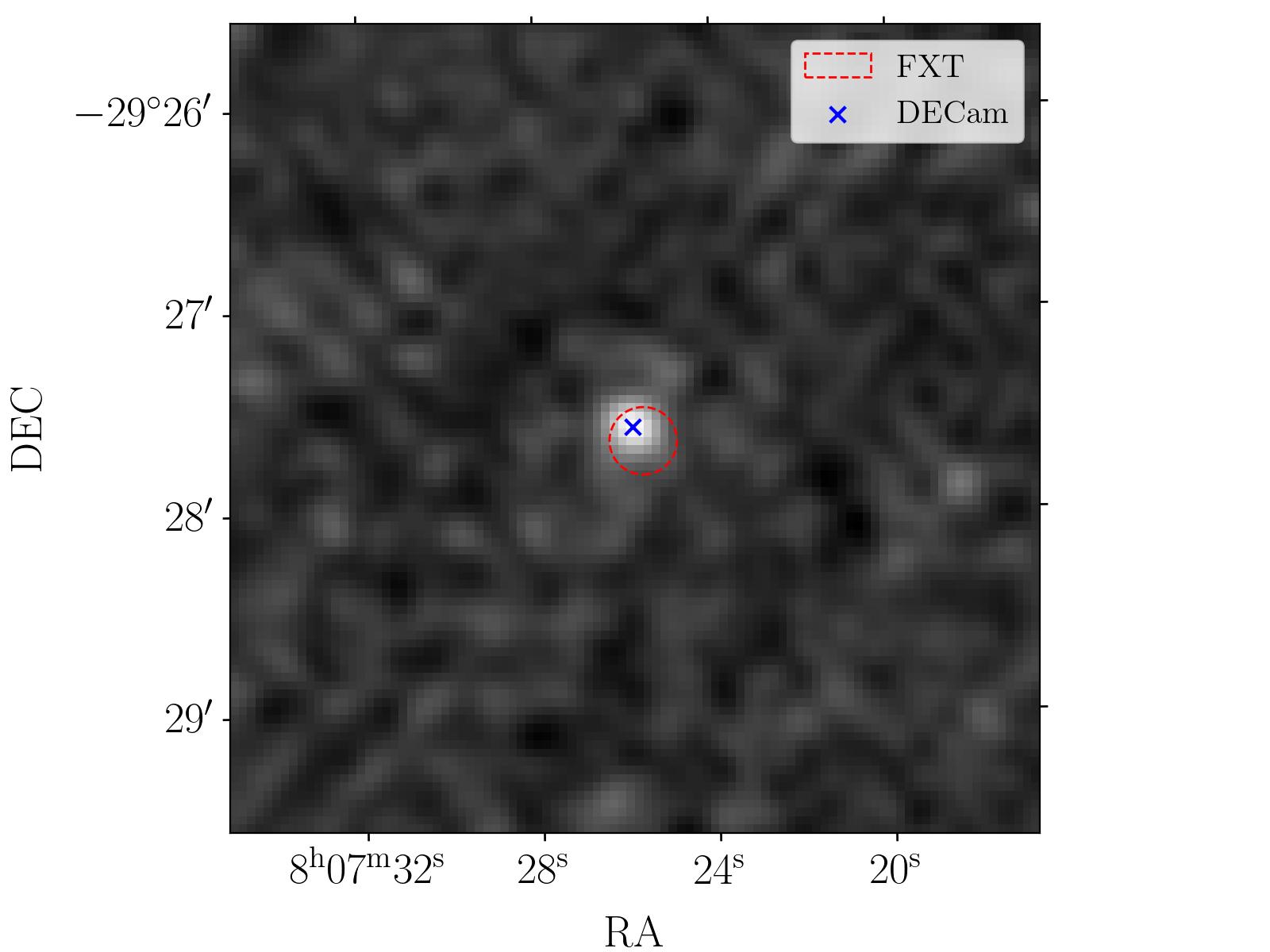.\n\nThis](http://here](https://www.vast-survey.org/assets/images/EP240426a.jpg).%5Cn%5CnThis)


